
Has Have and Had Helping Verbs Exercises for Young Learners

Helping Verbs with This English Grammar Worksheet for Grade 3 on Has, Have, and Had
Helping verbs make sentences clearer and more meaningful. In this English grammar worksheet for Grade 3, students get to practice using helping verbs “has,” “have,” and “had” through fun and engaging activities. Young learners can improve their sentence-building skills by solving fill-in-the-blanks, underlining helping verbs, choosing correct options, rewriting sentences, and sentence formation exercises.
This worksheet is designed especially for Grade 3 learners who are beginning to understand how helping verbs work in daily communication. The activities are simple, interactive, and easy to follow. By practicing regularly, students can become more confident in speaking and writing correct English sentences using “has,” “have,” and “had.”
Download these English grammar worksheets and practice regularly to strengthen your language skills and build a strong foundation. You can also book a free trial to get expert guidance and improve your reading, writing, and comprehension abilities. The worksheets are designed in a simple and structured way to help K–8 students learn grammar concepts easily and use them confidently in everyday communication.
What Is the Topic?
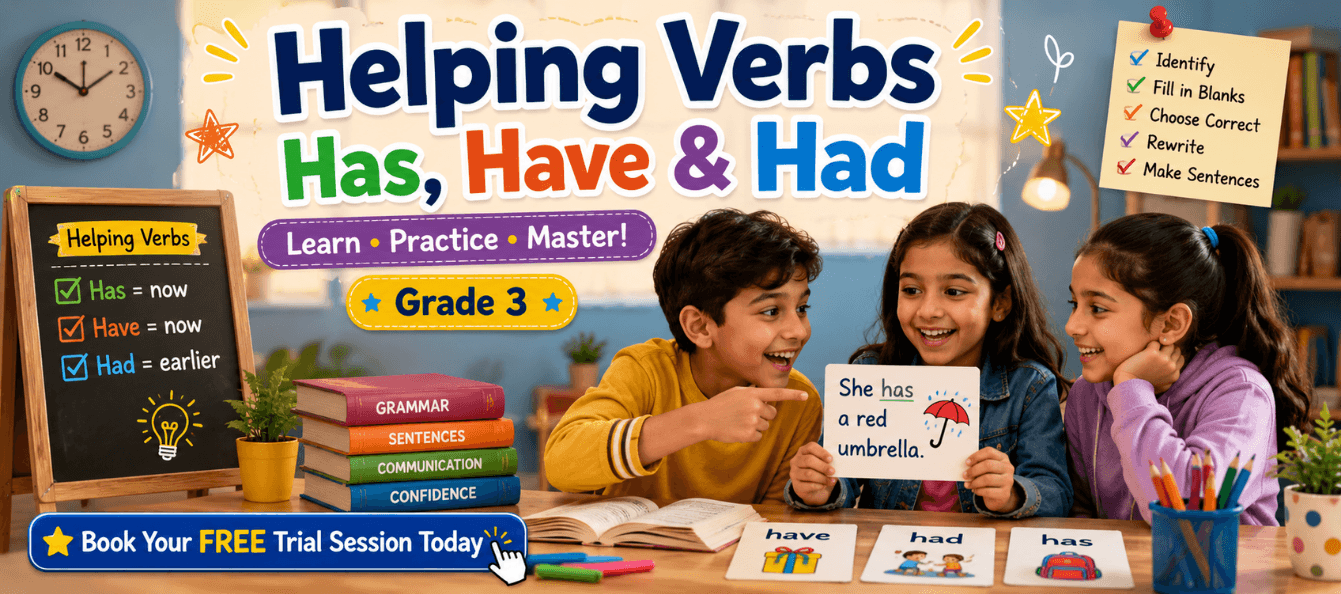
This worksheet focuses on helping verbs “has,” “have,” and “had.” These verbs show what someone has or had. They can also help show something is done or completed.
“Has” and “have” mean something you own or do now. “Had” means you owned or did it earlier.
Examples:
She has a red pencil box.
They had fun at the picnic.
Students learn how to:
1. Identify helping verbs in sentences
2. Use the correct helping verb in blanks
3. Choose correct helping verbs from options
4. Rewrite sentences correctly
5. Form sentences using helping verbs
What’s in This Worksheet?
1. Underline the helping verbs in each sentence.
2. Fill in the blanks with the correct helping verb: has, have, or had.
3. Choose the correct helping verb from the options given below and fill in the blanks.
4. Rewrite each sentence using the correct helping verb: has, have, or had.
5. Write 5 sentences using helping verbs has, have, had on the picture given below.
6. The worksheet includes simple grammar practice for Grade 3 learners.
7. Students practice reading, writing, identifying, and correcting helping verbs.
8. The worksheet supports school grammar practice and helps improve sentence formation.
Definitions, Examples, Techniques, and Tips
Definitions
“Has” and “have” mean something you own or do now.
“Had” means you owned or did it earlier.
Examples
She has a red pencil box.
They had fun at the picnic.
He has a red water bottle.
We have many books.
She had a pet cat.
Techniques
1. Read the sentence carefully before choosing the helping verb.
2. Look at the subject words like he, she, they, we, and I.
3. Check whether the sentence talks about now or earlier.
4. Practice rewriting incorrect sentences correctly.
Quick Learning Tips
1. Underline helping verbs while reading sentences.
2. Practice fill-in-the-blanks daily.
3. Read all options carefully in MCQs.
4. Rewrite incorrect sentences neatly.
5. Form your own sentences using has, have, and had.
Why Is It Important to Learn This?
Learning helping verbs is important because they help students make meaningful and correct sentences. Using “has,” “have,” and “had” properly improves grammar and sentence structure.
This topic helps students:
1. Speak clearly in English
2. Write complete sentences
3. Understand present and past actions
4. Improve grammar confidence
5. Build better communication skills
Helping verbs are used in daily speaking and writing, so regular practice is very useful for Grade 3 students.
Where Will This Knowledge Help You?
1. School grammar exercises
2. English tests and exams
3. Sentence writing activities
4. Classroom participation
5. Reading and understanding English sentences
6. Daily conversation practice
7. Homework and worksheet practice
How to Use This Worksheet?
1. Read each sentence carefully before answering.
2. Attempt all exercises independently first.
3. Underline the helping verbs wherever asked.
4. Fill in the blanks using the correct helping verb.
5. Choose the correct option carefully in MCQs.
6. Rewrite incorrect sentences correctly.
7. Practice sentence formation using the picture given.
8. Compare your answers carefully with the solutions.
9. The solutions follow the exact worksheet order for easy checking.
10. Practice regularly to improve grammar accuracy.
Important Tips and Tricks
1. Use “has” with singular subjects like he and she.
2. Use “have” with subjects like I, we, they, and you.
3. Use “had” for actions or things from earlier.
4. Read the sentence completely before choosing an answer.
5. Underline only the helping verb in underline exercises.
6. Rewrite the complete sentence correctly in rewriting exercises.
7. In MCQs, read all three options carefully before selecting the answer.
8. Write neat and complete sentences in sentence formation activities.
9. Practice every exercise in the correct order.
10. Regular grammar practice helps score better marks in exams.
Complete Answer Key
Exercise 1
Underline the helping verbs in each sentence.
1. He HAS a red water bottle.
2. They HAVE a cricket bat.
3. I HAD a cold last week.
4. She HAS two pencils.
5. We HAVE many books.
6. You HAD fun at the park.
7. I HAVE a drawing set.
8. They HAD ice cream after lunch.
9. She HAD a pet cat.
10. We HAD a great time yesterday.
Exercise 2
Fill in the blanks with the correct helping verb: has, have, or had.
1. I HAD a green water bottle.
2. She HAS many stickers.
3. We HAD lunch already.
4. He HAS a new school bag.
5. They HAD a party last night.
6. You HAVE some books to read.
7. The boy HAS a football.
8. They HAD fun at the picnic.
9. I HAVE a toy train.
10. My sister HAS a pink umbrella.
Exercise 3
Choose the correct helping verb from the options given below and fill in the blanks.
1. He HAD a blue backpack.
c) Had
2. They HAVE new crayons.
b) Have
3. I HAD a sore throat last week.
c) Had
4. She HAS a cute teddy bear.
a) Has
5. We HAVE pencils and erasers.
b) Have
6. You HAVE your lunch in the box.
b) Have
7. The cat HAS soft fur.
a) Has
8. I HAVE a gift for my friend.
b) Have
Exercise 4
Rewrite each sentence using the correct helping verb: has, have, or had. Underline the helping verb.
1. He HAVE a blue pencil.
He HAS a blue pencil.
2. They HAS many toys.
They HAVE many toys.
3. I HAS a cold last week.
I HAD a cold last week.
4. She HAVE a big bag.
She HAS a big bag.
5. We HAS homework to do.
We HAVE homework to do.
6. You HAS a red cap.
You HAVE a red cap.
7. The bird HAVE feathers.
The bird HAS feathers.
8. I HAS a new ruler.
I HAVE a new ruler.
9. They HAS fun yesterday.
They HAD fun yesterday.
10. My sister HAVE a teddy bear.
My sister HAS a teddy bear.
Exercise 5
Write 5 sentences using helping verbs has, have, had on the picture given below.
1. The boy HAS a robot toy.
2. The girls HAVE many toys.
3. The children HAD fun playing together.
4. The toy box HAS many toys inside.
5. The little boy HAS a teddy bear.
This English grammar worksheet for Grade 3 on helping verbs “has,” “have,” and “had” gives students a fun way to improve grammar skills through practice activities. By solving exercises regularly, students can become more confident in identifying helping verbs, correcting sentences, and forming proper English sentences. Continued practice helps young learners build strong communication and writing skills step by step.