
Helping Verbs Is Am Are Worksheet for Class 3 English


Helping Verbs Is, Am, Are with This English Grammar Worksheet for Grade 3
Learning helping verbs can be fun and exciting when students practice with simple and engaging exercises. This English grammar worksheet for Grade 3 on Helping Verbs Is, Am, Are helps children understand how helping verbs are used in everyday sentences. Students learn to identify helping verbs, fill in blanks correctly, rewrite incorrect sentences, and form their own meaningful sentences using is, am, and are.
This worksheet is designed with easy and interactive exercises that help Grade 3 students improve sentence formation and present tense usage. By practicing regularly, children become more confident in speaking and writing English correctly. The activities included in this worksheet make grammar learning enjoyable and effective for young learners.
Download these English grammar worksheets and practice regularly to strengthen your language skills and build a strong foundation. You can also book a free trial to get expert guidance and improve your reading, writing, and comprehension abilities. The worksheets are designed in a simple and structured way to help K–8 students learn grammar concepts easily and use them confidently in everyday communication.
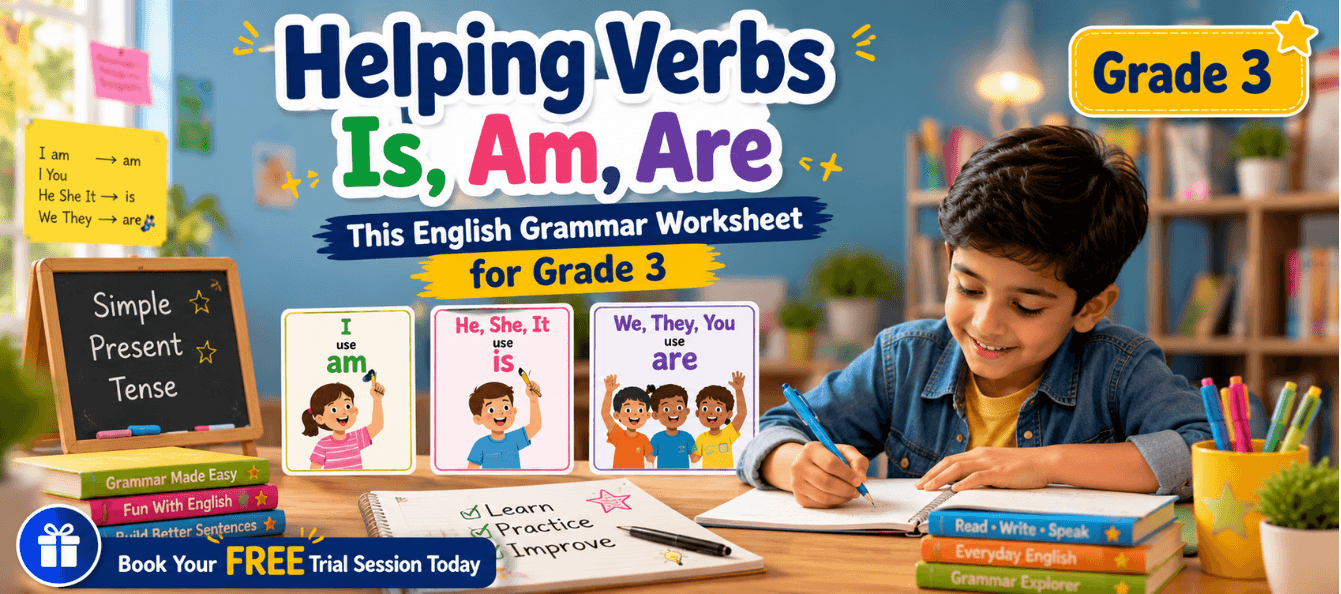
What Is the Topic?
Helping verbs is, am, and are are used to talk about actions happening now in the present tense. These helping verbs are used with action words to show something happening in the present.
This worksheet teaches Grade 3 students how to use helping verbs correctly in sentences. Students learn:
• When to use is
• When to use am
• When to use are
• How to identify helping verbs in sentences
• How to correct sentences using helping verbs
The worksheet also includes sentence rewriting and sentence formation activities that improve grammar understanding in a simple and practical way.
Examples from the worksheet:
• She is reading a storybook.
• I am going to school.
• He is dancing.
• I am drawing.
• We are learning.
What’s in This Worksheet?
1. Underline the helping verbs in sentences.
2. Fill in the blanks using the correct helping verb: is, am, or are.
3. Multiple-choice questions to select the correct helping verb.
4. Rewrite incorrect sentences using the correct helping verb.
5. Sentence writing activity using a picture prompt.
6. Practice with present tense sentences.
7. Exercises that improve grammar accuracy and sentence formation skills.
8. Activities that support better speaking and writing skills.
9. Structured exercises that help students prepare for school grammar activities and exams.
Definitions, Examples, Techniques, and Tips
Helping verbs are words that help describe actions happening in the present.
The helping verbs used in this worksheet are:
• Is
• Am
• Are
Examples:
• She is reading a storybook.
• I am going to school.
• They are playing with blocks.
Quick techniques students can use:
• Use am with I.
• Use is with he, she, it.
• Use are with we, they, you.
Examples from the exercises:
• I am writing a letter.
• We are waiting for the bus.
• It is raining outside.
• The boys are playing cricket.
Sentence correction examples:
• He am drawing a picture.
Correct sentence:
He is drawing a picture.
• They is eating lunch.
Correct sentence:
They are eating lunch.
These activities help students understand sentence structure and correct helping verb usage in daily English communication.
Why Is It Important to Learn This?
Learning helping verbs is important because they are used in everyday English sentences. Students use is, am, and are while speaking, writing, reading, and answering grammar questions in class.
This topic helps students:
• Speak clearly and correctly
• Write grammatically correct sentences
• Improve sentence construction
• Understand present tense usage
• Build confidence in communication
Correct helping verb usage also improves reading comprehension and classroom participation.
Where Will This Knowledge Help You?
Students can use helping verbs in many situations, including:
• School grammar exams
• Class assignments
• English writing tasks
• Daily conversations
• Story writing
• Reading activities
• Speaking practice
• Sentence correction exercises
Understanding helping verbs also helps students communicate confidently in both written and spoken English.
How to Use This Worksheet?
1. Read each sentence carefully before answering.
2. Identify the subject of the sentence first.
3. Choose the correct helping verb: is, am, or are.
4. Underline the helping verbs wherever instructed.
5. Solve the fill in the blanks independently.
6. Carefully check the multiple-choice options before selecting the answer.
7. Rewrite incorrect sentences using the correct helping verb.
8. Practice sentence writing using the picture prompt.
9. Review all answers carefully after completing the worksheet.
10. The solutions below follow the exact worksheet order, so compare your answers carefully with each question.
Important Tips and Tricks
1. Always use am with I.
Example:
I am drawing.
2. Use is with singular subjects like he, she, it.
Example:
She is wearing a pink dress.
3. Use are with plural subjects like we, they, boys, children.
Example:
They are playing with blocks.
4. Read the sentence completely before choosing the helping verb.
5. While rewriting sentences, check whether the subject is singular or plural.
6. Underline only the helping verb when instructed.
7. In multiple-choice questions, eliminate incorrect helping verbs first.
8. For sentence-writing activities, make meaningful present tense sentences.
9. Practice regularly to improve grammar accuracy and confidence.
10. Examiners expect correct helping verb usage and proper sentence formation.
Complete Answer Key
Exercise 1
Underline the helping verbs in each sentence.
1. They __ARE__ playing with blocks.
2. I __am__ writing a letter.
3. She __is__ wearing a pink dress.
4. We __are__ waiting for the bus.
5. He __is__ looking at the board.
6. I __am__ helping my sister.
7. The children __are__ singing a song.
8. You __are__ reading the book.
9. It __is__ raining outside.
10. I __am__ drawing a big tree.
Exercise 2
Fill in the blanks with the correct helping verb: is, am, or are.
1. I AM going to the shop.
2. She is drawing a house.
3. They are playing with blocks.
4. We are packing our bags.
5. He is reading a storybook.
6. You are learning English.
7. It is raining heavily.
8. The boys are playing cricket.
9. I am helping my little brother.
10. The cats are sitting on the wall.
Exercise 3
Choose the correct helping verb from the options given below and fill in the blanks.
1. She IS playing with her doll.
a) Is
b) Am
c) Are
2. I AM very happy today.
a) Is
b) Am
c) Are
3. We ARE reading our storybooks.
a) Is
b) Am
c) Are
4. He IS drawing on the board.
a) Is
b) Am
c) Are
5. They ARE going to the zoo.
a) Is
b) Am
c) Are
6. I AM brushing my teeth.
a) Is
b) Am
c) Are
7. You ARE helping your friend.
a) Is
b) Am
c) Are
8. It IS time to go home.
a) Is
b) Am
c) Are
Exercise 4
Rewrite each sentence using the correct helping verb: is, am, or are. Underline the helping verb.
1. He __is__ drawing a picture.
2. I __am__ playing in the garden.
3. They __are__ eating lunch.
4. She __is__ reading a book.
5. We __are__ writing stories.
6. I __am__ going to school.
7. It __is__ flying in the sky.
8. You __are__ making a card.
9. The dogs __are__ barking loudly.
10. I __am__ feeding the cat.
Exercise 5
Write 5 sentences using helping verbs is, am, are on the picture given below.
1. The children are playing in the park.
2. The girl is skipping with a rope.
3. The boy is flying a kite.
4. I am playing with my friends.
5. The children are having fun.
Practicing this Helping Verbs Is, Am, Are English grammar worksheet for Grade 3 can help students become more confident while using present tense sentences in daily communication. Regular grammar practice improves writing, speaking, and sentence-building skills. Keep practicing helping verbs through fun activities and exercises to build strong English grammar fundamentals and improve classroom performance.