
Homophones and Homonyms Printable English Worksheet for Class 6
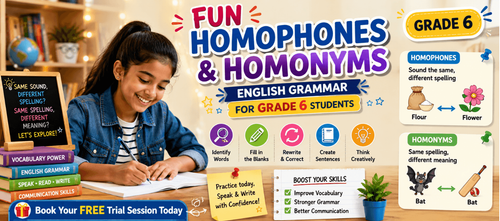

Fun Homophones and Homonyms English Grammar Worksheet for Grade 6 Students
Learning homophones and homonyms can be exciting when students explore words that sound alike or have different meanings in fun and creative ways. This Grade 6 English grammar worksheet on homophones and homonyms helps students improve vocabulary, sentence understanding, reading comprehension, and grammar skills through engaging activities. Students get to identify words, fill in blanks, rewrite incorrect sentences, and create their own examples using homophones and homonyms correctly.
This worksheet also helps students understand how the same word can completely change meaning depending on spelling or usage. By practicing these exercises carefully, Grade 6 students can become more confident in using English words correctly while speaking, reading, and writing.
Download these English grammar worksheets and practice regularly to strengthen your language skills and build a strong foundation. You can also book a free trial to get expert guidance and improve your reading, writing, and comprehension abilities. The worksheets are designed in a simple and structured way to help K–8 students learn grammar concepts easily and use them confidently in everyday communication.
What Is the Topic?
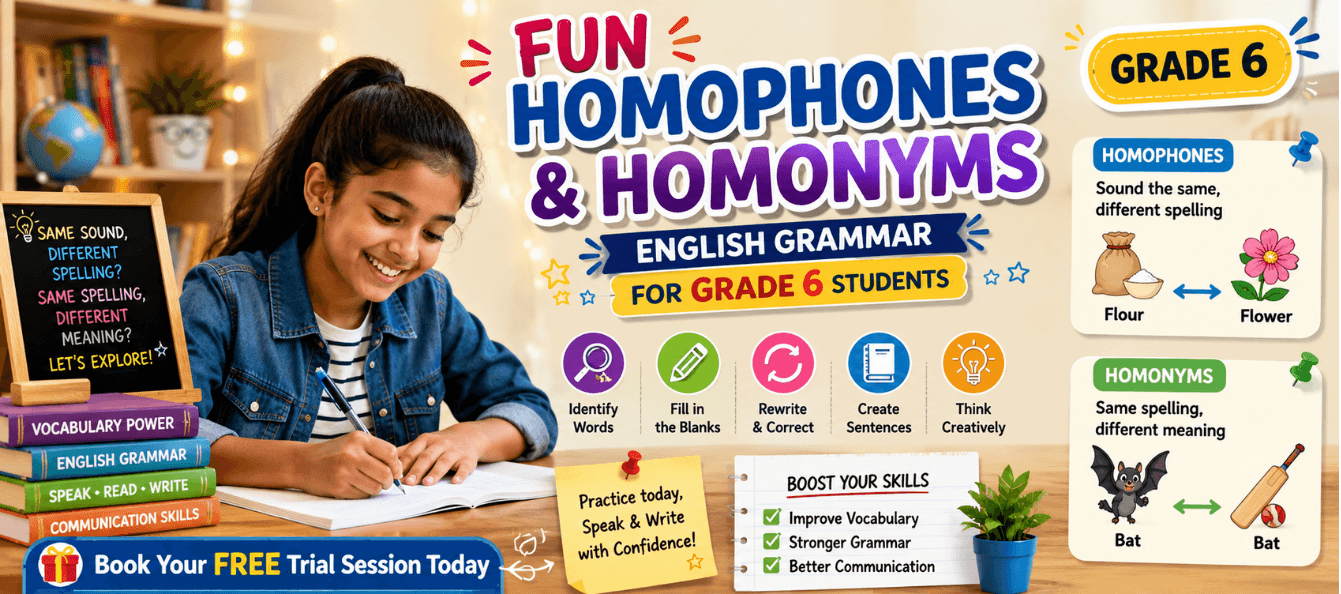
Homophones are words that sound the same but have different meanings and different spellings. These words are commonly used in listening activities, reading comprehension tasks, and riddles.
Example:
1. Flour – powder used for baking
2. Flower – part of a plant
Homonyms are words that are spelled the same and sound the same but have different meanings depending on how they are used in a sentence.
Example:
Bat
1. An animal
2. A sports equipment for cricket/baseball
This Grade 6 English grammar worksheet teaches students how to identify and correctly use homophones and homonyms through different sentence-based activities. Students learn how small spelling or meaning differences can completely change the meaning of a sentence.
What’s in This Worksheet?
1. Underlining activities where students identify homophones and homonyms in sentences.
2. Fill in the blanks exercises using the correct homophone.
3. Rewrite the sentence activities where students correct wrongly used homophones or homonyms.
4. Sentence formation activities for creating original examples.
5. Riddle-writing tasks using homophone pairs creatively.
6. Grammar practice that improves reading, writing, vocabulary, and sentence understanding.
7. Exercises arranged in a step-by-step format for easy learning and revision.
8. Practice questions that help students prepare for school grammar tests and classroom assignments.
Definitions, Examples, Techniques, and Tips
Homophones are words that sound the same but have different meanings and spellings.
Examples:
1. Flour / Flower
2. Sun / Son
3. Air / Heir
4. Bear / Bare
Homonyms are words that are spelled and pronounced the same but have different meanings.
Examples:
1. Bat
2. Wind
3. Bear
4. Fair
Techniques students can use while solving these exercises:
1. Read the full sentence carefully before choosing the word.
2. Understand the meaning of the sentence.
3. Check whether the word spelling matches the meaning.
4. Look for context clues in the sentence.
5. Practice pronunciation to understand similar-sounding words.
Quick learning tips:
1. Memorize common homophone pairs.
2. Read English storybooks regularly.
3. Practice sentence writing daily.
4. Speak sentences aloud to understand pronunciation differences.
5. Revise commonly confused words often.
Why Is It Important to Learn This?
Learning homophones and homonyms is important because these words are used regularly in English communication. Students who understand these grammar concepts can avoid common spelling and sentence mistakes.
This topic improves vocabulary and helps students understand the exact meaning of sentences while reading or listening. It also develops better writing skills because students learn to choose the correct word according to the sentence meaning.
Understanding homophones and homonyms also improves speaking confidence and helps students communicate more clearly in school and everyday conversations.
Where Will This Knowledge Help You?
1. In school grammar exams and class tests.
2. During reading comprehension activities.
3. While writing essays, stories, and answers.
4. During classroom speaking activities.
5. In vocabulary-building exercises.
6. While understanding riddles, jokes, and word games.
7. In improving spelling accuracy.
8. During everyday English conversations.
How to Use This Worksheet?
1. Read each sentence carefully before answering.
2. Identify whether the activity focuses on homophones or homonyms.
3. Attempt all questions independently first.
4. Compare your answers carefully with the solutions.
5. Check spelling properly because many words sound similar.
6. Practice rewriting incorrect sentences correctly.
7. Read every corrected sentence aloud for better understanding.
8. Follow the exact worksheet order while checking answers.
9. Revise difficult word pairs regularly.
10. Practice sentence formation activities to improve grammar confidence.
Important Tips and Tricks
1. Do not choose words only based on pronunciation. Always check the meaning.
2. Carefully read the entire sentence before selecting the answer.
3. Remember that homophones sound the same but usually have different spellings.
4. Homonyms may have the same spelling but different meanings.
5. Examiners expect correct spelling along with correct meaning.
6. Avoid rushing while solving fill in the blanks questions.
7. Underline important clue words in the sentence.
8. Practice confusing word pairs regularly.
9. For sentence-writing activities, make sure the sentence meaning is clear.
10. Read your answers again after completing the worksheet.
Complete Answer Key
Exercise 1
Underline the homonyms and homophones used in each sentence.
1. I saw the __bat__ hanging upside down near the cricket __bat__.
2. Please write your __write__ name on the __right__ side of the page.
3. The __knight__ rode his horse through the dark __night__.
4. They __won__ the game even though the score was __one__ point less.
5. I ate the __whole__ apple, but there’s a __hole__ in my tooth.
6. The __wind__ blew hard as she tried to __wind__ the scarf around her neck.
7. The __bear__ couldn’t __bear__ the cold anymore.
8. She wore a __red__ dress while reading the story of Little __Red__ Riding Hood.
9. I can’t __hear__ what she’s saying because it’s so noisy in here.
10. They saw the __fair__ judge at the fun __fair__.
Exercise 2
Fill in the blanks with the correct homophones.
1. He couldn’t __bear__ the weight of the bag.
2. The __sun__ rose above the castle.
3. Please __wrap__ the gift with colorful paper.
4. I forgot to lock the back __door__.
5. We went to see the play at the city __scene__.
6. The soldier wore his shiny __armor__ to battle.
7. He threw the ball high into the __air__.
8. That’s the __chorus__ of our new school song.
9. She made a chocolate __dessert__ for me.
10. The wind began to __blew__ as I opened windows.
Exercise 3
Each sentence contains an incorrectly used homophone or homonym. Identify and rewrite the statement.
1. I know the answer to that question.
2. There is a dog in the yard.
3. She read the book yesterday.
4. The sun has set over there.
5. We saw a bear climbing a tree.
6. He couldn’t bear the pain.
7. Let’s meet after school.
8. I want to buy a new pencil.
9. The night was dark and scary.
10. Can you hear the bell ringing?
Exercise 4
Write:
a) A two riddles for two different homophone pair
1. What flower can you bake with?
Answer: Flour / Flower
2. What shines brightly in the sky but can also mean a boy?
Answer: Sun / Son
b) Two sentence pairs using two homonyms in two different ways
1. Bat
a. The bat flew out of the cave at night.
b. He used a bat to hit the cricket ball.
2. Wind
a. The wind blew strongly during the storm.
b. Please wind the clock before sleeping.
Practicing homophones and homonyms regularly helps Grade 6 students become stronger readers, writers, and speakers. This English grammar worksheet gives students the confidence to understand word meanings, avoid spelling mistakes, and use English more accurately in daily communication. Continue practicing similar grammar activities to improve vocabulary and build excellent language skills step by step.