
Homophones vs Homonyms vs Homographs – Grade 5 Grammar Practice
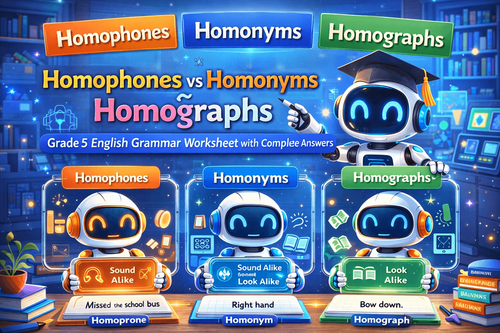

Homophones vs Homonyms vs Homographs – Grade 5 English Grammar Worksheet with Complete Answers
Learning English grammar can sometimes feel like solving a fun puzzle. Many words sound the same, look the same, or even share the same spelling but carry different meanings. This Grade 5 English grammar worksheet on Homophones vs Homonyms vs Homographs helps students understand these interesting word relationships through engaging activities and practice questions. By working through this worksheet, students can improve their vocabulary, strengthen their grammar skills, and become more confident in reading, writing, and speaking.
What Is The Topic?
This English grammar worksheet focuses on three important types of words in English:
Homophones – sound the same, different meanings and spellings
Homonyms – same spelling and sound, different meanings
Homographs – same spelling, different meanings, may or may not sound the same
These words can sometimes confuse students because they either sound alike or look alike. Understanding the difference helps students choose the correct word while speaking or writing sentences.
In Grade 5, students are expected to recognize these words, understand their meanings through context, and use them correctly in sentences. This worksheet helps learners practice identifying the correct meaning of a word based on how it is used.
What’s In This Worksheet?
This Grade 5 English grammar worksheet contains multiple activities designed to strengthen grammar understanding.
1. Picture identification where students circle the picture that represents the highlighted word.
2. Fill-in-the-blank questions where students choose the correct word from brackets.
3. Sentence creation tasks using word pairs.
4. Sorting activity where words are grouped under the correct heading.
5. Identification activity where students classify examples as Homophone, Homonym, or Homograph.
Each section builds understanding step by step and encourages students to observe word meanings carefully.
Definitions, Examples, Techniques, And Tips
The worksheet introduces three types of words that students often encounter in English.
Homophones are words that sound the same but have different meanings and spellings.
Example: pair and pear
Homonyms are words that have the same spelling and the same pronunciation but different meanings.
Example: bat (animal) and bat (used in cricket)
Homographs are words that share the same spelling but have different meanings and sometimes different pronunciation.
Example: tear (drop from eye) and tear (rip something)
Students can identify the correct meaning of such words by looking carefully at the sentence and understanding the context in which the word is used.
Why Is It Important To Learn This?
Learning homophones, homonyms, and homographs is important for students because these words appear frequently in English reading and writing.
Understanding them helps students:
• avoid spelling mistakes
• choose the correct word while writing
• understand sentence meaning clearly
• improve vocabulary and comprehension
When students know the difference between similar sounding or similar looking words, they can communicate more clearly and accurately.
Where Will This Knowledge Help You?
The concepts practiced in this English grammar worksheet help students in many real situations.
• School exams where students must choose correct words
• Writing assignments and grammar tests
• Reading comprehension activities
• Classroom discussions and speaking practice
Mastering these concepts helps students become more confident and accurate while using English.
How To Use This Worksheet?
1. Read each question carefully before answering.
2. Try to complete the worksheet independently.
3. Compare your answers carefully with the answer key.
4. Review the sentences to understand why each word is correct.
5. Practice regularly to become confident with similar words.
The solutions below follow the exact worksheet order. Students should carefully match each answer with the corresponding question.
Important Tips And Tricks
1. Always read the full sentence before choosing a word.
2. Think about the meaning of the sentence to decide which word fits best.
3. Pay attention to spelling differences in homophones.
4. Observe how the same word may have different meanings in homonyms and homographs.
5. Practice using these words in your own sentences to understand them better.
Complete Answer Key
Exercise – 1
Circle the picture that correctly represents the highlighted Homophone, Homonym or homograph.
1. present – giving or showing something at the exhibition (girl presenting)
2. water – watering plants (gardener watering plants)
3. rock – stone
4. roll – baby rolling over
5. desert – leave the picnic spot
6. lead – metal lead roof
7. wind – air moving around
Exercise – 2
Choose the correct word from the bracket and fill in the blank.
1. Rahul paid the bus **fare** before boarding.
2. Aanya saw a big black **bear** near the forest during her trip.
3. I cannot **hear** what the teacher is saying.
4. The wind was so strong that it blew the **sail** away.
5. He will **lead** the school parade during Republic Day.
6. Meera wore a red **pair** of sandals to the Diwali party.
7. The children went to the park to fly a colourful **kite**.
8. Neha dropped a coin into the **well** to make a wish.
9. The teacher asked us to **write** neatly in our notebooks.
10. Grandma told us a fun **tale** about a clever monkey during bedtime.
Exercise – 3
Use the given words to make sentences so that the difference is clear.
pair / pear
Sentence 1: I bought a new pair of shoes for school.
Sentence 2: She ate a sweet pear after lunch.
bat / bat
Sentence 1: The bat flew out of the cave at night.
Sentence 2: Rahul used a bat to play cricket in the playground.
right / write
Sentence 1: She gave the right answer in class.
Sentence 2: Please write your name on the notebook.
bark / bark
Sentence 1: The dog began to bark loudly at the stranger.
Sentence 2: The bark of the tree was rough and brown.
Exercise – 4
Sort the words given below and write under correct heading
Homophones
Pair / pear
blew / blue
plain / plane
flower / flour
right / write
break / brake
bare / bear
Homographs
tear / tear
watch / watch
row / row
bark / bark
light / light
Exercise – 5
Circle the Correct Option: Homophone / Homonym / Homograph
1. Homophone
2. Homonym
3. Homonym
4. Homophone
5. Homograph
6. Homophone
7. Homograph
8. Homograph
Learning about Homophones, Homonyms, and Homographs becomes much easier when students practice with examples like those in this Grade 5 English grammar worksheet. By carefully reading sentences, understanding meanings, and practicing regularly, students can confidently identify similar-sounding and similar-spelled words. With continued practice, grammar becomes clearer, writing improves, and communication becomes stronger.