
Homophones Worksheet for Grade 3 with Fun Word Exercises
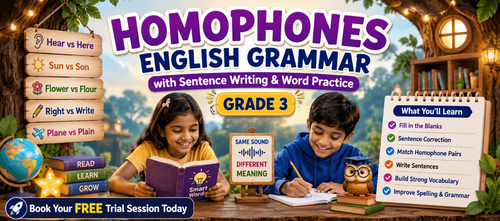

Homophones English Grammar Worksheet for Grade 3 with Sentence Writing and Word Practice
Learning homophones can be exciting and fun for young learners. In this Grade 3 English grammar worksheet, students get to explore words that sound the same but have different meanings and spellings. These engaging activities help children improve vocabulary, spelling, sentence formation, and reading skills in an enjoyable way. Through matching exercises, sentence correction, fill in the blanks, and sentence writing, students can understand how homophones are used differently in sentences.
This English grammar worksheet for Grade 3 is designed in a simple and interactive format so students can practice carefully and confidently. By completing each activity step by step, children can build stronger grammar skills and improve their understanding of commonly confused words.
Download these English grammar worksheets and practice regularly to strengthen your language skills and build a strong foundation. You can also book a free trial to get expert guidance and improve your reading, writing, and comprehension abilities. The worksheets are designed in a simple and structured way to help K–8 students learn grammar concepts easily and use them confidently in everyday communication.
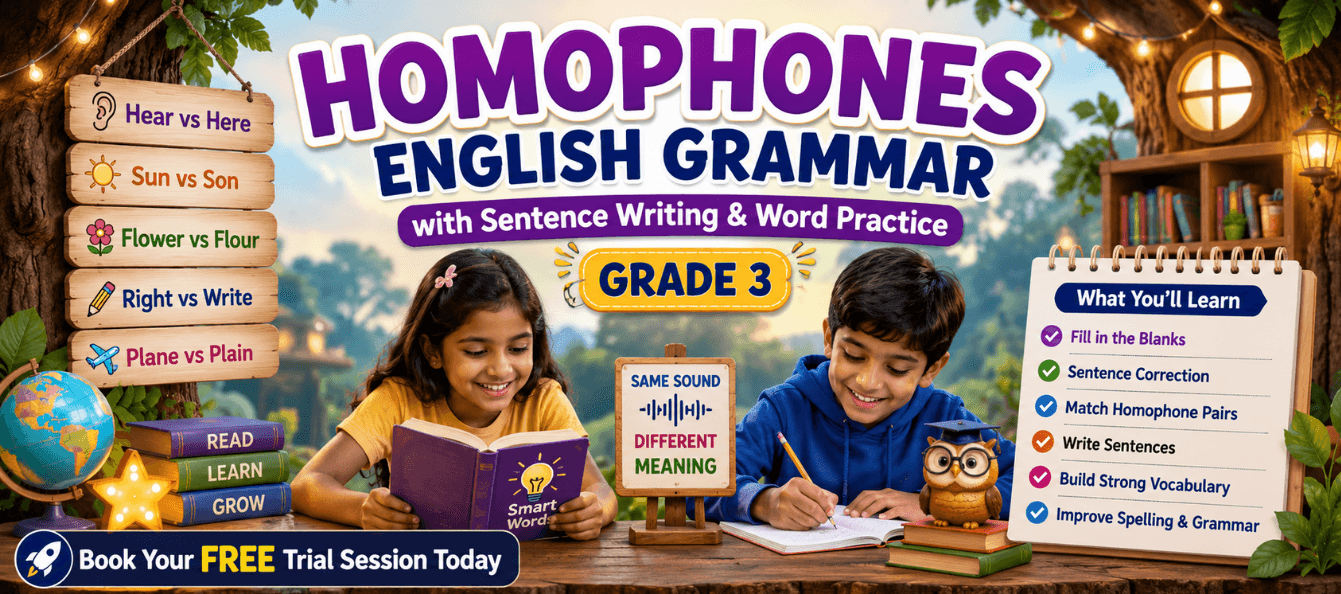
What Is Homophones?
Homophones are words that sound the same but have different meanings and different spellings. Even though they sound alike, they are used differently in sentences.
Examples from the worksheet:
sun – the bright star in the sky
son – a boy child
flower – a plant that blooms
flour – white powder used in cooking
In this Grade 3 English grammar worksheet, students learn how to identify the correct homophone according to the meaning of the sentence. They also learn how different spellings change the meaning of a word completely.
What’s in This Worksheet?
1. Fill in the blanks using correct homophones.
2. Rewrite incorrect words with the correct homophone.
3. Match words with their correct homophone pairs.
4. Write sentences using different homophone pairs.
5. Practice reading and understanding sentence meanings carefully.
6. Improve spelling and vocabulary through fun exercises.
7. Strengthen grammar concepts useful for school exams and classroom learning.
Definitions, Examples, Techniques, and Tips
Homophones are words that sound alike but have different meanings and spellings.
Examples included in the worksheet:
sun and son
flower and flour
buy and by
plane and plain
write and right
Students should read the complete sentence carefully before choosing the correct homophone. Understanding the meaning of the sentence helps in selecting the right word.
Example:
I want to buy a dress.
Here, “buy” means to purchase something.
Please write your name at the top of the page.
Here, “write” means to put words on paper.
Quick learning tips:
1. Read the full sentence slowly.
2. Understand the meaning before choosing a word.
3. Look carefully at spelling differences.
4. Practice writing both homophones in separate sentences.
5. Revise commonly confused words regularly.
Why Is It Important to Learn This?
Learning homophones is important because it improves spelling, vocabulary, reading, and writing skills. Students often confuse words that sound alike, so practicing homophones helps them avoid mistakes in sentences.
This topic also improves sentence understanding and communication skills. Students become more confident while speaking, reading aloud, and writing correctly in exams and classwork.
Homophones are commonly used in English conversations and written communication. Understanding them helps students use correct words in the correct situations.
Where Will This Knowledge Help You?
Students can use homophones in many areas of learning and communication.
1. School grammar exams
2. Sentence writing activities
3. Reading comprehension tasks
4. Dictation practice
5. Creative writing
6. Daily classroom participation
7. Speaking and communication activities
8. Homework and worksheet practice
Understanding homophones also helps students avoid spelling confusion while writing paragraphs, stories, and answers in English.
How to Use This Worksheet?
1. Read each sentence carefully before answering.
2. Try to solve the worksheet independently first.
3. Understand the meaning of the sentence before selecting a homophone.
4. Compare your answers carefully with the complete answer key.
5. Follow the exact worksheet order while checking answers.
6. Correct mistakes neatly after reviewing the solutions.
7. Practice difficult homophone pairs again and again.
8. Write extra sentences using homophones for better understanding.
Important Tips and Tricks
1. Do not choose words only because they sound correct. Check the meaning carefully.
2. Read the complete sentence before filling in blanks.
3. Watch spelling carefully because homophones have different spellings.
4. Practice common homophone pairs regularly.
5. In sentence correction activities, identify the incorrect word first.
6. While matching homophones, pronounce the words aloud to understand similarities.
7. In sentence writing tasks, make sure each word is used with the correct meaning.
8. Neat handwriting and correct spelling help score better marks in grammar worksheets and exams.
Complete Answer Key
Exercise 1
Choose the correct word to complete each sentence.
1. I want to buy a dress.
2. The wind blew the paper over there!
3. I saw a white plane in the sky.
4. Please lend me your pencil.
5. She wore a red bow in her hair.
6. We read the story out loud today.
7. He hurt his toe while playing.
8. Don’t forget to write your name.
9. The cat chased its tail across the floor.
10. I ate a piece of the cake.
Exercise 2
Rewrite the sentences using correct word for the underlined words.
1. I can see the birds flying over the lake.
2. She wore a red flower in her hair.
3. I want to know if we have homework.
4. He hurt his toe while pulling the heavy box.
5. The knight rode his horse into the dark night.
6. Please write your name at the top of the page.
7. I will meet my friends at the park.
8. The wind blew so hard it knocked over the chair.
Exercise 3
Match the word in Column A with its correct homophone in Column B.
1. sea – see
2. pair – pear
3. eight – ate
4. flower – flour
5. sun – son
6. right – write
7. blew – blue
8. mouse – mousse
9. plane – plain
10. meat – meet
Exercise 4
Write one sentence for each word in the homophone pair to show their different meanings.
1. Hear: I can't hear you.
Here: Please come here.
2. Two: I have two pencils.
Too: I want to play too.
3. See: I can see the rainbow.
Sea: The sea looks beautiful today.
4. Blue: My bag is blue.
Blew: The wind blew strongly.
5. Right: Turn right at the corner.
Write: Please write your answer neatly.
This Grade 3 English grammar worksheet on homophones is a great way for students to practice commonly confused words in a simple and enjoyable manner. By completing fill in the blanks, sentence correction, matching activities, and sentence writing tasks, learners can improve grammar accuracy and build stronger language skills. Regular practice with homophones helps students become more confident readers and writers while preparing effectively for school assignments and exams.