
Improve Grammar Skills with Modal Verbs Practice for Grade 7
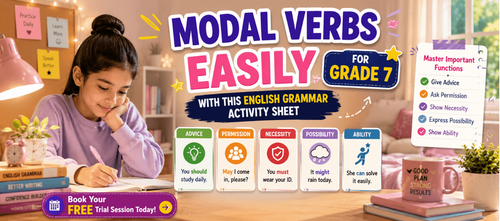

Modal Verbs Easily with This English Grammar Worksheet for Grade 7 Students
Modal verbs are an important part of English grammar because they help us express advice, permission, necessity, possibility, and ability in everyday communication. This Grade 7 English grammar worksheet on modal verbs gives students the chance to practice using modal verbs correctly through fun and engaging exercises. From underlining modal verbs to sentence correction and dialogue writing, this worksheet helps learners improve both grammar accuracy and sentence formation skills.
Students often use modal verbs while speaking and writing without realizing their importance. Words like can, should, may, might, must, and ought to help make communication clearer and more meaningful. This worksheet is specially designed for Grade 7 students to strengthen their understanding of modal verbs through structured practice activities and rewriting exercises.
Download these English grammar worksheets and practice regularly to strengthen your language skills and build a strong foundation. You can also book a free trial to get expert guidance and improve your reading, writing, and comprehension abilities. The worksheets are designed in a simple and structured way to help K–8 students learn grammar concepts easily and use them confidently in everyday communication.
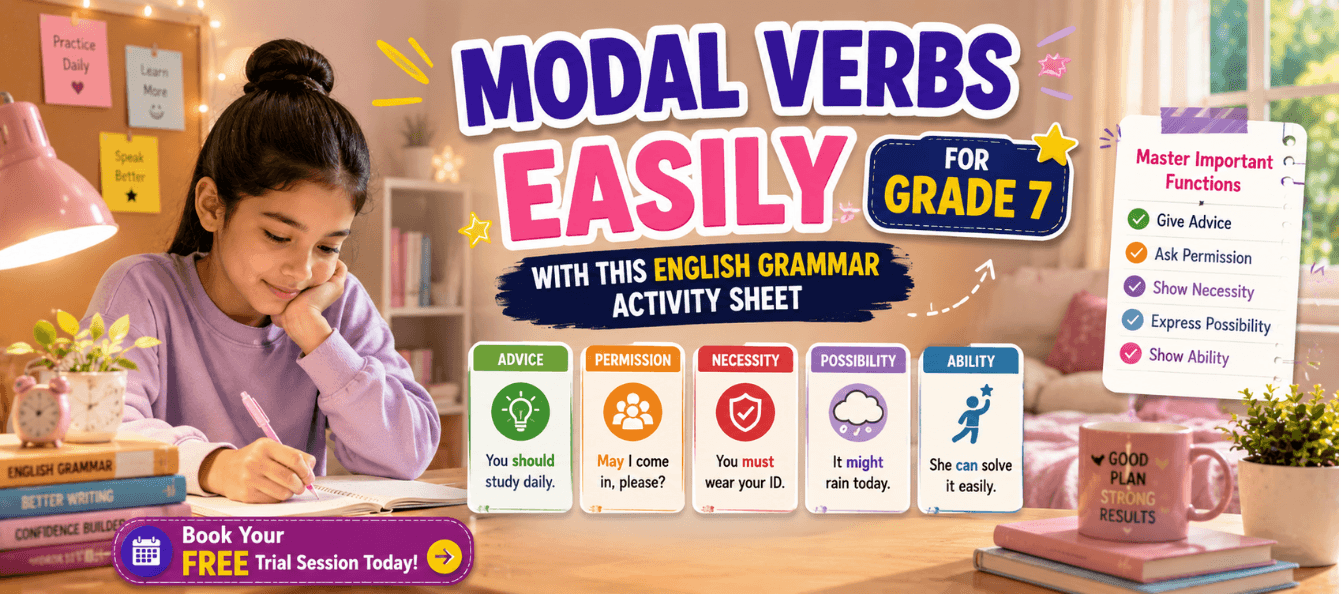
What Is the Topic?
Modal verbs are helping verbs used to express different meanings such as advice, permission, necessity, possibility, and ability. In this Grade 7 English grammar worksheet, students learn how to identify modal verbs in sentences, understand their functions, and use them correctly while forming and rewriting sentences.
The worksheet focuses on commonly used modal verbs such as:
• should
• must
• may
• might
• can
• could
• ought to
• need to
• will
• dare
Students are expected to:
• Identify modal verbs in sentences
• Understand the function of each modal verb
• Sort sentences according to modal functions
• Complete sentences using suitable modal verbs
• Correct incorrect modal verb usage
• Rewrite sentences using appropriate modal verbs
• Use modal verbs correctly in dialogue writing
What’s in This Worksheet?
1. Underline the modal verb activity where students identify modal verbs and label their functions.
2. Sorting exercise where students place sentences under categories such as advice, necessity, permission, and possibility.
3. Fill in the blanks activity using suitable modal verbs according to sentence meaning.
4. Sentence correction exercises that help students identify and fix incorrect modal verb usage.
5. Sentence rewriting practice where students rewrite sentences using the correct modal verbs.
6. Dialogue writing activity that encourages students to use different modal verbs naturally in conversation.
7. Grammar practice that supports better sentence structure, communication skills, and exam preparation.
Definitions, Examples, Techniques, and Tips
Definition:
Modal verbs are helping verbs used with the main verb to express ideas like advice, permission, possibility, necessity, and ability.
Examples from the worksheet:
• You should drink more water every day.
• May I borrow your pen?
• You must wear your ID card.
• We might go to the zoo this weekend.
• He can solve the puzzle easily.
Functions of modal verbs:
• Advice – should, ought to
• Necessity – must, need to
• Permission – may, can
• Possibility – might, may, could
• Ability – can, could
Techniques students can use:
• Read the sentence carefully to understand its meaning.
• Identify whether the sentence talks about advice, permission, necessity, or possibility.
• Choose the modal verb that matches the sentence purpose.
• Check sentence structure after using the modal verb.
Quick learning tips:
• Modal verbs are followed by the base form of the verb.
• Avoid adding “to” after can, could, should, must, may, and might.
• Use “ought to” and “need to” carefully because they already include “to.”
• Practice sentence correction exercises regularly to avoid grammar mistakes.
Why Is It Important to Learn This?
Learning modal verbs is important because they are used regularly in spoken and written English. They help students express thoughts politely, give advice clearly, and communicate ideas correctly.
This topic helps students:
• Improve sentence formation
• Speak politely and confidently
• Understand grammar functions better
• Write grammatically correct sentences
• Perform well in school grammar exercises and exams
Using modal verbs correctly also improves communication skills because students learn how to ask permission, give suggestions, and express possibilities naturally.
Where Will This Knowledge Help You?
Students will use modal verbs in many real-life situations and academic activities.
This knowledge helps in:
• School grammar tests and exams
• Writing paragraphs and essays
• Classroom discussions
• Dialogue and conversation writing
• Giving advice and suggestions
• Asking permission politely
• Speaking confidently in English
Modal verbs are useful in both formal and informal communication, making them an essential grammar topic for Grade 7 students.
How to Use This Worksheet?
1. Read each question carefully before answering.
2. Attempt every exercise independently to improve understanding of modal verbs.
3. Follow the exact question order while answering.
4. Underline or identify modal verbs properly wherever required.
5. Review all corrected sentences carefully to understand grammar rules.
6. Compare your answers with the solutions in the same order as the worksheet.
7. Practice sentence formation regularly to become more confident in using modal verbs.
8. Read the dialogue writing activity aloud to improve speaking confidence and fluency.
Important Tips and Tricks
1. Do not use “to” after modal verbs like can, could, should, must, may, and might.
2. Use “must” for strong necessity and “should” for advice.
3. Use “may” for polite permission requests.
4. Use “might” when the possibility is uncertain.
5. Read the sentence meaning carefully before selecting a modal verb.
6. In correction exercises, check both the modal verb and the verb that follows it.
7. During exams, underline or rewrite answers neatly according to instructions.
8. Practice dialogue writing carefully so modal verbs fit naturally into conversations.
Complete Answer Key
Exercise 1
Read each sentence. Underline the modal verb and label its function (possibility, advice, permission, necessity).
1. You should drink more water every day.
Underline: should
Function: Advice
2. May I borrow your pen?
Underline: May
Function: Permission
3. You must wear your ID card.
Underline: must
Function: Necessity
4. We might go to the zoo this weekend.
Underline: might
Function: Possibility
5. He can solve the puzzle easily.
Underline: can
Function: Ability
6. You ought to apologize to her.
Underline: ought to
Function: Advice
7. They could not open the jar.
Underline: could
Function: Ability
8. You need to finish the project by Monday.
Underline: need to
Function: Necessity
9. She will be late today.
Underline: will
Function: Possibility
10. Dare he speak like that to the teacher?
Underline: Dare
Function: Possibility
Exercise 2
Sort the below given sentences into correct categories.
ADVICE
• You should sleep earlier.
• They ought to clean their room.
• We should be more careful.
NECESSITY
• You must wear your helmet.
• You need to complete the form.
• You mustn’t be rude.
PERMISSION
• May I use your pencil for a moment?
• Can we go outside for a short break?
POSSIBILITY
• He might forget the instructions.
• She may arrive late.
Exercise 3
Use the correct modal verb to complete the sentence.
1. You should listen carefully to the instructions.
2. He might be late due to the traffic.
3. You should not speak so loudly here.
4. We must finish this by tomorrow.
5. May I help you with your bags?
6. You should be polite to others.
7. They might need more time to decide.
8. We should be careful near the edge.
9. You must complete the assignment today.
10. She might not have seen the notice.
Exercise 4
Identify and fix the incorrect use of modal verbs.
1. You must bring your notebook.
2. He can solve the puzzle quickly.
3. We might go out later.
4. She ought to finish her homework now.
5. They should listen carefully.
6. You may open the window.
7. He could run very fast.
8. You mustn’t be late.
9. Shall we start the game?
10. They need help with the task.
Exercise 5
Rewrite the sentence using the appropriate modal for the situation.
1. You must submit your work.
2. He should speak politely.
3. May I enter the room?
4. It might rain today.
5. They ought to be on time.
6. You should not shout at him.
7. She can solve the puzzle.
8. May I borrow your pen?
9. She might visit us.
10. We need to leave now.
Exercise 6
Write a dialogue between two classmates planning a class event. Use at least four different modals with correct functions (permission, advice, necessity, possibility).
Riya: We should plan the class event properly this time.
Arjun: Yes, we must decide the activities today.
Riya: May I invite students from the other section too?
Arjun: Yes, you can invite them.
Riya: We might need more decorations for the classroom.
Arjun: That’s true. We should ask everyone to help.
Riya: Can we organize a singing competition?
Arjun: Yes, that could make the event more exciting.
Riya: We must also prepare the schedule before Friday.
Arjun: I will bring chart papers tomorrow.
Practicing modal verbs regularly will help Grade 7 students become more confident in English grammar and communication. This English grammar worksheet on modal verbs gives students the opportunity to improve sentence formation, understand grammar functions clearly, and use modal verbs correctly in both writing and speaking. Continue practicing grammar concepts regularly to build stronger language skills and perform better in school activities and exams.