
Informal to Formal Writing: Grade 7 Grammar Worksheet [Free PDF]
![Informal to Formal Writing: Grade 7 Grammar Worksheet [Free PDF]](https://cdn5.planetspark.in/media/small_Class_7_Grammar_Worksheet_on_Informal_to_Formal_Rewriting_2cc987542c.png)

English Grammar Worksheet Grade 7: Rewriting Informal to Formal Paragraphs
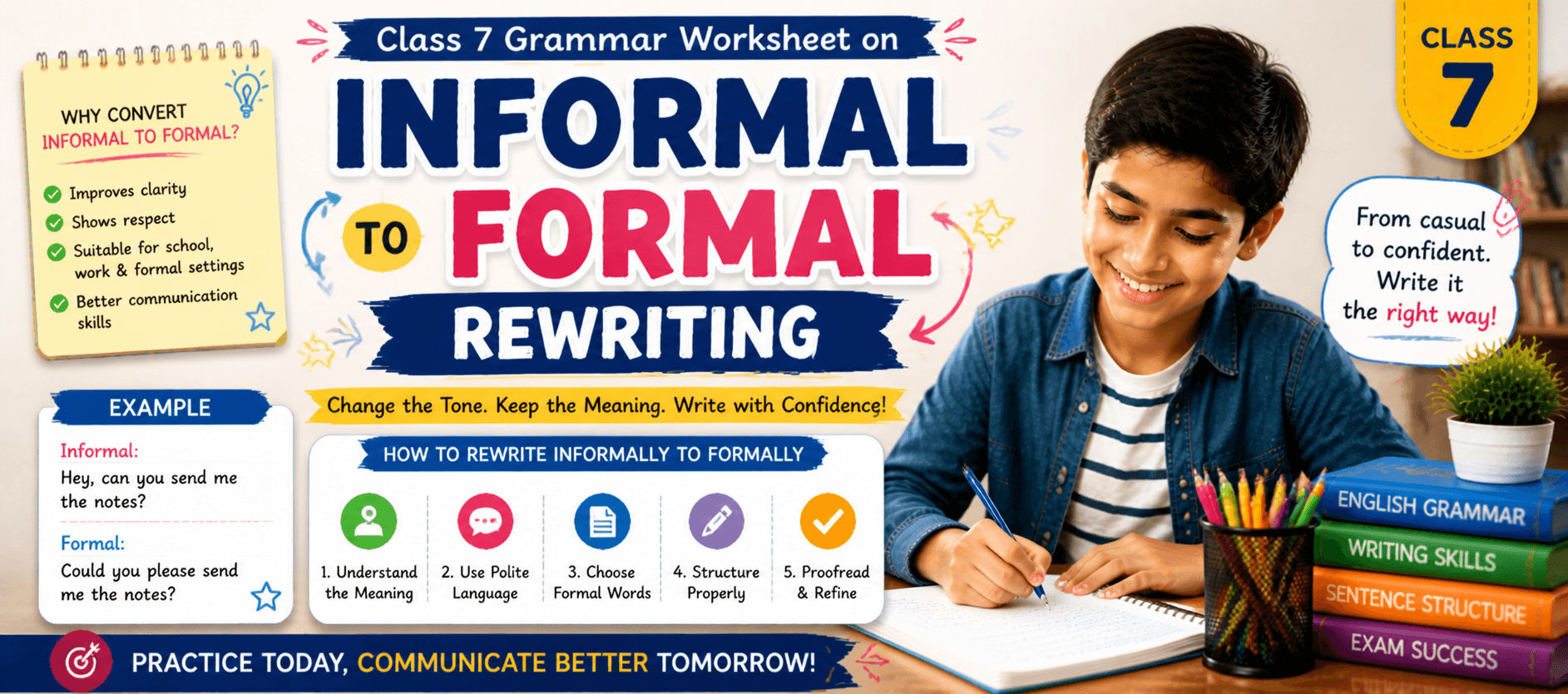
The ability to adjust the tone of writing is crucial in both academic and professional settings. In this Grade 7 worksheet on "Rewriting Informal to Formal Paragraphs," students will practice transforming informal language into formal language. This exercise will enhance students' writing by helping them understand the difference between casual and formal tones and how to adapt their writing accordingly.
Download these English grammar worksheets and practice regularly to strengthen your language skills and build a strong foundation. You can also book a free trial to get expert guidance and improve your reading, writing, and comprehension abilities. The worksheets are designed in a simple and structured way to help K–8 students learn grammar concepts easily and use them confidently in everyday communication. Book a free trial!
## What is the topic?
This worksheet focuses on rewriting informal paragraphs into a formal tone. Informal language is conversational and casual, while formal language is more structured and professional. Learning to switch between these two styles is essential for Grade 7 students, as it will help them in both academic writing and future professional communication.
Students will learn:
- How to identify informal language and transform it into a formal style.
- The importance of using a formal tone in different writing situations.
- How to apply appropriate vocabulary, sentence structures, and grammar for formal writing.
## What’s in this worksheet?
The worksheet includes a series of exercises to help students practice rewriting informal paragraphs into formal ones. The exercises consist of:
1. **Underline the words** – Identifying informal words or phrases in a sentence.
2. **Multiple choice questions** – Choosing the correct formal version of an informal sentence.
3. **Sentence rewriting** – Rewriting sentences or paragraphs from informal to formal.
4. **Fill in the blanks** – Completing sentences with the appropriate formal language.
5. **Paragraph writing** – Writing a formal paragraph on a given topic, ensuring it uses formal language and tone.
By completing these exercises, students will improve their ability to write in a professional and academic style, enhancing both their written communication and their ability to adapt to different writing contexts.
## Definitions, examples, techniques, and tips
- **Informal to Formal Rewriting Definition**: Rewriting informal language into formal language involves changing casual expressions, contractions, and slang into more structured, clear, and professional phrasing. This transformation helps students develop writing that is appropriate for academic, business, and formal contexts.
- **Example of Informal to Formal Rewriting**:
- **Informal**: "I’m gonna do my homework later, and then I’ll head to bed."
- **Formal**: "I will complete my homework later, and subsequently retire for the night."
- **Techniques for transforming informal writing**:
1. Replace contractions with full forms (e.g., "I'm" becomes "I am").
2. Avoid using slang or casual phrases (e.g., "gonna" becomes "going to").
3. Use more formal vocabulary (e.g., "help" becomes "assist").
4. Change informal sentence structures to more formal ones (e.g., avoiding starting sentences with conjunctions).
- **Quick learning tips**:
- Focus on avoiding contractions, slang, and colloquial expressions when rewriting.
- Use more sophisticated vocabulary to elevate the tone of the writing.
- Practice rewriting short informal paragraphs as formal ones to improve fluency in shifting writing styles.
## Why is it important to learn this?
Mastering the art of switching between informal and formal writing styles is essential for students, especially in academic settings. By learning this skill, students will:
- Be able to write formal essays, reports, and assignments with the appropriate tone.
- Understand the difference in language use between casual and professional settings.
- Improve their ability to communicate effectively in both personal and professional environments.
For Grade 7 students, this skill is particularly useful as they begin to write more structured and formal pieces in school.
## Where will this knowledge help you?
This knowledge will be beneficial in:
- **Exams**: Many exams require students to write in a formal, academic style, especially in essays or reports.
- **Writing tasks**: This skill is essential when writing formal letters, reports, research papers, and other academic assignments.
- **Class participation**: Clear, formal communication is valuable in academic discussions, debates, and presentations.
## How to use this worksheet?
1. **Attempt independently first**: Read each informal sentence and try to rewrite it in a more formal tone.
2. **Review answers carefully**: After transforming the sentences, check if the tone is formal and appropriate.
3. **Correct mistakes**: If the transformation sounds too casual or inappropriate for formal writing, adjust the sentence accordingly.
4. **Practice regularly**: Keep practicing informal-to-formal transformations to improve your writing skills.
The solutions follow the exact worksheet order. Compare your answers carefully to ensure accuracy.
## Important tips and tricks
- **Common mistakes**:
- Overcomplicating sentences in an attempt to sound formal, making them harder to read.
- Using informal language that might still sound too casual or inappropriate for formal contexts.
- **What examiners expect**:
- Well-structured, formal writing that communicates ideas clearly and professionally.
- Proper grammar, punctuation, and vocabulary use for formal writing.
- **How to score full marks**:
- Focus on clarity, precision, and the use of formal vocabulary.
- Ensure that each sentence flows logically and maintains the formal tone.
- **How to approach activity-based or writing-based tasks**:
- In rewriting exercises, ensure the transformation keeps the meaning intact while enhancing the formality of the language.
- For paragraph writing, focus on using appropriate formal language and maintaining a professional tone throughout.
## Complete Answer Key
**Exercise No. 1:**
- I'm kinda tired. (Underline: I'm, Circle: tired)
- She’s got a lot of homework. (Underline: She’s, Circle: got)
- He was really mad. (Underline: He, Circle: was)
- They didn't wanna go to the party. (Underline: They, Circle: didn't)
- She’s got a lot of homework. (Underline: She’s, Circle: got)
**Exercise No. 2:**
1. b) I am somewhat tired.
2. b) She has a considerable amount of homework.
3. b) He was extremely angry.
4. b) They did not want to attend the event.
5. b) I am going to finish the work.
**Exercise No. 3:**
1. I am somewhat tired. (Ensure correct use of formal language.)
2. She has a considerable amount of homework. (Ensure correct use of formal language.)
3. He was extremely angry. (Ensure correct use of formal language.)
4. They did not want to attend the party. (Ensure correct use of formal language.)
5. I am going to finish the work. (Ensure correct use of formal language.)
**Exercise No. 4:**
1. extremely
2. considerable
3. extremely
4. attend
5. will
6. assist
7. recommended
8. arrived
9. later
10. disliked
**Exercise No. 5**: Answers may vary.
## Outro
Mastering the ability to rewrite informal sentences in a formal tone will help students improve their communication skills and adapt their writing to different contexts. This essential skill will serve students well in both academic and professional writing tasks.
Book a free trial!