
Interactive Word Families Worksheet for Kids Practice
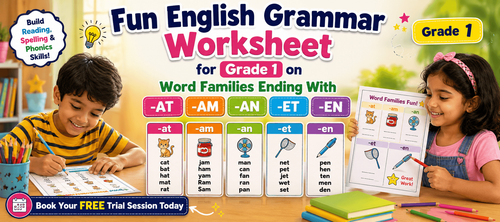

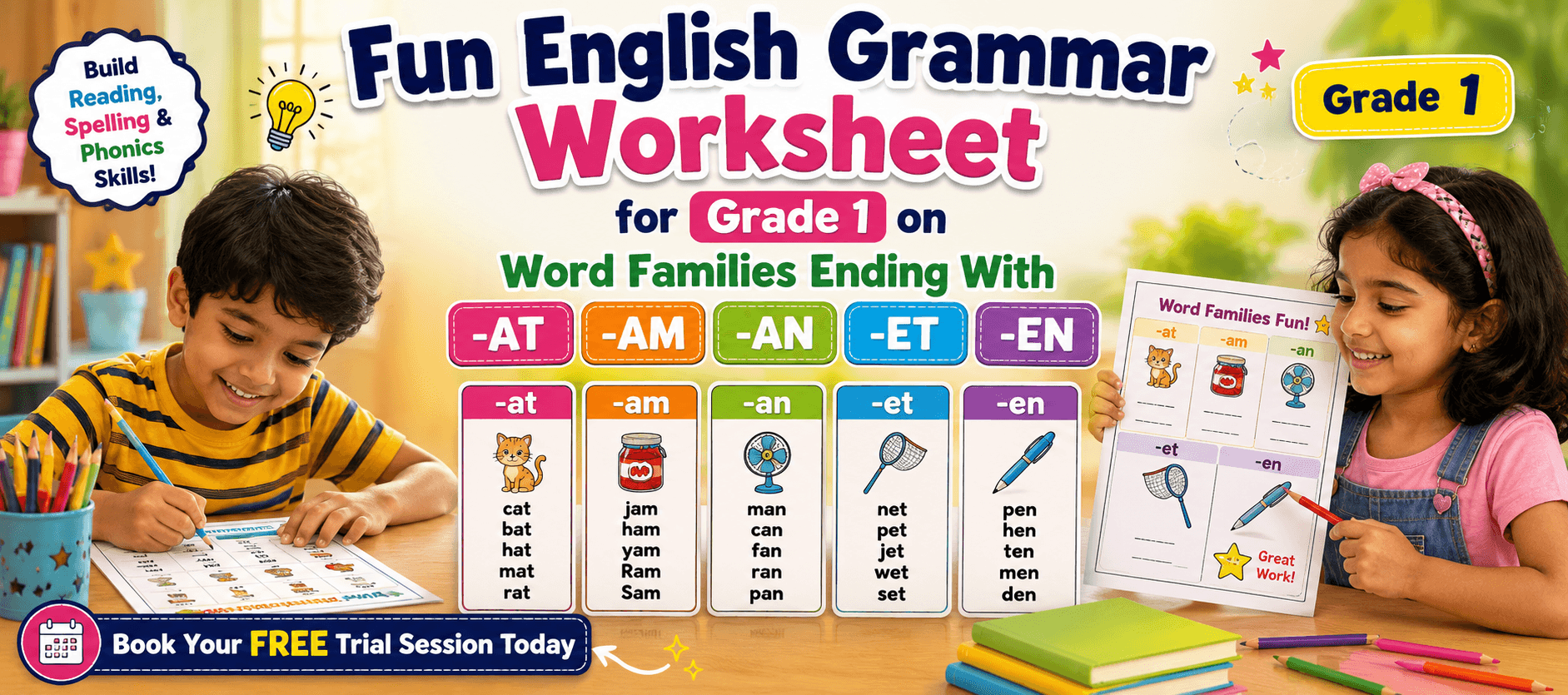
Fun English Grammar Worksheet for Grade 1 on Word Families Ending With AT, AM, AN, ET, and EN
Learning word families is an exciting part of early phonics and reading practice for young learners. In Grade 1, students begin to understand how words can share the same ending sounds while starting with different beginning letters. This English grammar worksheet on Word Families Ending With AT, AM, AN, ET, and EN helps children recognize common spelling patterns and sound families through engaging exercises and simple examples. By practicing these word families regularly, students improve reading fluency, pronunciation, spelling, and vocabulary skills in a fun and structured way.
This Grade 1 English grammar worksheet introduces different word families such as -at, -am, -an, -et, and -en using familiar words and easy phonics activities. Students practice blending sounds, identifying patterns, filling in blanks, matching words, and sorting words into correct groups. These exercises help children build confidence in reading and strengthen their understanding of phonics rules in everyday English learning.
Download these English grammar worksheets and practice regularly to strengthen your language skills and build a strong foundation. You can also book a free trial to get expert guidance and improve your reading, writing, and comprehension abilities. The worksheets are designed in a simple and structured way to help K–8 students learn grammar concepts easily and use them confidently in everyday communication.
What Is the Topic?
Word families are groups of words that share the same ending letters and sounds. In this worksheet, students learn different word families ending with -at, -am, -an, -et, and -en.
The worksheet explains how sounds blend together to form words. Students practice saying letter sounds aloud and combining them to read simple words correctly.
Examples from the worksheet include:
cat, bat, hat, mat, rat
jam, ham, yam, Ram, Sam
man, can, fan, ran, pan
net, pet, jet, wet, set
pen, hen, ten, men, den
By practicing these word families, students improve phonics understanding, reading confidence, and spelling skills.
What’s in This Worksheet?
1. Introduction to different word families
2. Sound blending activities using simple phonics rules
3. Matching words to pictures
4. Fill-in-the-blank exercises
5. Word recognition activities
6. Word coloring exercises
7. Circle-the-correct-word activities
8. Reading and pronunciation practice
9. Phonics-based spelling support
10. Structured exercises suitable for Grade 1 students
Definitions, Examples, Techniques, and Tips
Definition
Word families are groups of words that share the same ending letters and sounds.
Examples
Examples from the worksheet include:
cat, bat, hat, mat, rat
jam, ham, yam, Ram, Sam
man, can, fan, ran, pan
net, pet, jet, wet, set
pen, hen, ten, men, den
Techniques
1. Read each sound slowly and clearly.
2. Blend the sounds together carefully.
3. Identify the ending letters in each word family.
4. Practice saying the words aloud.
5. Match similar sounding words together.
Quick Learning Tips
1. Practice reading word families every day.
2. Focus on the ending sound in each word.
3. Repeat the examples aloud for better pronunciation.
4. Look for similar spelling patterns in new words.
5. Use the worksheet examples to remember sound families easily.
Why Is It Important to Learn This?
Learning word families helps students become stronger readers and better spellers. Recognizing similar word endings makes it easier for children to read new words confidently and improve pronunciation.
Word family practice also helps students understand phonics patterns. When children recognize common endings like -at, -am, -an, -et, and -en, they can decode words more quickly while reading.
This topic supports vocabulary building, classroom learning, spelling development, and reading fluency. Regular practice improves confidence and helps students communicate more effectively in English.
Where Will This Knowledge Help You?
Students can use word family knowledge in many learning situations.
1. Reading simple English words correctly
2. Improving pronunciation during reading practice
3. Writing words with correct spelling patterns
4. Completing grammar and phonics exercises
5. Understanding sound patterns while reading stories
6. Participating confidently in classroom activities
7. Preparing for school tests and phonics tasks
How to Use This Worksheet?
1. Read the examples carefully before beginning each exercise.
2. Say the sounds aloud while reading the words.
3. Blend the sounds together slowly.
4. Complete the activities step by step.
5. Match, fill, circle, or color the correct words carefully.
6. Compare your completed answers carefully with the answer key.
7. The solutions follow the exact worksheet order for easy checking.
8. Correct mistakes neatly after reviewing your work.
9. Practice reading all completed words aloud.
Important Tips and Tricks
1. Focus on the ending letters in each word family.
2. Read each word slowly before answering.
3. Say the sounds aloud while solving the exercises.
4. Practice blending sounds regularly.
5. Keep handwriting neat while completing activities.
6. Double-check spellings before finishing the worksheet.
7. Examiners usually expect correct word recognition and accurate spelling.
8. Practice similar word patterns daily to improve reading fluency.
Complete Answer Key
English Word Families
Ending with at, am, an, et, en
WORD FAMILIES
ENDING WITH - AT
These are words that end with the letters “a” and “t.”
Say /a/ like a short “aaa” sound (like in apple)
Say /t/ like a quick “tuh” sound (like in hat)
Now blend them:
/a/ + /t/ → at
Examples: cat, bat, hat, mat, rat
Say this:
/c/ + /a/ + /t/ → cat
/h/ + /a/ + /t/ → hat
Exercise 1
Match the word to its picture.
mat
chat
rat
pat
bat
fat
sat
hat
flat
cat
WORD FAMILIES
ENDING WITH - AM
These are words that end with the letters “a” and “m.”
Say /a/ like a short “aaa” sound (like in apple)
Say /m/ like a humming “mmm” sound (like in man)
Now blend them:
/a/ + /m/ → am
Examples: jam, ham, yam, Ram, Sam
Say this:
/j/ + /a/ + /m/ → jam
/y/ + /a/ + /m/ → yam
Exercise 2
Color the word that ends with ‘-am’.
CLAM
SAM
SCAM
YAM
SPAM
CRAM
JAM
WHAM
HAM
TRAM
SLAM
GRAM
RAM
WORD FAMILIES
ENDING WITH - AN
These are words that end with the letters “a” and “n.”
Say /a/ like a short “aaa” sound (like in apple)
Say /n/ like a soft “nnn” sound (like in pan)
Now blend them:
/a/ + /n/ → an
Examples: man, can, fan, ran, pan
Say this:
/m/ + /a/ + /n/ → man
/f/ + /a/ + /n/ → fan
Exercise 3
Fill in the blanks using the ‘-an’ and say the sounds aloud as you solve each.
van
fan
pan
swan
tank
man
ran
plant
can
WORD FAMILIES
ENDING WITH - ET
These are words that end with the letters “e” and “t.”
Say /e/ like a short “eh” sound (like in egg)
Say /t/ like a quick “tuh” sound (like in hat)
Now blend them:
/e/ + /t/ → et
Examples: net, pet, jet, wet, set
Say this:
/n/ + /e/ + /t/ → net
/p/ + /e/ + /t/ → pet
Exercise4
Circle the word that belongs to the ‘-et’ family.
1. JET
2. NET
3. GET
4. PET
5. WET
6. BET
7. VET
8. MET
WORD FAMILIES
ENDING WITH - EN
These are words that end with the letters “e” and “n.”
Say /e/ like “eh” (like in pen)
Say /n/ like a soft “nnn” sound (like in pan)
Now blend them:
/e/ + /n/ → en
Examples: pen, hen, ten, men, den
Say this:
/p/ + /e/ + /n/ → pen
/h/ + /e/ + /n/ → hen
Exercise5
Color the word that ends with ‘-en’.
OPEN
WHEN
GREEN
OVEN
YEN
THEN
PEN
MEN
DEN
SEVEN
Practicing word families regularly helps Grade 1 students improve reading, pronunciation, spelling, and phonics skills in a simple and enjoyable way. This English grammar worksheet on Word Families Ending With AT, AM, AN, ET, and EN helps children recognize sound patterns and build stronger language foundations through engaging exercises and examples. With regular practice, students can become more confident readers and writers while developing important phonics and vocabulary skills step by step.