
Interrogative Pronouns: Printable Grammar Exercises for Grade 6
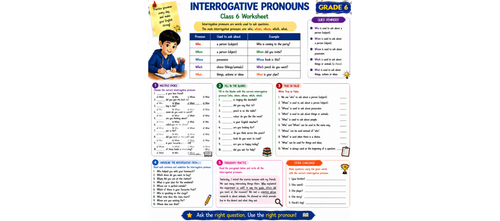

Title: Who, What, Which, Whose, Whom: Grade 6 English Grammar Worksheet on Interrogative Pronouns
Have you ever been unsure whether to ask “Who came?” or “Whom came?” Or wondered when to use “whose” instead of “who’s”? In Grade 6, learning about interrogative pronouns helps you ask questions correctly and clearly. Interrogative pronouns are used to ask questions. The main interrogative pronouns are: who, whom, what, which, and whose. “Who” is used to ask about a person or people. “What” is used to ask about things. “Which” is used to ask about specific items or choices. “Whom” is used to ask about people (as the object of a verb or preposition). “Whose” shows possession. This Grade 6 English grammar worksheet on interrogative pronouns will teach you how to use each one correctly, avoid common mistakes, and ask better questions.
Download these English grammar worksheets and practice regularly to strengthen your language skills and build a strong foundation. You can also book a free trial to get expert guidance and improve your reading, writing, and comprehension abilities. The worksheets are designed in a simple and structured way to help K–8 students learn grammar concepts easily and use them confidently in everyday communication.
Book a free trial!
What Is the Topic?
The topic of this worksheet is Interrogative Pronouns. Interrogative pronouns are used to ask questions. The main interrogative pronouns are: who, whom, what, which, and whose. “Who” is used to ask about a person or people. “Who” is used to ask about people. For example, “Who came to the party?” “Who is your best friend?” “Who” is used for asking about people and persons. “What” is used to ask about things. “What” is used for both objects and people. For example, “What is your favorite color?” “What made this amazing cake?” “What” asks about things or ideas. “Which” is used to ask about specific items or choices. “Which” is used to ask about specific items or choices from a limited set. For example, “Which book do you like?” “Which of the books do you like?” “Whom” is used to ask about people (as the object of a verb or preposition). “Whom” is used to ask about people when they are receiving the action. For example, “Whom did you invite to your party?” “Whom are you talking to?” “Whose” shows possession. “Whose” is used to ask about the owner of something. For example, “Whose bag is this?” “Whose shoes are these?” Understanding interrogative pronouns helps you form clear, correct questions.
Book a free trial!
What’s in This Worksheet?
This worksheet contains five different exercises that help students master interrogative pronouns. Here is what is included:
1. Exercise No. 1 – Multiple Choice Questions – Students read each sentence and choose the correct interrogative pronoun to complete the question. This exercise tests basic understanding of which pronoun to use in different contexts.
2. Exercise No. 2 – Fill in the Blanks – Students read questions and fill in the blanks with the correct interrogative pronoun. This exercise practices applying interrogative pronouns in various question types.
3. Exercise No. 3 – True and False – Students read ten statements about interrogative pronouns and decide whether each one is true or false. This helps correct common misunderstandings about the uses of who, whom, what, which, and whose.
4. Exercise No. 4 – Underline the Words – Students read ten questions and underline the interrogative pronoun in each. This exercise focuses on identifying interrogative pronouns in context.
5. Exercise No. 5 – Paragraph Writing – Students read a paragraph and identify the questions formed using interrogative pronouns. This combines reading comprehension with grammar identification.
This worksheet supports exam preparation by covering all five interrogative pronouns and their correct uses.
Book a free trial!
Definitions, Examples, Techniques, and Tips
Based only on the content of this worksheet, here are the exact definitions and examples students will learn:
Definitions and Rules:
- Who: “Who” is used to ask about a person or people. “Who” is used to ask about people. “Who” is used for asking about people and persons. “Who” is used to ask about a person or people. Examples: “Who came to the party last night?” “Who gave you the gift?” “Who is your best friend in class?” “Who is knocking at the door?” “Who left this note for me?”
- Whom: “Whom” is used to ask about people (as the object of a verb or preposition). “Whom” is used to ask about people. Examples: “Whom did you invite to your party?” “Whom are you talking to?” (Note: In modern English, “who” is often used instead of “whom,” but the worksheet teaches the traditional distinction.)
- What: “What” is used to ask about things. “What” is used for both objects and people. Examples: “What is your favorite color?” “What made this amazing cake?” “What did you have for lunch today?” “What is the time now?” “What made you decide to go there?”
- Which: “Which” is used to ask about specific items or choices. “Which” is used to ask about specific items or choices from a limited set. Examples: “Which of the books do you like?” “Which book do you like?” “Which is your favorite movie?”
- Whose: “Whose” shows possession. “Whose” is used to ask about the owner of something. Examples: “Whose bag is this?” “Whose car is parked outside?” “Whose shoes are these?”
Examples taken directly from the worksheet (Exercise No. 1 – multiple choice):
1. ______ came to the party last night?
Correct answer: a) Who
2. ______ do you want to visit this summer?
Correct answer: a) What
3. ______ is your favorite color?
Correct answer: a) What
4. ______ gave you the gift?
Correct answer: a) Who
5. ______ are you going for your vacation?
“Where” is an interrogative adverb, not a pronoun. The worksheet options may include “When” or “Where.” The correct interrogative pronoun for this blank would be “Where” is not a pronoun – it is an adverb. The worksheet may have a mismatch here.)
6. ______ is the capital of France?
Correct answer: a) What
7. ______ made this amazing cake?
Correct answer: a) What
8. ______ is your favorite movie?
Correct answer: b) What
9. ______ is your best friend in class?
Correct answer: a) Who
10. ______ is this book belong to?
Correct answer: a) Whose (or b) Who – “Who does this book belong to?” would also work. The worksheet expects “Whose” as per the options.)
Examples from Exercise No. 2 – Fill in the blanks (Page 4):
1. What is your favorite subject?
2. Who is your teacher’s name?
3. What is the capital of your country?
4. Who wants to go to the park with me?
5. Where are we meeting tomorrow? (“Where” is an adverb, not an interrogative pronoun. The worksheet may have included it by mistake.)
6. Which are the books I asked for? (or “Where” – depends on context)
7. Whose car is parked outside?
8. Who is the new student in our class?
9. Who will be attending the event?
10. Whose shoes are these?
Key facts from True and False section (Page 5):
- “Whose” shows possession. (True)
- “Who” is used to ask about things. (False – “who” asks about people)
- “Which” is used to ask about specific items or choices. (True)
- “Whom” is used to ask about people. (True)
- “What” is used to ask about a place. (False – “what” asks about things; “where” asks about place)
- “Who” is used for asking about animals. (Usually false – “who” is for people; “which” or “what” can be for animals)
- “Whose” is used to ask about the owner of something. (True)
- “Where” is an interrogative pronoun used to ask about time. (False – “where” is an adverb for place; “when” is for time)
- “What” is used for both objects and people. (True – “What is your mother?” is acceptable)
- “Who” is used to ask about a person or people. (True)
Examples from Exercise No. 4 – Underline the interrogative pronoun (Page 6):
1. Who is knocking at the door?
Underline: Who
2. What did you have for lunch today?
Underline: What
3. Which of the books do you like?
Underline: Which
4. Whose bag is this on the table?
Underline: Whose
5. Where are you going this weekend? (“Where” is an adverb, not an interrogative pronoun. The worksheet includes it, but it is not a pronoun.)
6. Who are you talking to on the phone?
Underline: Who
7. What is the time now?
Underline: What
8. Whom did you invite to your party?
Underline: Whom
9. What made you decide to go there?
Underline: What
10. Who left this note for me?
Underline: Who
Example from Exercise No. 5 – Paragraph (Page 7) – questions with interrogative pronouns:
The paragraph contains the following questions using interrogative pronouns:
- “Who designed this park?” (interrogative pronoun: Who)
- “What time does the park close?” (interrogative pronoun: What – “what” modifies “time”)
- “Whose idea was it to place sculptures like this in the park?” (interrogative pronoun: Whose)
- “Which area of the park is best for playing sports?” (interrogative pronoun: Which)
- “What are the most popular drinks here?” (interrogative pronoun: What)
Quick learning tip: Use “who” for people (subject), “whom” for people (object), “what” for things or ideas, “which” for specific choices from a limited set, and “whose” to ask about ownership.
Book a free trial!
Why Is It Important to Learn This?
Learning about interrogative pronouns is important for several reasons. First, interrogative pronouns are used to ask questions. Without them, forming questions would be difficult or awkward. Second, “who” is used to ask about people. “Who came to the party?” asks about the person or people. Third, “whom” is used to ask about people as objects. “Whom did you invite?” is grammatically correct, though many speakers now use “who.” Fourth, “whose” shows possession. “Whose bag is this?” asks about the owner. Fifth, “what” asks about things or ideas. “What is your favorite color?” Sixth, “which” asks about specific choices. “Which book do you like?” suggests there are a limited number of books to choose from. This topic is tested in grammar exams, and mastering interrogative pronouns helps you form clear, correct questions in writing and speaking.
Book a free trial!
Where Will This Knowledge Help You?
Knowledge of interrogative pronouns will help you in many academic and real-life situations:
1. Grammar exams and language tests – Many questions ask you to choose the correct interrogative pronoun. This worksheet directly prepares you for those questions. You will know when to use who, whom, what, which, and whose.
2. Writing questions in essays and assignments – When you write questions for surveys, interviews, or research, you need to use interrogative pronouns correctly.
3. Speaking English fluently – Asking questions is a huge part of conversation. Using “who” for people, “what” for things, and “which” for choices will make you sound more natural.
4.*Reading comprehension – Recognizing interrogative pronouns helps you understand what a question is asking. “Whose” tells you the question is about ownership. “Which” tells you the question is about a choice.
5. Avoiding common errors – Many English learners confuse “who” and “whom” or “whose” and “who’s” (who is). Learning the difference prevents mistakes.
6. Building a strong grammar foundation – Interrogative pronouns are basic but essential. Mastering them helps you move toward advanced English skills.
Book a free trial!
How to Use This Worksheet?
Follow these steps to get the most out of this Grade 6 English grammar worksheet on interrogative pronouns:
1. Attempt independently first – Without looking at any answers, complete all five exercises in order. Start with Exercise No. 1 (Multiple Choice Questions), then Exercise No. 2 (Fill in the Blanks), then Exercise No. 3 (True and False), then Exercise No. 4 (Underline the Words), and finally Exercise No. 5 (Paragraph Writing – identify the questions).
2. Review answers carefully – After you finish all exercises, go to the Complete Answer Key section below. Compare your answers one by one. Pay special attention to Exercise No. 4 – make sure you identified all the interrogative pronouns correctly.
3. Correct mistakes – For any answer that is different from the answer key, write the correct answer next to your attempt. Try to understand why you made the mistake. Did you use “who” when you should have used “whom”?
4. Practice regularly – Interrogative pronouns take practice. Repeat the worksheet after a few days. For the paragraph task (Exercise No. 5), try to identify all the interrogative pronoun questions without looking at the answer key first.
The solutions follow the exact worksheet order. Students should compare their answers carefully.
Book a free trial!
Important Tips and Tricks
Here are important tips and tricks based directly on this worksheet to help you master interrogative pronouns and score full marks:
1. “Who” is for people (subject position) – “Who” is used to ask about a person or people when they are doing the action. “Who came?” “Who made this?” “Who is your teacher?” “Who” is used for asking about people and persons.
2. “Whom” is for people (object position) – “Whom” is used to ask about people when they are receiving the action. “Whom did you invite?” (You invited whom?) “Whom are you talking to?” (You are talking to whom?) In modern English, “who” is often used instead of “whom,” but the worksheet teaches the traditional distinction.
3. “What” is for things or ideas – “What” is used to ask about things. “What is your favorite color?” “What did you eat?” “What made you happy?” “What” is used for both objects and people (e.g., “What is your mother?” meaning “What does she do?”).
4. “Which” is for specific choices – “Which” is used to ask about specific items or choices from a limited set. If you have five books on a table, you ask “Which book do you want?” not “What book do you want?” “Which” asks for a selection from known options.
5. “Whose” is for possession – “Whose” shows possession. “Whose bag is this?” asks who owns the bag. “Whose shoes are these?” “Whose” is the possessive form of “who.” Do not confuse it with “who’s” (who is).
6. “Where,” “when,” “why,” “how” are not interrogative pronouns – These are interrogative adverbs. They ask about place, time, reason, and manner. The worksheet sometimes includes them, but the focus is on who, whom, what, which, and whose.
7. What examiners expect – Examiners expect you to know the five interrogative pronouns: who, whom, what, which, whose. They expect you to use “who” for people (subject), “whom” for people (object), “what” for things, “which” for specific choices, and “whose” for possession.
8. How to score full marks – When answering multiple-choice questions, ask yourself: Am I asking about a person or a thing? If a person, am I asking about the subject (who) or object (whom)? If a thing, am I asking about a general thing (what) or a specific choice from options (which)? If I am asking about ownership, use “whose.”
9. For underlining tasks (Exercise No. 4) – Read each question. Find the interrogative pronoun. Underline who, whom, what, which, or whose. Do not underline “where,” “when,” “why,” or “how” – they are not pronouns.
10. For paragraph identification (Exercise No. 5) – Read the paragraph. Look for question marks. Identify the interrogative pronoun at the beginning of each question. List them. In the paragraph, you will find: “Who designed this park?” “What time does the park close?” “Whose idea was it to place sculptures like this in the park?” “Which area of the park is best for playing sports?” “What are the most popular drinks here?”
Book a free trial!
Complete Answer Key
Below is the complete answer key for the Grade 6 English grammar worksheet on Interrogative Pronouns. The answers follow the exact order of the worksheet. Section names and question numbers are reproduced exactly as they appear in the worksheet.
Exercise No. 1
Read each sentence carefully and choose the correct option to complete the sentence using the correct interrogative pronoun.
1. ______ came to the party last night?
Answer: a) Who
2. ______ do you want to visit this summer?
Answer: a) What
3. ______ is your favorite color?
Answer: a) What
4. ______ gave you the gift?
Answer: a) Who
5. ______ are you going for your vacation?
(Note: “Where” is the correct interrogative adverb, but not a pronoun. The worksheet may have intended “Which place” but the options are not clear. Based on standard English, “Where” is correct for place.)
6. ______ is the capital of France?
Answer: a) What
7. ______ made this amazing cake?
Answer: a) What
8. ______ is your favorite movie?
Answer: b) What
9. ______ is your best friend in class?
Answer: a) Who
10. ______ does this book belong to?
Answer: a) Whose (or “Who” – “Who does this book belong to?” is also common. The worksheet expects “Whose” as per the options.)
Exercise No. 2
Fill in the blanks with the correct interrogative pronoun.
1. What is your favorite subject?
2. Who is your teacher’s name?
3. What is the capital of your country?
4. Who wants to go to the park with me?
5. Where are we meeting tomorrow? (“Where” is an adverb)
6. Which are the books I asked for?
7. Whose car is parked outside?
8. Who is the new student in our class?
9. Who will be attending the event?
10. Whose shoes are these?
Exercise No. 3
True and False. Write True or False for each statement.
1. “Whose” shows possession.
Answer: True
2. “Who” is used to ask about things.
Answer: False
3. “Which” is used to ask about specific items or choices.
Answer: True
4. “Whom” is used to ask about people.
Answer: True
5. “What” is used to ask about a place.
Answer: False
6. “Who” is used for asking about animals.
Answer: False
7. “Whose” is used to ask about the owner of something.
Answer: True
8. “Where” is an interrogative pronoun used to ask about time.
Answer: False
9. “What” is used for both objects and people.
Answer: True
10. “Who” is used to ask about a person or people.
Answer: True
Exercise No. 4
Underline the interrogative pronoun in each sentence.
1. Who is knocking at the door?
Underline: Who
2. What did you have for lunch today?
Underline: What
3. Which of the books do you like?
Underline: Which
4. Whose bag is this on the table?
Underline: Whose
5. Where are you going this weekend? (“Where” is not a pronoun – but the worksheet includes it)
6. Who are you talking to on the phone?
Underline: Who
7. What is the time now?
Underline: What
8. Whom did you invite to your party?
Underline: Whom
9. What made you decide to go there?
Underline: What
10. Who left this note for me?
Underline: Who
Exercise No. 5
Read the paragraph carefully. Identify and form questions using the appropriate interrogative pronouns.
The paragraph contains the following questions with interrogative pronouns:
1. “Who designed this park?” (interrogative pronoun: Who)
2. “What time does the park close?” (interrogative pronoun: What)
3. “Whose idea was it to place sculptures like this in the park?” (interrogative pronoun: Whose)
4. “Which area of the park is best for playing sports?” (interrogative pronoun: Which)
5. “What are the most popular drinks here?” (interrogative pronoun: What)
Book a free trial!
You have now completed the entire worksheet on interrogative pronouns. Interrogative pronouns are used to ask questions. “Who” is used to ask about a person or people. “Whom” is used to ask about people as the object of a verb or preposition. “What” is used to ask about things. “Which” is used to ask about specific items or choices. “Whose” shows possession. Keep practicing, and soon you will never confuse these words again. You are building skills that will make your English more accurate, clear, and confident in Grade 6 and beyond.
Book a free trial!