
Interrogative Sentence Practice Worksheet for Class 6 PDF
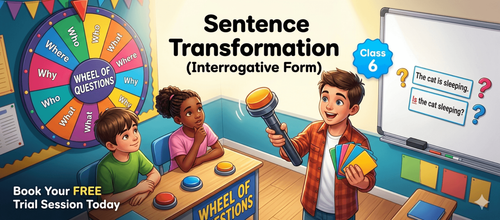

English Grammar Worksheet Grade 6 – Mastering Interrogative Form with Fun Exercises
Grammar becomes more interesting when we explore how questions are formed! In this English grammar worksheet for Grade 6, students dive deep into interrogative form sentences—learning how to transform statements into questions and understanding the structure of questions in English. This worksheet helps students practice recognizing and constructing questions, which is an essential skill for both speaking and writing.
Download these English grammar worksheets and practice regularly to strengthen your language skills and build a strong foundation. You can also book a free trial to get expert guidance and improve your reading, writing, and comprehension abilities. The worksheets are designed in a simple and structured way to help K–8 students learn grammar concepts easily and use them confidently in everyday communication.
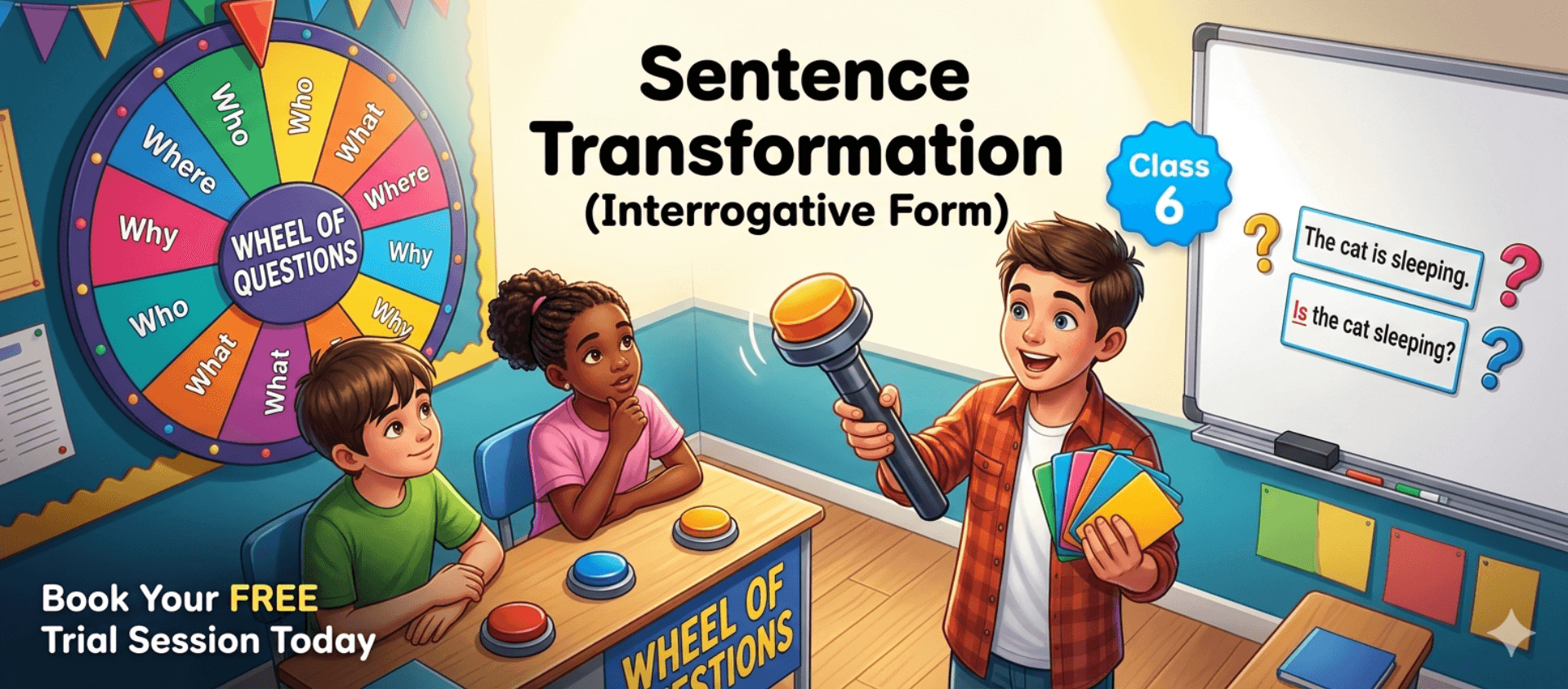
What is the topic?
The main focus of this worksheet is the **Interrogative Form**, which refers to the structure of sentences that are used to ask questions. In English, interrogative sentences often start with words like "what," "why," "how," "where," and "who," followed by the appropriate verb and subject. This worksheet helps students recognize the difference between a statement and a question, and how to convert one into the other correctly.
Students will learn how to transform statements into interrogative sentences and practice identifying correct question forms. This is crucial for improving both verbal and written communication.
What’s in this worksheet?
1. **Multiple Choice Questions** where students select the correct form of an interrogative sentence.
2. **Fill in the Blanks** that help students apply their knowledge of question forms in context.
3. **Sentence Rewriting** where students change assertive sentences into interrogative ones.
4. **Underline the Words** activity to identify the interrogative elements in sentences.
5. **Paragraph Writing** where students write short paragraphs using correct interrogative sentences.
These exercises are designed to practice a variety of grammatical skills, which are fundamental for mastering the interrogative form and enhancing overall language proficiency.
Definitions, examples, techniques, and tips
**Definitions:**
- **Interrogative sentences** are sentences that ask questions. They can be in the form of "yes/no" questions or "wh-" questions (who, what, where, etc.).
- For example:
- "What is your name?"
- "Is she coming to the party?"
**Examples:**
- “Is the teacher in class?”
- “Can you help me with this task?”
- “Where did you go yesterday?”
**Techniques to help identify interrogative sentences:**
- Look for question words like “what,” “where,” “why,” and “who.”
- Check the word order—often, the verb precedes the subject in yes/no questions (e.g., "Are you ready?").
**Quick learning tips:**
- Remember that all questions must end with a question mark.
- In yes/no questions, the auxiliary verb (like "do," "is," or "can") typically precedes the subject.
- Pay attention to word order when transforming assertive sentences into questions.
Why is it important to learn this?
Mastering the interrogative form allows students to communicate more effectively by asking questions and obtaining information. It plays a vital role in both written and spoken communication, enabling students to engage in conversations, ask for clarification, and seek answers.
This topic also reinforces sentence structure knowledge, which is foundational for advanced grammar topics in higher grades. Understanding how to ask questions is key to expressing curiosity, gaining knowledge, and participating in classroom discussions.
Where will this knowledge help you?
Knowledge of interrogative sentences will help in:
- **Exams**, where students need to identify and construct questions.
- **Writing tasks**, especially in essays or dialogues that involve asking questions.
- **Class participation**, where students can ask questions for clarification or discussion.
How to use this worksheet?
1. **Attempt each question independently** before reviewing answers.
2. **Identify the type of question** being asked in the exercise.
3. **Rewrite sentences** correctly by transforming assertive sentences into interrogative forms.
4. **Review your answers** after completing the worksheet.
5. **Check your mistakes** carefully and understand the rules that apply to the transformations.
6. **Practice regularly** to improve your confidence in using interrogative forms.
The solutions follow the exact worksheet order, so compare your answers carefully with the provided key.
Important tips and tricks
1. **Focus on word order**—especially when transforming statements into questions.
2. **Practice with a variety of question types**—both yes/no and wh-questions.
3. Pay attention to **question words** like "who," "what," "when," and "why."
4. **Check for punctuation**—all interrogative sentences should end with a question mark.
5. Practice **writing your own questions** on different topics to improve.
Complete answer key
Exercise No. 1
Identify if the sentence is interrogative.
1. Yes
2. Yes
3. Yes
4. Yes
5. Yes
6. Yes
7. Yes
8. Yes
9. Yes
10. Yes
Exercise No. 2
Choose the correct interrogative sentence.
1. b) Is she ready?
2. b) Does he play cricket?
3. b) Are they happy?
4. b) Does she eat rice?
5. b) Does he run fast?
Exercise No. 3
Rewrite each sentence as directed.
1. Is she ready?
2. Are they happy?
3. Does Riya eat rice?
4. Does he play cricket?
5. Does Meera sing well?
6. Does Raj run fast?
7. Does the girl write neatly?
8. Does the boy read books?
9. Does she enjoy music?
Exercise No. 4
Fill in the blanks with the correct question form.
1. Does
2. Did
3. Does
4. Is
Exercise No. 5
Write a short paragraph using interrogative sentences (80–100 words).
**Sample Answer for Exercise 5:**
Yesterday, I went to the park and saw many people. What was the weather like? Was it sunny or cloudy? I wondered how many people were enjoying their time. Did they bring snacks or drinks with them? How long did they stay? Some were walking, others were playing basketball. I asked my friend, "Did you see that amazing jump?" We laughed and had a great time. By the end of the day, we were both very tired but happy. What a fun afternoon it was!
This worksheet on **Interrogative Form** will help you become more confident in constructing and using questions in both writing and speaking. Keep practicing regularly to improve your grammar skills!