
Introduction to Greek and Latin Roots for Grade 6 [Free PDF]
![Introduction to Greek and Latin Roots for Grade 6 [Free PDF]](https://cdn5.planetspark.in/media/small_17_77c131e205.png)

Grade 6 English Grammar Worksheet: Introduction to Greek and Latin Roots [With Examples]
Greek and Latin roots form the foundation of many English words. Understanding these roots can greatly expand Grade 6 students’ vocabulary and help them decode unfamiliar words. This worksheet introduces students to common Greek and Latin roots, helping them form a deeper connection with the English language.
Download these English grammar worksheets and practice regularly to strengthen your language skills and build a strong foundation. You can also book a free trial to get expert guidance and improve your reading, writing, and comprehension abilities. The worksheets are designed in a simple and structured way to help K–8 students learn grammar concepts easily and use them confidently in everyday communication.
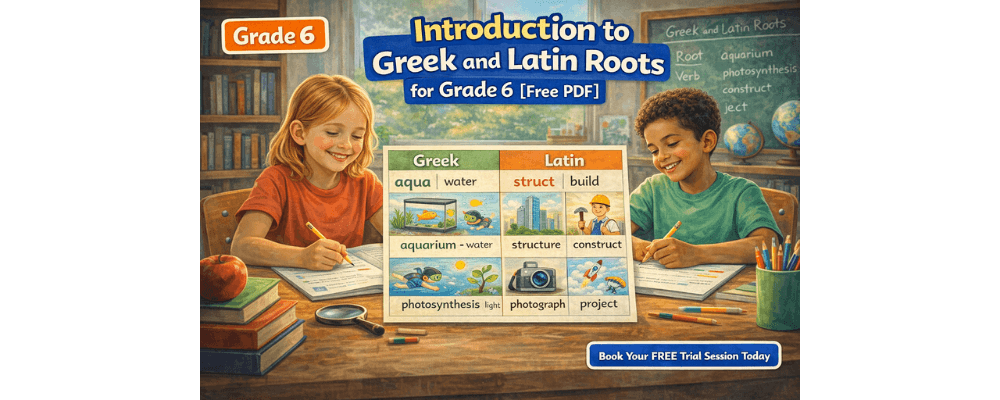
What is the topic?
This worksheet introduces students to Greek and Latin roots, which are the building blocks of many English words. By understanding these roots, students can more easily understand complex words and expand their vocabulary.
What's in this worksheet?
1. Introduction to common Greek and Latin roots.
2. Exercises that help students identify and understand these roots in words.
3. Understanding how these roots contribute to word meanings.
4. Designed to help students build a strong vocabulary foundation.
Definitions, Examples, Techniques, and Tips:
• Definitions:
- Greek and Latin roots are the core of many English words. Recognizing them helps students understand the meaning of unfamiliar words.
• Examples:
- "Aqua" (water) + "fer" (to carry) = "Aquifer" (a layer of rock that holds water).
- "Bio" (life) + "logy" (study) = "Biology" (the study of life).
• Tips:
- Focus on learning the most common Greek and Latin roots to quickly identify their meaning in words.
- Practice recognizing and using these roots in your own sentences.
Why is it important to learn this?
Mastering Greek and Latin roots allows students to quickly understand the meaning of new words. It also helps improve spelling and reading comprehension, as students will be able to decode complex words with ease.
Where will this knowledge help you?
• Exams: Greek and Latin roots are frequently tested in vocabulary and comprehension exams.
• Writing tasks: Knowing Greek and Latin roots helps students form more complex and varied sentences.
• Class participation: Understanding the meaning of roots allows students to engage more clearly in discussions.
How to use this worksheet?
1. Review the Greek and Latin roots and their meanings.
2. Practice identifying these roots in different words.
3. Check your answers to ensure you understand how the root contributes to the word’s meaning.
4. Regular practice will help reinforce this knowledge and expand your vocabulary.
Important Tips and Tricks:
1. Familiarize yourself with the most common Greek and Latin roots.
2. Practice breaking down words into their root parts to improve understanding.
3. Keep practicing regularly to expand your knowledge of roots and increase your vocabulary.
Complete Answer Key:
Exercise 1 – Match the Following
aqua → water
bio → life
geo → earth
graph → to write
port → to carry
aud → to hear
dict → to say
vis → to see
scrib → to write
tele → far away
Exercise 2 – Sort the Words
Root words: geo, photo, auto, scope, tele, graph, aqua, bio, micro, hydro, vis, log, ject, port, dict
Meaning words: earth, light, self, see, far, write, water, life, small, water, see, study, throw, carry, speak
Exercise 3 – Fill in the Blanks
1. auditorium
2. library
3. biology
4. telescope
5. geographic
6. autograph
7. ecology
8. biography
9. auditory
10. visual
Exercise 4 – Multiple Choice Questions
1. c) Tele
2. b) Graph
3. a) Aqua
4. b) Bio
5. d) Micro
6. a) Geo
7. c) Phone
8. c) Auto
9. b) vis
10. d) Dict
Exercise 5 – Sentence Rewriting
1. Anjali went to the auditorium to watch the school's annual drama.
2. Rahul borrowed a biography of Nelson Mandela from the school.
3. Diya looked through the telescope at the stars from her roof.
4. Pooja studied about aquatic creatures in her science chapter.
5. Arjun asked the cricketer for an autograph after the big match.
6. Neha studied the geographical features of Indian rivers in geography.
7. Kartik could hear clearly from the last row of the auditorium.
8. Aarav wrote about the biological life cycle of butterflies in class.
9. Rohan described the geographic map of South India in his project.
10. Anjali submitted her script for the school writing contest.
Understanding Greek and Latin roots will give you a solid foundation for learning new words. With regular practice, you’ll soon be able to recognize and understand a wide range of words, improving your vocabulary and language skills.