
Irregular Plural Nouns: Class 6 Editing & Exercises (PDF)
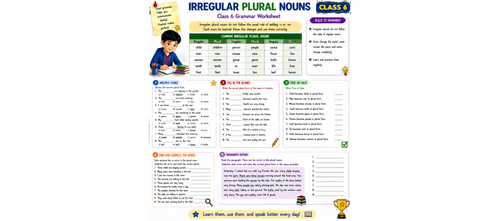

Title: Child to Children, Mouse to Mice: Grade 6 English Grammar Worksheet on Irregular Plural Nouns
Have you ever wondered why we say “children” instead of “childs,” or “mice” instead of “mouses”? That is because these are irregular plural nouns. In Grade 6, learning about irregular plural nouns helps you understand that not all nouns follow the simple rule of adding “s” or “es” to make them plural. Some nouns change completely. For example, the plural of child is children, not “childs.” The plural of mouse is mice, not “mouses.” The plural of foot is feet, not “foots.” The plural of tooth is teeth, not “tooths.” This Grade 6 English grammar worksheet on irregular plural nouns will teach you the most common irregular plurals, help you avoid mistakes, and improve your writing and speaking accuracy.
Download these English grammar worksheets and practice regularly to strengthen your language skills and build a strong foundation. You can also book a free trial to get expert guidance and improve your reading, writing, and comprehension abilities. The worksheets are designed in a simple and structured way to help K–8 students learn grammar concepts easily and use them confidently in everyday communication.
Book a free trial!
What Is the Topic?
The topic of this worksheet is Irregular Plural Nouns. Most nouns become plural by adding “s” or “es” (cat → cats, box → boxes). However, some nouns are irregular. They change in different ways. The plural of child is children. The plural of woman is women. The plural of man is men. The plural of person is people. The plural of mouse is mice. The plural of foot is feet. The plural of tooth is teeth. The plural of leaf is leaves. The plural of wolf is wolves. The plural of baby is babies (this follows a rule – change “y” to “ies”). Some nouns change their spelling completely. Others change vowels. Learning these irregular plural nouns is essential for correct English grammar.
Book a free trial!
What’s in This Worksheet?
This worksheet contains five different exercises that help students master irregular plural nouns. Here is what is included:
1. Exercise No. 1 – Multiple Choice Questions – Students read each sentence and choose the correct plural form of the noun. This exercise tests basic knowledge of common irregular plural nouns.
2. Exercise No. 2 – Fill in the Blanks – Students write the correct plural form of given nouns. This exercise practices applying irregular plural rules.
3. Exercise No. 3 – True and False – Students read statements about irregular plural nouns and decide whether each one is true or false. This helps correct common misunderstandings.
4. Exercise No. 4 – Underline the Words – Students read ten sentences that contain errors in plural noun usage. Students must underline the incorrect plural noun and write the correct form. This exercise focuses on identifying and correcting common mistakes.
5. Exercise No. 5 – Paragraph Writing – Students read a paragraph that contains errors in plural noun usage. Students must identify and correct the incorrect plural forms. This combines reading comprehension with grammar application.
This worksheet supports exam preparation by covering the most common irregular plural nouns and the patterns for changing them.
Book a free trial!
Definitions, Examples, Techniques, and Tips
Based only on the content of this worksheet, here are the exact definitions and examples students will learn:
Common Irregular Plural Nouns (from the worksheet):
- child → children (not “childs”)
- woman → women (not “womans”)
- man → men (not “mans”)
- person → people (not “persons” – though “persons” is used in legal contexts, “people” is the common plural)
- mouse → mice (not “mouses”)
- foot → feet (not “foots”)
- tooth → teeth (not “tooths”)
- leaf → leaves (not “leafs” – change “f” to “ves”)
- wolf → wolves (not “wolfs” – change “f” to “ves”)
- baby → babies (change “y” to “ies” – not “babys”)
Examples taken directly from the worksheet (Exercise No. 1 – multiple choice):
1. The plural of child is:
Answer: b) children
2. The plural of woman is:
Answer: b) women
3. The plural of man is:
Answer: a) men
4. The plural of person is:
Answer: b) people
5. The plural of mouse is:
Answer: a) mice
6. The plural of baby is:
Answer: a) babies (or b – both options appear identical in the file; the correct spelling is “babies”)
7. The plural of foot is:
Answer: b) feet
8. The plural of leaf is:
Answer: b) leaves
9. The plural of tooth is:
Answer: a) teeth
10. The plural of tomato is:
Answer: a) tomatoes (adds “es” – regular, but included)
Examples from Exercise No. 2 – Fill in the blanks (Page 4):
1. The plural of mouse is: mice
2. The plural of tooth is: teeth
3. The plural of foot is: feet
4. The plural of leaf is: leaves
5. The plural of man is: men
6. The plural of woman is: women
7. The plural of baby is: babies
8. The plural of child is: children
9. The plural of person is: people
10. The plural of wolf is: wolves
Key facts from True and False section (Page 5):
- Foot becomes feet in plural. (True)
- Mouse becomes mouses in plural. (False – mouse becomes mice)
- Women is the plural of woman. (True)
- Child becomes childs in plural. (False – child becomes children)
- Teeth is the plural of tooth. (True)
- Man becomes mans in plural. (False – man becomes men)
- Baby becomes babys in plural. (False – baby becomes babies)
- Person becomes people in plural. (True)
- Wolves is the plural of wolf. (True)
- Leaf becomes leafs in plural. (False – leaf becomes leaves)
Examples from Exercise No. 4 – Underline the error and correct (Page 6):
1. The womans went to the market.
Error: womans
Correction: women
2. I saw many mouses in the field.
Error: mouses
Correction: mice
3. The childs played outside.
Error: childs
Correction: children
4. She has two foots.
Error: foots
Correction: feet
5. The babies were crying. (No error – “babies” is correct)
6. There are three teeth on the table. (No error – “teeth” is correct)
7. We have many peoples in the room.
Error: peoples (when referring to multiple individuals, “people” is already plural)
Correction: people
8. The leafs are turning yellow.
Error: leafs
Correction: leaves
9. The men went to work. (No error – “men” is correct)
10. The wolfs were howling in the distance.
Error: wolfs
Correction: wolves
Example from Exercise No. 5 – Paragraph (Page 7) – errors to correct:
Original paragraph with errors:
The womans were sitting on the benches, chatting about their families, while their childs played in the park. Some of the men were discussing their plans for the weekend, while the foots of the children touched the grass. The sun was shining brightly, and the leaves from the trees were falling gently to the ground. Nearby, a group of babies were playing near a fountain, and the mothers watched them closely. In the distance, a few mouses scurried across the path, and some people were walking their dogs. As the day went on, more and more people arrived, and the park was filled with laughter and joy.
Corrected paragraph:
The women were sitting on the benches, chatting about their families, while their children played in the park. Some of the men were discussing their plans for the weekend, while the feet of the children touched the grass. The sun was shining brightly, and the leaves from the trees were falling gently to the ground. Nearby, a group of babies were playing near a fountain, and the mothers watched them closely. In the distance, a few mice scurried across the path, and some people were walking their dogs. As the day went on, more and more people arrived, and the park was filled with laughter and joy.
Quick learning tip: Memorize the most common irregular plurals: child/children, woman/women, man/men, person/people, mouse/mice, foot/feet, tooth/teeth, leaf/leaves, wolf/wolves, baby/babies. Practice them regularly.
Book a free trial!
Why Is It Important to Learn This?
Learning about irregular plural nouns is important for several reasons. First, not all nouns follow the simple rule of adding “s” or “es.” The plural of child is children, not “childs.” Using “childs” is a common mistake. Second, the plural of mouse is mice, not “mouses.” Saying “mouses” sounds incorrect to native speakers. Third, the plural of tooth is teeth, not “tooths.” Fourth, the plural of foot is feet, not “foots.” Fifth, this topic is tested in grammar exams where you may be asked to choose the correct plural form or correct errors. Finally, using correct irregular plurals makes your English sound more natural and educated.
Book a free trial!
Where Will This Knowledge Help You?
Knowledge of irregular plural nouns will help you in many academic and real-life situations:
1. Grammar exams and language tests – Many questions ask you to choose the correct plural form. This worksheet directly prepares you for those questions. You will know that “children” is correct, not “childs.”
2. Writing essays and stories – Using correct plurals makes your writing look professional. “The women went to the market” is correct. “The womans went to the market” is incorrect.
3. Speaking English fluently – Native speakers use irregular plurals naturally. Saying “mice” instead of “mouses” will make you sound more fluent.
4. Reading comprehension – Recognizing irregular plurals helps you understand what you read. If you see “mice,” you know it means more than one mouse.
5. Avoiding common errors – Many English learners say “childs,” “mouses,” “foots,” “tooths,” “womans,” and “mans.” Learning the correct forms helps you avoid these mistakes.
6. Building a strong grammar foundation – Irregular plurals are basic but essential. Mastering them is a key step toward advanced English skills.
Book a free trial!
How to Use This Worksheet?
Follow these steps to get the most out of this Grade 6 English grammar worksheet on irregular plural nouns:
1. Attempt independently first – Without looking at any answers, complete all five exercises in order. Start with Exercise No. 1 (Multiple Choice Questions), then Exercise No. 2 (Fill in the Blanks), then Exercise No. 3 (True and False), then Exercise No. 4 (Underline the Words), and finally Exercise No. 5 (Paragraph Writing – correct the errors).
2. Review answers carefully – After you finish all exercises, go to the Complete Answer Key section below. Compare your answers one by one. Pay special attention to Exercise No. 4 – make sure you identified all the errors correctly.
3. *Correct mistakes – For any answer that is different from the answer key, write the correct answer next to your attempt. Try to understand why you made the mistake. Did you write “childs” instead of “children”?
4. Practice regularly – Irregular plurals take practice. Repeat the worksheet after a few days. For the paragraph correction task (Exercise No. 5), try to find all the errors without looking at the answer key first.
The solutions follow the exact worksheet order. Students should compare their answers carefully.
Book a free trial!
Important Tips and Tricks
Here are important tips and tricks based directly on this worksheet to help you master irregular plural nouns and score full marks:
1. Memorize the common irregular plurals – The best way to learn irregular plurals is to memorize them. Make flashcards. Practice daily. The plural of child is children. The plural of woman is women. The plural of man is men. The plural of person is people. The plural of mouse is mice. The plural of foot is feet. The plural of tooth is teeth. The plural of leaf is leaves. The plural of wolf is wolves. The plural of baby is babies.
2. “Childs” is always wrong – Never write “childs.” The correct plural is always children. This is one of the most common mistakes.
3. “Mouses” is always wrong – Never write “mouses” when referring to the animal. The correct plural is mice. (However, “mouses” can be used for computer mice – but the worksheet focuses on the animal.)
4. “Foots” is always wrong – Never write “foots.” The correct plural is feet.
5. “Tooths” is always wrong – Never write “tooths.” The correct plural is teeth.
6. “Womans” is always wrong – Never write “womans.” The correct plural is women.
7. “Mans” is always wrong – Never write “mans.” The correct plural is men.
8. “Leafs” is wrong for tree leaves – The correct plural of leaf (from a tree) is leaves. “Leafs” is only used for the Toronto Maple Leafs hockey team.
9. “Wolfs” is wrong – The correct plural of wolf is wolves. Change the “f” to “ves.”
10. What examiners expect – Examiners expect you to know the correct irregular plural forms. They expect you to correct errors like “childs” to “children,” “mouses” to “mice,” “foots” to “feet,” “tooths” to “teeth,” “womans” to “women,” “mans” to “men,” “peoples” to “people” (when referring to multiple individuals), “leafs” to “leaves,” and “wolfs” to “wolves.”
11. How to score full marks – When answering multiple-choice questions, choose the form you know is correct. If you are unsure, remember the most common irregulars. For true and false, know that mouse does NOT become mouses, child does NOT become childs, man does NOT become mans, baby does NOT become babys, and leaf does NOT become leafs.
12. For underlining tasks (Exercise No. 4) – Read each sentence. Look for plural nouns. If the plural form is incorrect (like “womans,” “mouses,” “childs,” “foots,” “peoples,” “leafs,” “wolfs”), underline it and write the correct form.
13. For paragraph correction (Exercise No. 5) – Read the paragraph slowly. Look for every plural noun. Check if it is correct. Correct “womans” to “women,” “childs” to “children,” “foots” to “feet,” “mouses” to “mice.” “Leaves” and “babies” and “people” are already correct.
Book a free trial!
Complete Answer Key
Below is the complete answer key for the Grade 6 English grammar worksheet on Irregular Plural Nouns. The answers follow the exact order of the worksheet. Section names and question numbers are reproduced exactly as they appear in the worksheet.
Exercise No. 1
Read each sentence carefully and choose the correct plural form of the noun.
1. The plural of child is:
Answer: b) children
2. The plural of woman is:
Answer: b) women
3. The plural of man is:
Answer: a) men
4. The plural of person is:
Answer: b) people
5. The plural of mouse is:
Answer: a) mice
6. The plural of baby is:
Answer: a) babies
7. The plural of foot is:
Answer: b) feet
8. The plural of leaf is:
Answer: b) leaves
9. The plural of tooth is:
Answer: a) teeth
10. The plural of tomato is:
Answer: a) tomatoes
Exercise No. 2
Fill in the blanks with the correct plural form of the noun.
1. The plural of mouse is: mice
2. The plural of tooth is: teeth
3. The plural of foot is: feet
4. The plural of leaf is: leaves
5. The plural of man is: men
6. The plural of woman is: women
7. The plural of baby is: babies
8. The plural of child is: children
9. The plural of person is: people
10. The plural of wolf is: wolves
Exercise No. 3
Read each statement carefully. Write True if the sentence is correct and False if it is incorrect.
1. Foot becomes feet in plural.
Answer: True
2. Mouse becomes mouses in plural.
Answer: False
3. Women is the plural of woman.
Answer: True
4. Child becomes childs in plural.
Answer: False
5. Teeth is the plural of tooth.
Answer: True
6. Man becomes mans in plural.
Answer: False
7. Baby becomes babys in plural.
Answer: False
8. Person becomes people in plural.
Answer: True
9. Wolves is the plural of wolf.
Answer: True
10. Leaf becomes leafs in plural.
Answer: False
Exercise No. 4
Underline the incorrect plural noun and write the correct form.
1. The womans went to the market.
Underline: womans
Correction: women
2. I saw many mouses in the field.
Underline: mouses
Correction: mice
3. The childs played outside.
Underline: childs
Correction: children
4. She has two foots.
Underline: foots
Correction: feet
5. The babies were crying. (No error)
6. There are three teeth on the table. (No error)
7. We have many peoples in the room.
Underline: peoples
Correction: people
8. The leafs are turning yellow.
Underline: leafs
Correction: leaves
9. The men went to work. (No error)
10. The wolfs were howling in the distance.
Underline: wolfs
Correction: wolves
Exercise No. 5
Read the paragraph carefully. Identify and correct any incorrect plural forms of nouns.
Original paragraph with errors underlined and corrected:
The womans (→ women) were sitting on the benches, chatting about their families, while their childs (→ children) played in the park. Some of the men were discussing their plans for the weekend, while the foots (→ feet) of the children touched the grass. The sun was shining brightly, and the leaves from the trees were falling gently to the ground. Nearby, a group of babies were playing near a fountain, and the mothers watched them closely. In the distance, a few mouses (→ mice) scurried across the path, and some people were walking their dogs. As the day went on, more and more people arrived, and the park was filled with laughter and joy.
Corrected paragraph:
The women were sitting on the benches, chatting about their families, while their children played in the park. Some of the men were discussing their plans for the weekend, while the feet of the children touched the grass. The sun was shining brightly, and the leaves from the trees were falling gently to the ground. Nearby, a group of babies were playing near a fountain, and the mothers watched them closely. In the distance, a few mice scurried across the path, and some people were walking their dogs. As the day went on, more and more people arrived, and the park was filled with laughter and joy.
Book a free trial!
You have now completed the entire worksheet on irregular plural nouns. The plural of child is children, not “childs.” The plural of woman is women, not “womans.” The plural of man is men, not “mans.” The plural of person is people, not “persons” (in general use). The plural of mouse is mice, not “mouses.” The plural of foot is feet, not “foots.” The plural of tooth is teeth, not “tooths.” The plural of leaf is leaves, not “leafs.” The plural of wolf is wolves, not “wolfs.” The plural of baby is babies, not “babys.” Keep practicing, and soon you will master all these irregular forms. You are building skills that will make your English more accurate, natural, and confident in Grade 6 and beyond.
Book a free trial!