
Jobs and Community Places for Class 2: Practice [With Answers]
![Jobs and Community Places for Class 2: Practice [With Answers]](https://cdn5.planetspark.in/media/small_Jobs_and_Community_Places_for_Class_2_Practice_With_Answers_e963243133.png)

Jobs and Community Places for Class 2: Practice [With Answers]
Learning about jobs and community places is like discovering how people work together to make our world function smoothly. This Grade 2 English grammar worksheet on Jobs and Community Places helps students understand different occupations and the places where important services are provided. By practicing these, children expand their vocabulary and gain awareness of the roles people play in society.
Download these English grammar worksheets and practice regularly to strengthen your language skills and build a strong foundation. You can also book a free trial to get expert guidance and improve your reading, writing, and comprehension abilities. The worksheets are designed in a simple and structured way to help K–8 students learn grammar concepts easily and use them confidently in everyday communication.
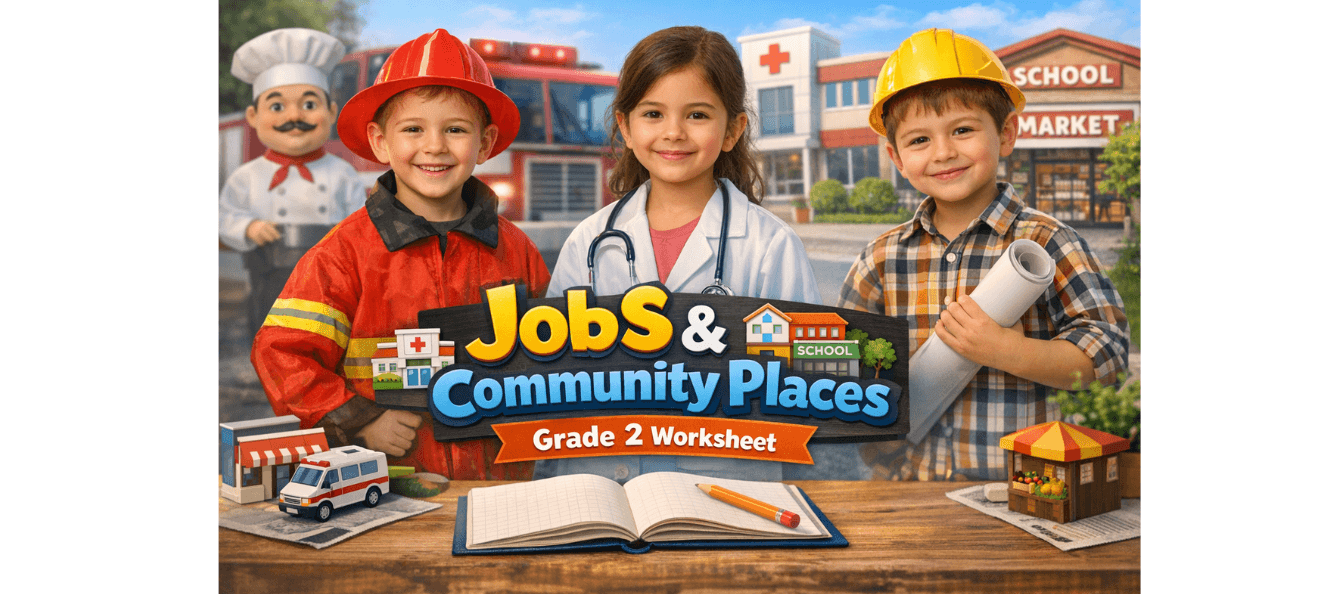
What Is the Topic?
Jobs are the work people do to earn a living and help others. Community places are locations where people go for services, learning, shopping, or recreation. In this Grade 2 English grammar worksheet, students learn to identify occupations and match them with the correct community places. The goal is to build vocabulary and appreciation for the roles people play in everyday life.
What’s in This Worksheet?
1. Identifying occupations based on descriptions.
2. Recognizing job words used in sentences.
3. Choosing community places for specific activities.
4. Understanding services provided at different places.
This worksheet supports exam preparation by strengthening vocabulary, comprehension, and practical knowledge of society.
Definitions, Examples, Techniques, and Tips
- Definitions:
- Occupation is the work someone does.
- Community place is a location where people gather or receive services.
- Examples from the worksheet:
- “A person who flies an aeroplane is a pilot.”
- “We borrow books from a library.”
- “Doctors and nurses work in a hospital.”
- Techniques:
- Read the sentence carefully before choosing the word.
- Focus on the role or service described.
- Quick learning tips:
- Practice by matching jobs with tools or places.
- Notice occupations in daily life.
- Think about the services you use in your community.
Why Is It Important to Learn This?
Learning jobs and community places helps students understand society better. It builds respect for different occupations and awareness of services available in the community. Academically, it improves vocabulary and comprehension.
Where Will This Knowledge Help You?
- In exams with vocabulary and comprehension questions.
- In writing tasks like essays and stories.
- In class participation when discussing community roles.
How to Use This Worksheet?
1. Attempt each question independently first.
2. Review the answers carefully.
3. Correct mistakes by checking the answer key.
4. Practice regularly to remember job and place words.
The solutions follow the exact worksheet order, so students should compare their answers carefully.
Important Tips and Tricks
1. Do not confuse objects with occupations; focus on the role described.
2. Examiners expect correct identification of jobs and places, so read carefully.
3. To score full marks, practice occupations and community places regularly.
4. For service-based tasks, think about what happens in that place.
Complete Answer Key
Exercise No. 1 (Occupations)
1. A person who flies an aeroplane → pilot
2. A person who teaches students in school → teacher
3. A person who grows crops in the field → farmer
4. A person who cooks food in a restaurant → cook
5. A person who stitches clothes → tailor
6. A person who treats sick people → doctor
7. A person who drives a bus → driver
8. A person who cuts hair → barber
9. A person who paints pictures or houses → painter
10. A person who delivers letters → postman
Exercise No. 2 (Job Words)
1. A person who designs buildings → architect
2. A person who takes care of books in a library → librarian
3. A person who looks after sick animals → vet
4. A person who works in a shop and sells things → shopkeeper
5. A person who takes photos → photographer
6. A person who works on a train → conductor
7. A person who repairs pipes → plumber
8. A person who writes stories or books → writer
9. A person who takes care of plants and gardens → gardener
10. A person who makes shoes → cobbler
Exercise No. 3 (Community Places)
1. We go to see old things and art in a → museum
2. We borrow books from a → library
3. We buy fruits and vegetables from a → market
4. We go to study and learn in a → school
5. We pray in a → temple
6. We go to learn swimming in a → pool
7. We eat food outside at a → restaurant
8. We go to buy medicines from a → pharmacy
9. We play on swings in a → park
10. We watch movies in a → cinema
Exercise No. 4 (Services)
1. Firefighters work at the → fire station
2. Trains stop to pick passengers at the → railway station
3. We keep money safely in a → bank
4. Letters and parcels are sent from the → post office
5. Doctors and nurses work in a → hospital
6. We complain about electricity problems at the → power office
7. We go to get help during floods or emergencies from a → disaster center
8. The dustbin is full. We should → empty it
9. We go for treatment when sick at a → hospital
10. We go to borrow books from the → library
Learning jobs and community places in Grade 2 builds a strong foundation for vocabulary and social awareness. With this English grammar worksheet, students can practice confidently, understand society better, and prepare well for exams. Keep practicing, stay motivated, and remember that every word you learn makes you stronger in understanding the world around you.