
Learn Collective Nouns with Class 2 English Grammar PDF
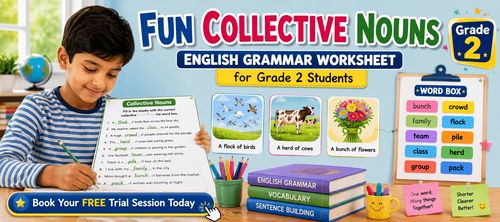

Fun Collective Nouns English Grammar Worksheet for Grade 2 Students
Learning grammar becomes more exciting when students discover special words that describe groups of people, animals, and things together. This English grammar worksheet for Grade 2 on Collective Nouns helps young learners understand how one word can represent an entire group. Through easy examples and fill in the blanks activities, students improve vocabulary, sentence-building, and grammar understanding in a simple and enjoyable way.
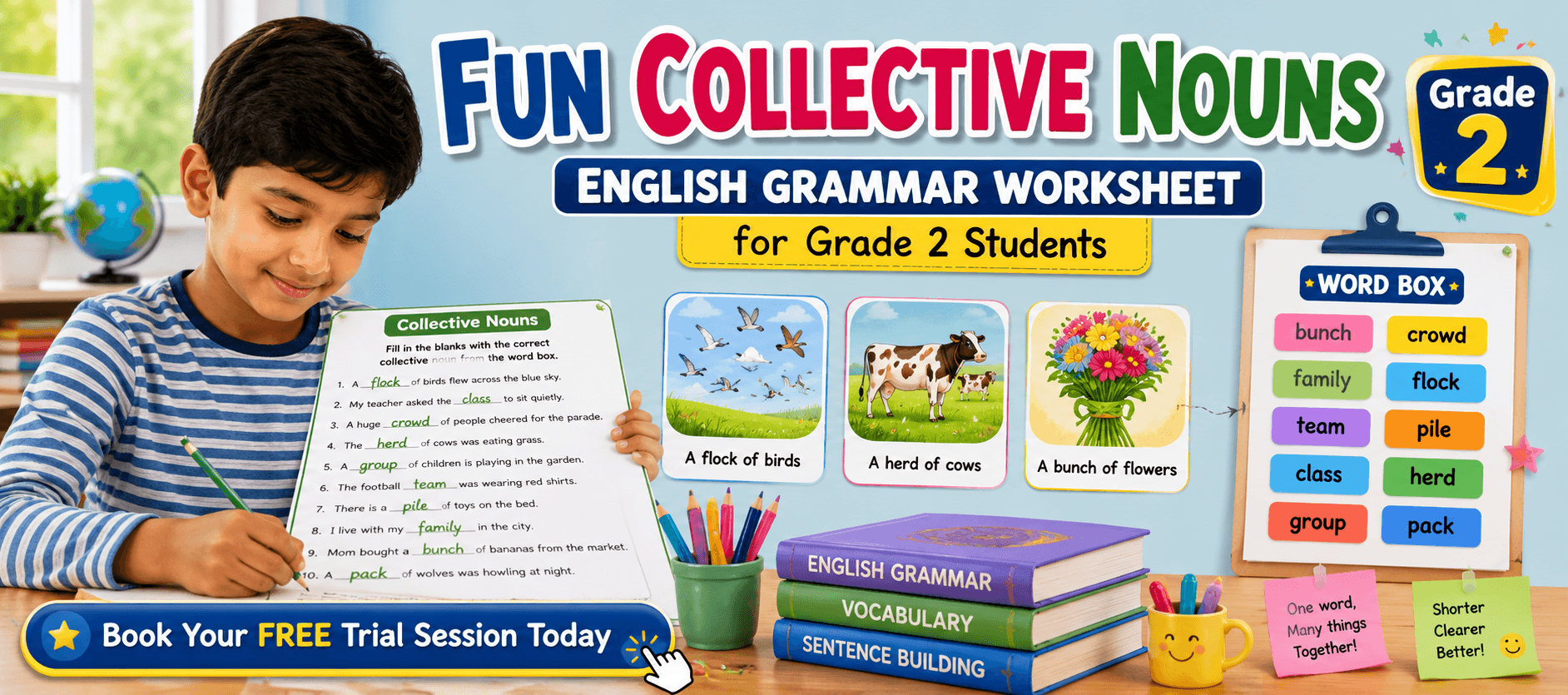
In Grade 2, children begin learning how to use more meaningful and descriptive words in sentences. Collective nouns help students speak and write more clearly by replacing long descriptions with one suitable word. This worksheet introduces collective nouns through real-life examples such as a flock of birds, a herd of cows, and a bunch of flowers. Students also get practice identifying the correct collective noun based on sentence clues.
Download these English grammar worksheets and practice regularly to strengthen your language skills and build a strong foundation. You can also book a free trial to get expert guidance and improve your reading, writing, and comprehension abilities. The worksheets are designed in a simple and structured way to help K–8 students learn grammar concepts easily and use them confidently in everyday communication.
What Is Collective Nouns?
A Collective Noun is a word that means a group of people, animals, or things.
Instead of saying “many cows,” we say “a herd of cows.” This one word tells us about the whole group.
This worksheet teaches students how collective nouns make sentences shorter, clearer, and easier to understand. Students learn to identify group words correctly and use them in everyday sentences.
The worksheet includes examples related to students, birds, cows, flowers, toys, and players. These examples help children connect grammar concepts with familiar daily situations.
What’s in This Worksheet?
1. A simple explanation of collective nouns
2. Easy examples showing how collective nouns are used in sentences
3. Group words related to people, animals, and things
4. A table showing collective nouns and matching sentence examples
5. Fill in the blanks questions based on collective nouns
6. A helpful word box for choosing the correct answers
7. Sentence-based grammar practice suitable for Grade 2 students
8. Vocabulary-building activities connected to everyday objects and groups
9. Grammar exercises that improve reading and sentence understanding
10. Structured practice useful for classroom learning and exam preparation
Definitions, Examples, Techniques, and Tips
A Collective Noun is a word that means a group of people, animals, or things.
Examples from the worksheet:
Many students — class
Our class is learning English.
Many birds — flock
A flock of birds is flying in the sky.
Many cows — herd
A herd of cows is in the field.
Many flowers — bunch
I gave mom a bunch of flowers.
Many toys — pile
I saw a pile of toys in the room.
Many players — team
Our team won the football game.
Students can improve grammar accuracy by reading the sentence carefully and identifying what type of group is being described. Animal groups, people groups, and object groups often use different collective nouns.
The worksheet also helps students build vocabulary by learning special group words used in daily English sentences.
Why Is It Important to Learn This?
Learning collective nouns helps students make sentences more meaningful and descriptive. Instead of using many words to describe groups, students can use one suitable word that clearly explains the group.
Collective nouns improve speaking and writing skills because sentences become shorter and easier to understand. Students also learn new vocabulary words that are commonly used in books, stories, classroom discussions, and conversations.
This grammar topic is important for Grade 2 learners because it strengthens sentence construction and helps students communicate ideas correctly. Understanding collective nouns also improves reading comprehension and vocabulary development.
Where Will This Knowledge Help You?
Collective nouns are useful in schoolwork, reading activities, speaking tasks, and writing exercises.
This knowledge helps students during:
1. English grammar exams
2. Sentence writing practice
3. Reading comprehension exercises
4. Story writing activities
5. Classroom discussions
6. Vocabulary-building tasks
7. Daily communication
8. Identifying group words correctly in sentences
9. Understanding grammar used in books and passages
10. Improving speaking and writing confidence
Students who understand collective nouns can describe groups more accurately in both spoken and written English.
How to Use This Worksheet?
1. Read the explanation of collective nouns carefully before starting the exercise.
2. Study the examples provided in the worksheet to understand different group words.
3. Read the word box before answering the fill in the blanks questions.
4. Attempt all questions independently first.
5. Read every sentence carefully to identify what type of group is being described.
6. Compare your answers carefully with the complete answer key provided below.
7. Correct mistakes and practice collective nouns regularly.
8. Follow the exact worksheet order while checking answers.
9. Revise the examples again to improve memory and understanding.
10. Practice grammar exercises regularly to improve accuracy and confidence.
Important Tips and Tricks
1. Read the sentence carefully before choosing the collective noun.
2. Animal groups and people groups usually have different collective nouns.
3. Use the word box carefully while selecting answers.
4. Learn common collective nouns through regular practice.
5. Do not choose a collective noun that does not match the group mentioned in the sentence.
6. Observe sentence clues carefully to identify the correct answer.
7. Practice writing collective nouns in sentences to improve grammar skills.
8. During exams, avoid guessing without reading the full sentence.
9. Revise worksheet examples regularly for better understanding.
10. Regular grammar practice helps students improve vocabulary and sentence-building skills.
Complete Answer Key
A Collective Noun is a word that means a group of people, animals, or things.
Instead of saying “many cows,” we say “a herd of cows.”
This one word tells us about the whole group.
Many students — class
Our class is learning English.
Many birds — flock
A flock of birds is flying in the sky.
Many cows — herd
A herd of cows is in the field.
Many flowers — bunch
I gave mom a bunch of flowers.
Many toys — pile
I saw a pile of toys in the room.
Many players — team
Our team won the football game.
Fill in the blanks with the correct collective noun from the word box below.
bunch crowd family flock
team pile class herd
group
pack
1. A flock of birds flew across the blue sky.
2. My teacher asked the class to sit quietly.
3. A huge crowd of people cheered for the parade.
4. The herd of cows was eating grass.
5. A group of children is playing in the garden.
6. The football team was wearing red shirts.
7. There is a pile of toys on the bed.
8. I live with my family in the city.
9. Mom bought a bunch of bananas from the market.
10. A pack of wolves was howling at night.
Practicing collective nouns regularly helps Grade 2 students improve vocabulary, grammar understanding, and sentence-writing confidence. This English grammar worksheet on Collective Nouns introduces simple group words through easy examples and enjoyable exercises. By practicing these grammar activities regularly, students can improve reading, writing, and communication skills while learning how to describe groups correctly in sentences.