
Learn Collective Nouns with Examples – Grade 2 Worksheet
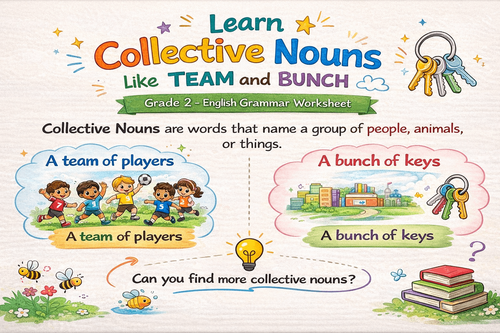

Learn Collective Nouns Like Team and Bunch – Grade 2 English Grammar Worksheet with Answers
Learning grammar becomes exciting when students discover how words can represent groups of people, animals, or things. In Grade 2, children begin learning about collective nouns, which are special naming words that describe groups together. This English grammar worksheet titled “Learn Collective Nouns Like Team and Bunch Grade 2 Worksheet” helps students understand how a single word can represent many items.
Through matching activities, multiple-choice questions, sorting tasks, true or false statements, and a short story exercise, students practice recognizing and using collective nouns in meaningful sentences. These exercises help young learners improve their vocabulary and build stronger grammar skills.
What Is Collective Nouns?
Collective nouns are naming words that refer to a group of people, animals, or things. Instead of mentioning many individual items separately, we use one word to describe the whole group.
For example:
A swarm of bees
A herd of cows
A pride of lions
A fleet of ships
A team of players
In this Grade 2 English grammar worksheet, students learn collective nouns through simple examples and practice questions. These naming words help make sentences clearer and more interesting.
For instance, instead of saying many bees together, we say a swarm of bees. Instead of saying many cows together, we say a herd of cows.
Students learn that collective nouns are useful because they help describe groups easily and clearly.
What’s in This Worksheet?
This English grammar worksheet contains several engaging exercises designed to help Grade 2 students understand collective nouns step by step.
1. Matching activity
Students match nouns such as bees, cows, lions, ships, stars, players, keys, soldiers, fish, and books with the correct collective nouns.
2. Multiple-choice questions
Students read sentences and choose the correct collective noun from the options provided.
3. Sorting activity
Students sort different noun pairs into correct and incorrect collective noun combinations.
4. True or False statements
Students read sentences and decide whether the collective noun used is correct.
5. Story completion activity
Students read a short story and fill in blanks with appropriate collective nouns.
These exercises help learners identify collective nouns and understand how they are used in sentences.
Definitions, Examples, Techniques, and Tips
Definition
A collective noun is a word used to describe a group of people, animals, or things together.
Examples from the worksheet include:
Swarm of bees
Herd of cows
Pride of lions
Fleet of ships
Team of players
Galaxy of stars
School of fish
Bunch of keys
Army of soldiers
Library of books
Examples in sentences
Ravi saw a swarm of bees near the tree.
The farmer looked after a herd of cows.
The zoo keeper showed a pride of lions.
Children played football in a team of players.
The city was guarded by an army of soldiers.
Techniques to identify collective nouns
1. Look for a word that describes a group.
2. Notice if the word refers to many items together.
3. Identify patterns like “group word + of + noun”.
Quick learning tips
1. Many animals have special collective nouns.
2. Objects and people also have group names.
3. Reading sentences carefully helps identify the correct collective noun.
Why Is It Important to Learn This?
Learning collective nouns helps students understand how English groups words together. Instead of listing many items separately, students can use one word to describe the whole group.
For Grade 2 learners, this improves:
Vocabulary development
Sentence formation
Reading comprehension
Writing clarity
Collective nouns also help students describe scenes in stories more effectively.
Where Will This Knowledge Help You?
Understanding collective nouns helps students in several areas of learning.
Exams
Collective noun questions often appear in English grammar worksheets and tests.
Writing
Students can describe groups clearly in stories and paragraphs.
Reading
Understanding group words helps students understand sentences more easily.
Speaking
Students can describe groups of animals, objects, or people correctly.
How to Use This Worksheet?
Students should follow these steps to practice effectively.
1. Read every question carefully.
2. Try answering the questions independently first.
3. Think about the group mentioned in each sentence.
4. Compare your answers with the answer key below.
5. Review mistakes and learn the correct collective nouns.
The answers below follow the exact order of the worksheet questions, so students should compare them carefully.
Important Tips and Tricks
1. Read the full sentence before selecting the answer.
2. Identify the noun that follows the word “of”.
3. Remember common collective nouns such as swarm, herd, pride, fleet, team, galaxy, school, bunch, library, and army.
4. In true or false questions, check whether the group word matches the noun.
5. In matching exercises, make sure each noun connects with the correct collective noun.
Complete Answer Key
Exercise No. 1
Match the nouns to collective nouns.
Bees — Swarm
Lions — Pride
Cows — Herd
Ships — Fleet
Players — Team
Stars — Galaxy
Keys — Bunch
Fish — School
Soldiers — Army
Books — Library
Exercise No. 2
Choose the right collective noun for the sentence.
1. Ravi saw a swarm of bees near the tree.
Answer: Swarm
2. We read stories from a library of books.
Answer: Library
3. The farmer looked after a herd of cows.
Answer: Herd
4. The sky was shining with a galaxy of stars.
Answer: Galaxy
5. The zoo keeper showed a pride of lions.
Answer: Pride
6. Children played football in a team of players.
Answer: Team
7. The sailor guided a fleet of ships.
Answer: Fleet
8. Neha opened her bunch of keys.
Answer: Bunch
9. We watched fish swimming in a school of fish.
Answer: School
10. The city was guarded by an army of soldiers.
Answer: Army
Exercise No. 3
Sort the pairs into correct and incorrect collective nouns.
Correct
Swarm of bees
Herd of cows
Fleet of ships
Team of players
Library of books
Bunch of keys
Incorrect
Pride of books
School of pencils
Galaxy of toys
Army of cats
Exercise No. 4
Write True or False.
1. The forest ranger spotted a flock of bees near the tree. — False
2. The city was guarded by an army of soldiers. — True
3. The farmer had a herd of cows in the field. — True
4. The teacher showed us a bouquet of flowers. — True
5. The fishermen caught a school of fish. — True
6. The hunter saw a pride of lions in the forest. — True
7. The park was full of a fleet of people. — False
8. The children played with a buncle of cards. — False
9. The jungle was home to a group of monkeys. — True
10. The sailor guided the fleet of ships to the shore. — True
Exercise No. 5
Fill in the blanks with collective nouns in the story.
One sunny day, Aarav went to the park with his friend. They saw a swarm of bees buzzing near the flowers. Aarav was scared but his friend laughed. Then they walked further and found a herd of cows grazing in the field. The boys counted them and felt happy. Near the river, they saw a big fleet of ships sailing slowly. Aarav pointed and said, “Look at the ships moving together!” In the playground, children were playing football and a team of players worked as a group. Later, they went to the library where a whole library of books was neatly kept. Aarav borrowed one storybook. On the way home, they looked up and saw a shining galaxy of stars. At the gate, Aarav dropped his bunch of keys, but he quickly picked them up. His friend saluted like an army of soldiers and they laughed. They loved the day full of fun, nature, and new words.
Learning collective nouns becomes easier with practice and real examples. This Grade 2 English grammar worksheet on collective nouns helps students recognize group words such as swarm, herd, team, fleet, and bunch. By completing these exercises, students strengthen their grammar skills and gain confidence in using collective nouns correctly in everyday sentences.