
Learn Gandhi’s Role in Independence | Grade 7 PDF
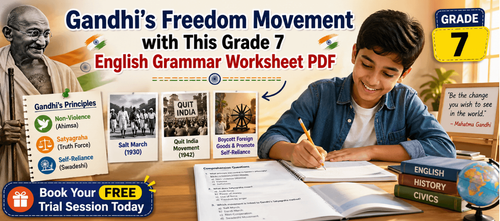

Gandhi’s Freedom Movement with This Grade 7 English Grammar Worksheet PDF
Learning about great leaders and important historical movements helps students improve both their reading and comprehension skills. This Grade 7 English grammar worksheet based on Gandhi’s role in India’s independence movement introduces students to powerful ideas like non-violence, Satyagraha, self-reliance, and peaceful protest. The passage and exercises help students understand the importance of truth, courage, and unity while also strengthening their comprehension abilities.
This worksheet includes objective and subjective questions that encourage students to read carefully, identify correct answers, and connect ideas from the passage. Students can improve vocabulary, understanding, and written responses through regular practice. The activities are simple, engaging, and suitable for Grade 7 learners who want to build confidence in English comprehension and answer-writing skills.
Download these English grammar worksheets and practice regularly to strengthen your language skills and build a strong foundation. You can also book a free trial to get expert guidance and improve your reading, writing, and comprehension abilities. The worksheets are designed in a simple and structured way to help K–8 students learn grammar concepts easily and use them confidently in everyday communication.
What Is the Topic?
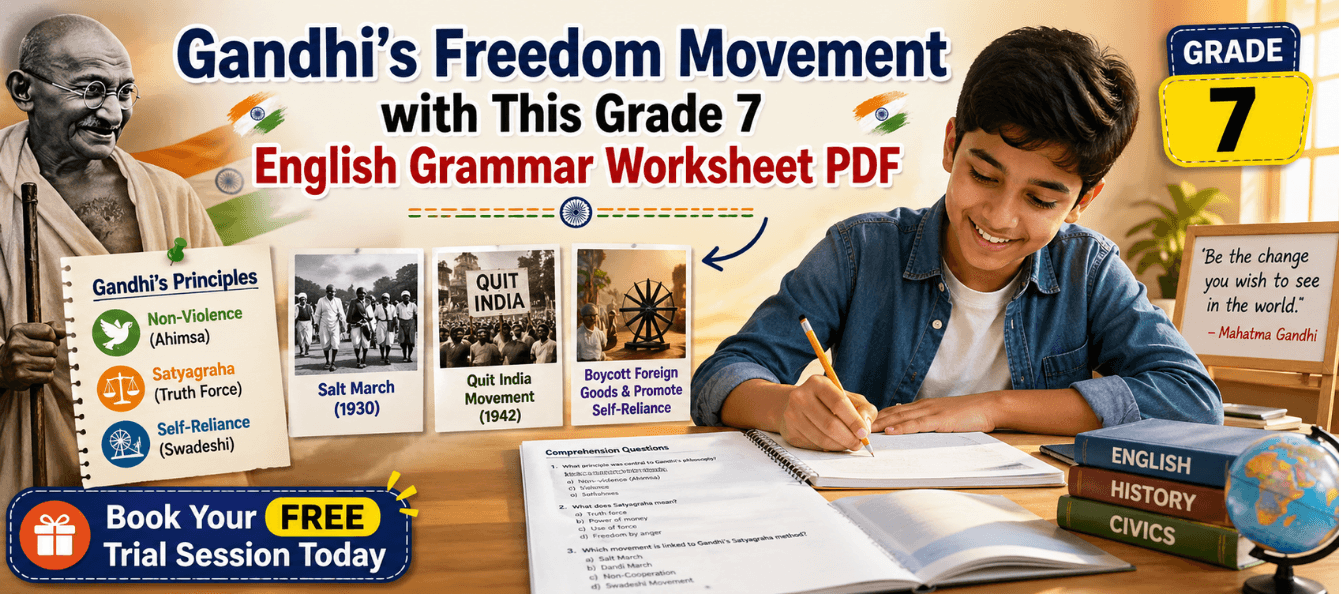
This Grade 7 English grammar worksheet focuses on reading comprehension through the topic “Role of Gandhi in Independence.” Students read a short informational passage about Mahatma Gandhi’s philosophy and contribution to India’s freedom movement.
The worksheet explains how Gandhi believed in non-violence and Satyagraha, or “truth force.” It also describes how peaceful protests such as the Salt March and the Quit India Movement helped Indians fight against British rule.
Students are expected to:
• Read and understand the passage carefully
• Identify important facts
• Choose correct options from multiple-choice questions
• Answer comprehension questions
• Make connections with the text
• Improve vocabulary and understanding
The worksheet helps students learn how to locate answers directly from a passage and write responses in a clear and accurate manner.
What’s in This Worksheet?
1. A reading passage about Gandhi’s role in India’s independence movement.
2. Multiple-choice questions based on the passage.
3. Short-answer comprehension questions.
4. Text-based analytical questions that require deeper understanding.
5. Vocabulary practice through synonym identification.
6. Questions related to Gandhi’s principles of non-violence and self-reliance.
7. Exercises that improve reading, interpretation, and answer-writing skills.
8. Practice questions arranged in a simple and structured format for Grade 7 students.
9. Activities that support school exam preparation and classroom learning.
Definitions, Examples, Techniques, and Tips
Definitions
• Satyagraha:
“Truth force,” referring to the power of truth and non-violent action.
• Non-violence:
A peaceful method of protest without using force or violence.
• Self-reliance:
Producing one’s own goods and reducing dependence on British products.
Examples
• Gandhi led movements like the Salt March and Quit India Movement through Satyagraha.
• He urged Indians to boycott British products and produce their own goods.
• Gandhi’s ideas inspired leaders like Martin Luther King Jr. and Nelson Mandela.
Techniques
• Read the passage slowly and underline important ideas.
• Identify keywords in the questions before answering.
• Match the question with the correct line from the passage.
• Re-read difficult sections carefully to improve understanding.
Quick Learning Tips
• Focus on important terms like Satyagraha, non-violence, and self-reliance.
• Practice answering in complete sentences.
• Read comprehension passages daily to improve speed and accuracy.
• Learn meanings of important words from the passage.
Why Is It Important to Learn This?
Learning about Gandhi’s role in independence helps students understand the importance of peace, truth, and unity. His philosophy teaches students how positive actions can bring change without violence.
This topic also improves reading comprehension skills. Students learn how to:
• Understand informational passages
• Identify important details
• Answer objective and subjective questions
• Build vocabulary
• Write accurate responses
The worksheet also helps students improve concentration, interpretation, and analytical thinking. These skills are useful in English exams and classroom activities.
Where Will This Knowledge Help You?
This knowledge will help students in many academic and practical situations.
• School Exams:
Students can answer comprehension questions more accurately.
• Reading Skills:
Students become better readers by understanding passages carefully.
• Writing Tasks:
Students learn how to frame proper answers in complete sentences.
• Vocabulary Building:
Students improve their understanding of important words and meanings.
• Class Participation:
Students can confidently discuss Gandhi’s role and ideas during classroom discussions.
• General Knowledge:
Students learn important facts about India’s independence movement.
How to Use This Worksheet?
1. Read the passage carefully before attempting the questions.
2. Underline important words such as Satyagraha, non-violence, Salt March, and self-reliance.
3. Attempt all multiple-choice questions independently.
4. Answer subjective questions using information directly from the passage.
5. Compare your responses carefully with the solutions.
6. Correct mistakes and rewrite incorrect answers neatly.
7. Practice regularly to improve reading comprehension skills.
8. Follow the exact worksheet order while checking answers.
9. Review difficult questions again to improve understanding.
Important Tips and Tricks
1. Read every question carefully before answering.
2. Look for keywords from the question inside the passage.
3. Do not rush while answering comprehension questions.
4. Write answers clearly and neatly in complete sentences.
5. For multiple-choice questions, eliminate incorrect options first.
6. Revise important terms like Satyagraha and self-reliance before exams.
7. Pay attention to meanings of words used in the passage.
8. Re-read the passage if you are confused between options.
9. Examiners expect answers that are directly connected to the passage.
10. Practice similar reading passages regularly for better scores.
Complete Answer Key
Reading Passage:
Role of Gandhi in Independence
Gandhi's leadership in India's independence movement was rooted in non-violence and Satyagraha, or "truth force." He believed genuine freedom could only be achieved through peaceful means and civil disobedience against unjust laws. This philosophy was evident in pivotal protests like the Salt March and the Quit India Movement, which mobilized millions and were critical in liberating India from British rule. Gandhi's dedication to non-violent resistance and truth were more than political strategies; they were core beliefs. He promoted self-reliance by urging Indians to produce their own goods and boycott British products, weakening the colonial economy. His ideals inspired global leaders like Martin Luther King Jr. and Nelson Mandela, showing the enduring power of peaceful resistance.
Exercise No. 1
1. What principle was central to Gandhi’s philosophy?
✔ a) Non-violence (Ahimsa)
2. What does Satyagraha mean?
✔ a) Truth force
3. Which movement is linked to Gandhi's Satyagraha method?
✔ a) Salt March
Exercise No. 2
1. What was the core principle of Gandhi’s philosophy?
Gandhi’s philosophy was rooted in non-violence and Satyagraha.
2. What is the meaning of Satyagraha?
It means “truth force,” referring to the power of truth and non-violent action.
3. Which major movements were led by Gandhi?
Gandhi led movements like the Salt March and Quit India Movement.
Exercise No. 3
1. How did Gandhi's idea of Satyagraha aid India’s independence?
Gandhi’s non-violent approach united millions of Indians to fight for independence peacefully.
2. Why is non-violence seen as a strong weapon in the fight for freedom?
Non-violence was a powerful tool because it united people without using force or violence.
3. How did Gandhi's philosophy of self-reliance influence the independence movement?
He promoted self-reliance, which empowered people to resist British control in everyday life.
4. Find a synonym of “advocated” from the passage.
Supported
This Grade 7 English grammar worksheet on Gandhi’s role in independence is an excellent way to improve reading comprehension, vocabulary, and answer-writing skills. By practicing passages and comprehension exercises regularly, students can become more confident readers and writers. Understanding Gandhi’s principles of truth and non-violence also teaches valuable life lessons while helping students perform better in exams and classroom activities.