
Learn Picture Sequencing for KG – English Practice Worksheet PDF

Learn Picture Sequencing for KG – English Practice Worksheet PDF
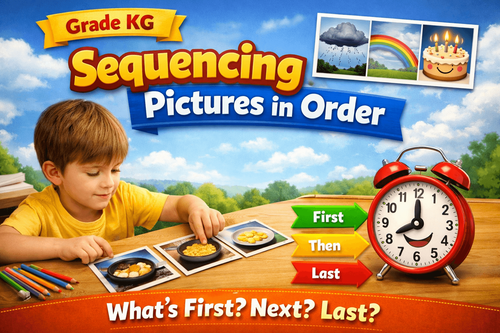
A bright and curious mind enjoys discovering how things happen step by step. Children observe many daily activities such as washing hands, getting ready for bed, celebrating birthdays, or watching rain fall from the clouds. All these activities follow a particular order. This English grammar worksheet for Grade KG on the topic “Sequencing Pictures in Order” helps young learners understand how events occur in a sequence. Through engaging activities, students observe pictures and actions carefully and learn to identify what comes first, what comes next, and what happens last.
What Is the Topic?
Sequencing Pictures in Order means understanding the correct order in which actions or events happen. When students look at pictures or actions in a sequence, they learn to recognize how one step follows another.
In this Grade KG English grammar worksheet, students explore different themes and everyday situations. They identify the first action in a sequence, arrange steps in the correct order, and decide whether a sequence is correct or not.
For example, a child may open a book, read it, and then close it. Similarly, rain clouds appear first, rain falls, and later a rainbow may appear. These events happen in a logical order.
Learning sequencing helps children observe carefully and understand how events are connected. It also improves their ability to explain processes, routines, and stories in the correct order.
What’s in This Worksheet?
This English grammar worksheet for Grade KG includes several engaging activities designed to help students understand sequences.
1. Identifying the first action in a sequence
Students look at different themes and circle what comes first in the sequence.
2. Matching actions in the correct order
Students match the steps involved in activities such as painting a picture and growing a tree.
3. Checking whether a sequence is correct
Students read a sequence of actions or objects and decide whether the order is correct.
4. Identifying correct and incorrect sequences
Students look at sequences and write True or False depending on whether the order is correct.
5. Predicting the next action
Students observe a sequence and write what action comes next.
These activities allow children to practice observation and logical thinking while learning grammar concepts.
Definitions, Examples, Techniques, and Tips
Definition
A sequence is the order in which events or actions happen.
Understanding sequences helps children identify which event comes first, which comes next, and which comes last.
Examples From the Worksheet
Boy opening book → Reading → Closing book
Rain cloud → Rain falling → Rainbow
Baby crawling → Standing → Walking
These examples show actions that follow a logical and natural order.
Techniques Used in the Worksheet
The worksheet uses different techniques to help students understand sequencing.
Looking at themes and identifying the first action.
Matching steps in the correct order.
Checking whether sequences are correct.
Writing the next action in a sequence.
These activities help children build observation and thinking skills.
Quick Learning Tips
Look at each step carefully.
Think about what usually happens first in real life.
Observe how one action leads to another.
Check whether the sequence makes sense logically.
These simple techniques help children understand sequences more easily.
Why Is It Important to Learn This?
Learning sequencing is important for young learners because many daily activities happen step by step. Understanding this order helps children make sense of routines and processes.
Sequencing also helps improve logical thinking. When children recognize patterns and order, they become better at understanding events around them.
This skill also supports language development. Students who understand sequences can describe events and tell stories more clearly.
Sequencing is also useful when children follow instructions or complete tasks in the correct order.
For these reasons, practicing sequencing through an English grammar worksheet for Grade KG helps children strengthen their observation and thinking abilities.
Where Will This Knowledge Help You?
Understanding sequences helps students in many learning situations.
During exams, students may need to identify the correct order of events.
While reading stories, sequencing helps students understand what happens first and what happens later.
During class discussions, students can describe actions in the correct order.
In writing activities, sequencing helps organize ideas clearly.
In daily life, children use sequencing when explaining routines or describing activities.
This makes sequencing an important skill for both learning and communication.
How to Use This Worksheet?
Students can follow a few simple steps to complete this worksheet effectively.
1. Attempt independently first
Students should carefully read the instructions and try to answer the questions on their own.
2. Observe each sequence carefully
Look at the actions or events and think about their natural order.
3. Think about real-life situations
Many sequences are based on everyday experiences.
4. Compare with the answer key
The solutions follow the exact worksheet order, so students should compare their answers carefully.
5. Practice regularly
Repeated practice helps students understand sequencing more confidently.
Important Tips and Tricks
1. Always read instructions carefully
Understanding what the question asks is the first step.
2. Think about real-life actions
Many sequences follow everyday routines.
3. Observe the beginning and ending actions
This helps determine the correct order.
4. Do not rush
Take time to analyze each sequence carefully.
5. Practice similar activities
Regular practice improves sequencing skills.
6. Check your answers
Always review your responses to make sure the order makes sense.
Complete Answer Key
Exercise No. 1
Look at the sequence for different themes and circle what comes first.
1. Sunny Day – The sun rises.
2. Baby – Baby crawling.
3. Washing Hands – Turn on the tap.
4. Traffic – Traffic signal turns green.
5. Glass of water – Fill the glass with water.
Exercise No. 2
Match the correct order of the actions in a sequence for painting a picture.
1 – 5
2 – 3
3 – 1
4 – 2
5 – 4
Match the correct order of the actions in a sequence for growing a tree.
1 – 3
2 – 2
3 – 4
4 – 1
5 – 5
Exercise No. 3
Write “S” if the sequence is correct and “N” if the sequence is not correct.
1. Clock → Kite → Spoon — N
2. Boy opening book → Reading → Closing book — S
3. Dog → Hat → Balloon — N
4. Rain cloud → Rain falling → Rainbow — S
5. Girl washing hands → Eating food → Smiling clean face — S
6. Boy wearing socks → Wearing shoes → Tying laces — S
7. Apple → Mango → Banana — N
8. Chair → Car → Cup — N
9. Bus → Fish → Ball — N
10. Baby crawling → Standing → Walking — S
Exercise No. 4
Look at each sequence carefully. Write True if it is correct and False if it is incorrect.
1. True
2. False
3. False
4. True
5. True
6. True
7. False
8. False
9. False
10. True
Exercise No. 5
Look at the picture and write the action that comes next in the sequence of order.
1. The boy catches the ball.
2. The boy throws the ball.
3. The ball goes into the air.
4. The ball comes down.
5. The boy catches the ball.
Learning sequences is an enjoyable way for young learners to understand how actions and events are connected. This English grammar worksheet for Grade KG on “Sequencing Pictures in Order” encourages children to observe carefully and recognize the order of events. By practicing activities such as identifying the first step, arranging actions correctly, and checking sequences, students develop stronger thinking and observation skills. With continued practice, children become more confident in understanding and describing events in the correct order.