
Learn Possessive Adjectives with Fun Exercises for Class 3
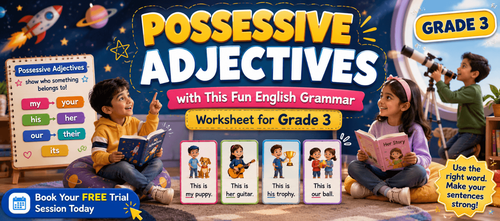

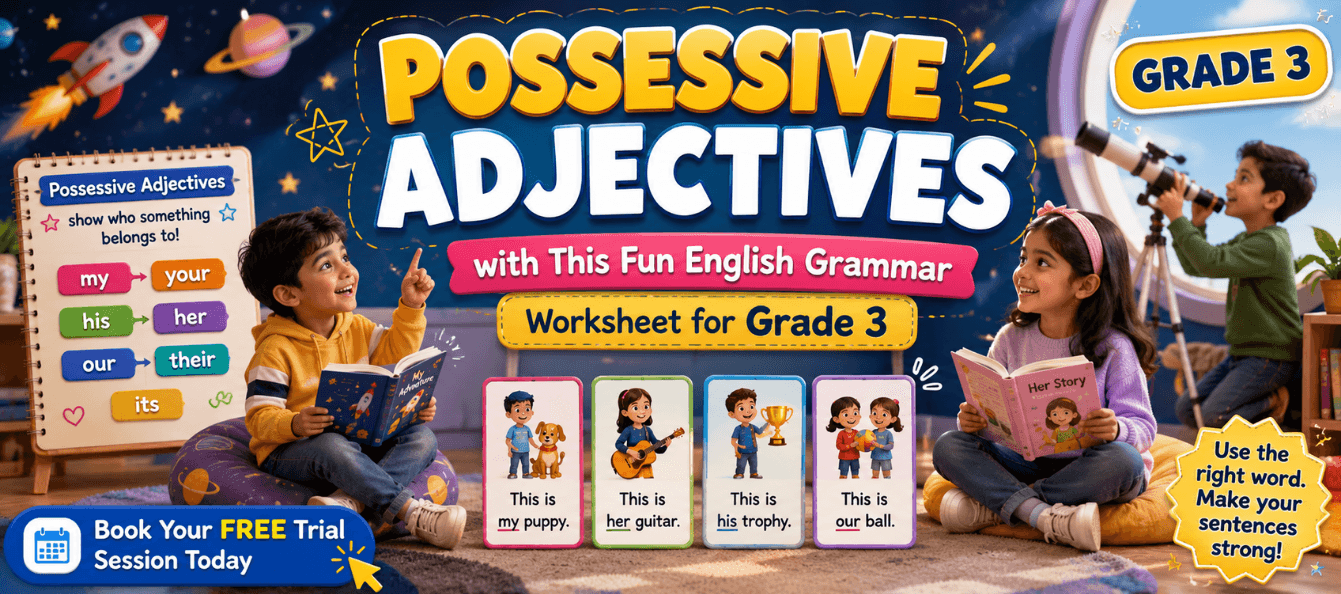
Possessive Adjectives with This Fun English Grammar Worksheet for Grade 3
Possessive adjectives help us show who something belongs to in a sentence. They make our sentences clear, meaningful, and personal. In this Grade 3 English grammar worksheet on possessive adjectives, students get to practice identifying, filling in blanks, rewriting sentences, and describing pictures using ownership words. These activities are simple, interactive, and enjoyable for young learners.
This worksheet is designed to help Grade 3 students understand how possessive adjectives work in everyday communication. Through fun exercises and sentence-building activities, students learn how to correctly use words like my, your, his, her, our, their, and its in sentences. The worksheet also encourages observation and creative thinking through picture-based sentence writing tasks.
Download these English grammar worksheets and practice regularly to strengthen your language skills and build a strong foundation. You can also book a free trial to get expert guidance and improve your reading, writing, and comprehension abilities. The worksheets are designed in a simple and structured way to help K–8 students learn grammar concepts easily and use them confidently in everyday communication.
What Is the Topic?
Possessive adjectives are words that show who something belongs to. They tell us whose thing we are talking about. These words help make sentences more personal and meaningful.
Examples from the worksheet:
My cat is sleeping on the sofa.
Her dress is very pretty.
In this Grade 3 English grammar worksheet, students learn how possessive adjectives are used in sentences. They practice recognizing ownership words, filling in missing possessive adjectives, rewriting sentences, and writing their own sentences using possessive adjectives.
Students are expected to:
1. Identify possessive adjectives in sentences
2. Understand who something belongs to
3. Use possessive adjectives correctly in writing
4. Build complete sentences using ownership words
What’s in This Worksheet?
1. Color the adjectives activity
Students identify and color words that show who something belongs to.
2. Underline the adjectives activity
Students read sentences and underline possessive adjectives.
3. Fill in the blanks
Students complete sentences using suitable possessive adjectives.
4. Rewrite the sentences
Students rewrite sentences by adding possessive adjectives and underlining the added words.
5. Picture description
Students observe a classroom picture and write sentences using possessive adjectives.
6. Grammar practice for exams
The worksheet gives students sentence-based grammar practice that improves accuracy and confidence.
7. Step-by-step learning
The exercises move from simple identification to complete sentence writing.
Definitions, Examples, Techniques, and Tips
Definition:
A possessive adjective is a word that shows who something belongs to.
Examples:
My cat is sleeping on the sofa.
Her dress is very pretty.
Possessive adjectives used in the worksheet:
my
your
his
her
our
their
its
Techniques:
1. Read the sentence carefully to understand who owns the object.
2. Look for clues such as I, she, he, they, we, or you.
3. Match the correct possessive adjective with the subject.
4. Practice rewriting sentences with ownership words.
Quick learning tips:
1. Use my when something belongs to you.
2. Use your when something belongs to another person you are talking to.
3. Use his for a boy or man.
4. Use her for a girl or woman.
5. Use our for a group including yourself.
6. Use their for more than one person.
7. Use its for animals or things.
Why Is It Important to Learn This?
Learning possessive adjectives helps students make better sentences. These words are used in everyday speaking and writing. They help explain ownership clearly and make communication easier.
This grammar topic is important because:
1. It improves sentence formation.
2. It helps students speak more clearly.
3. It makes writing more meaningful.
4. It supports reading comprehension.
5. It helps students answer grammar questions correctly in exams.
When students understand possessive adjectives, they become more confident while writing stories, answering questions, and speaking in class.
Where Will This Knowledge Help You?
Possessive adjectives are useful in many situations.
1. School exams
Students can answer grammar questions correctly and score better marks.
2. Writing tasks
Students can write meaningful and complete sentences.
3. Speaking activities
Students can describe people, objects, and situations clearly.
4. Class participation
Students can confidently answer questions and participate in grammar activities.
5. Everyday communication
Possessive adjectives are commonly used while talking about belongings and relationships.
How to Use This Worksheet?
1. Read the definition first
Understand what possessive adjectives are and how they show ownership.
2. Attempt every exercise carefully
Complete each activity one by one in the correct order.
3. Identify ownership words
Look carefully at who the object belongs to before choosing the possessive adjective.
4. Review the answers carefully
Compare your completed work with the correct answers in the exact worksheet order.
5. Correct mistakes
Rewrite incorrect answers and practice them again.
6. Practice regularly
Repeated practice improves grammar skills and sentence writing.
7. Follow the worksheet order
The solutions below follow the exact order of the worksheet questions.
Important Tips and Tricks
1. Read the sentence completely before choosing the answer.
2. Match the possessive adjective correctly with the subject.
I → my
You → your
He → his
She → her
We → our
They → their
It → its
3. Do not confuse possessive adjectives with names or nouns.
4. Underline only the possessive adjective when asked.
5. In fill in the blanks exercises, choose the ownership word that matches the sentence correctly.
6. In rewriting exercises, add suitable possessive adjectives naturally into the sentence.
7. In picture description tasks, write complete and meaningful sentences.
8. Check spellings carefully to avoid grammar mistakes.
Complete Answer Key
Exercise 1
Color all the words that show who something belongs to.
1. your
2. your
3. his
4. its
5. their
6. her
7. my
8. our
Exercise 2
Underline the words that tell us who something belongs to.
1. Rani forgot __HER__ lunchbox at home.
2. I love playing with __my__ puppy in the garden.
3. Rahul and Neha are doing __their__ homework.
4. The dog wagged __its__ tail happily.
5. Meena borrowed __his__ sharpener.
6. We visited __our__ grandparents last weekend.
7. Please bring __your__ raincoat tomorrow.
8. The baby is sleeping in __her__ crib.
9. They packed __their__ bags for the trip.
10. I wrote __my__ name on the project.
Exercise 3
Fill in the blanks with words that show who something belongs to.
1. I forgot to bring MY notebook to class.
2. She loves __her__ new bicycle.
3. The cat licked __its__ paw.
4. We are going to visit __our__ aunt today.
5. He dropped __his__ toy on the floor.
6. Please wear __your__ hat in the sun.
7. They are reading __their__ storybooks together.
8. Rohan and I shared __our__ lunch.
9. The baby is crying for __her__ mother.
10. You must complete __your__ work on time.
Exercise 4
Rewrite each sentence by adding a word that tells who something belongs to. Underline the word you added.
1. Ravi brought __his__ lunch to school.
2. Mina played with __her__ puppy.
3. The children packed __their__ bags.
4. Grandma told us __her__ story.
5. I found __my__ pencil on the floor.
6. We cleaned __our__ room.
7. The teacher corrected __our__ homework.
8. You must tie __your__ shoelaces.
9. The dog chewed __its__ bone.
10. Rahul carried __his__ umbrella.
Exercise 5
Write 5 sentences that show who something belongs to in the picture. Underline the possessive adjective in each sentence.
1. The boy opened __his__ book.
2. The girl kept __her__ bag near the desk.
3. The teacher raised __her__ hand.
4. The children are sitting at __their__ desks.
5. The student finished __his__ work quietly.
This Grade 3 English grammar worksheet on possessive adjectives is a fun and effective way to improve grammar skills. By practicing these exercises regularly, students can become more confident in sentence writing, classroom participation, and communication. Learning possessive adjectives helps children express ownership clearly and use better grammar in everyday language.