
Learn Prefixes (In, Im, Il, Ir) for Grade 6 English [With Examples]
![Learn Prefixes (In, Im, Il, Ir) for Grade 6 English [With Examples]](https://cdn5.planetspark.in/media/small_11_fd5a4a22c2.png)

Grade 6 English Grammar Worksheet: Prefixes (In-, Im-, Il-, Ir-) [With Examples]
Prefix knowledge is key to understanding how words are formed in English. For Grade 6 students, prefixes like "in-", "im-", "il-", and "ir-" are important for building vocabulary and understanding word meanings. This worksheet focuses on these prefixes and their usage in forming new words.
Download these English grammar worksheets and practice regularly to strengthen your language skills and build a strong foundation. You can also book a free trial to get expert guidance and improve your reading, writing, and comprehension abilities. The worksheets are designed in a simple and structured way to help K–8 students learn grammar concepts easily and use them confidently in everyday communication.
What is the topic?
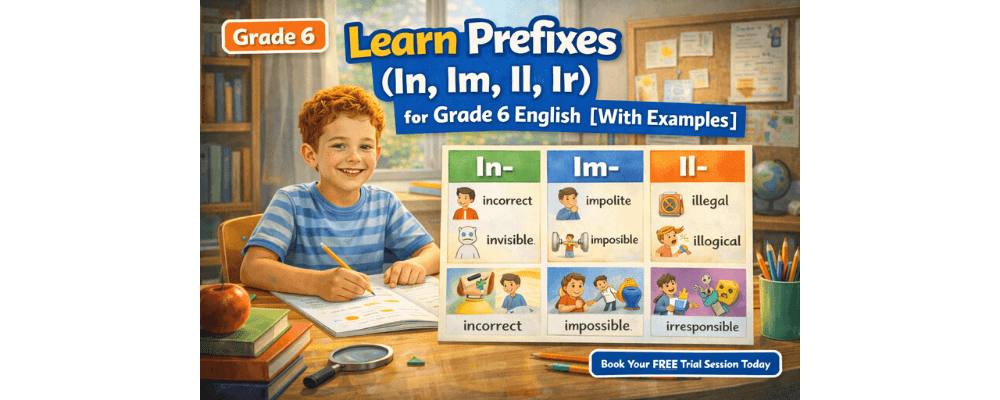
This worksheet focuses on the prefixes "in-", "im-", "il-", and "ir-". These prefixes can change the meaning of words, and this worksheet will help students understand how these prefixes are used to form negative or oppositional words.
What's in this worksheet?
1. Exercises on understanding and applying the prefixes "in-", "im-", "il-", and "ir-".
2. Identifying words that use these prefixes in different contexts.
3. Practical examples to help students understand their usage in forming opposites.
4. Designed to support vocabulary building and grammar exam preparation.
Definitions, Examples, Techniques, and Tips:
• Definitions:
- "In-" means not or into (e.g., "incomplete" means not complete).
- "Im-" means not or opposite of (e.g., "impossible" means not possible).
- "Il-" means not (e.g., "illegal" means against the law).
- "Ir-" means not (e.g., "irregular" means not regular).
• Examples:
- In-: "Inaccurate," "Incompetent"
- Im-: "Impolite," "Impossible"
- Il-: "Illegal," "Illogical"
- Ir-: "Irresponsible," "Irregular"
• Tips:
- Pay attention to how these prefixes change the meaning of the base word.
- Practice using each prefix in sentences to get a better understanding of their meanings.
Why is it important to learn this?
Mastering prefixes is crucial for expanding vocabulary and understanding the structure of words. It also improves spelling, writing, and reading comprehension skills. Understanding how prefixes change word meanings allows students to interpret unfamiliar words more easily.
Where will this knowledge help you?
• Exams: Prefix usage is often tested in language and spelling sections of exams.
• Writing tasks: Using prefixes effectively can enhance sentence structure and clarity.
• Class participation: Knowing how to use prefixes helps students speak clearly and accurately in class discussions.
How to use this worksheet?
1. Read each sentence and identify the word with the prefix.
2. Understand how the prefix changes the meaning of the base word.
3. Review your answers to ensure you’ve used the correct word.
4. Regular practice will help you get more comfortable with prefixes.
Important Tips and Tricks:
1. Pay attention to the prefix’s meaning, as it changes the base word’s definition.
2. Practice with both positive and negative prefixes to expand your vocabulary.
3. Don’t rush—take your time to fully understand each word before moving on.
4. Keep practicing—prefixes are foundational for improving language skills.
Complete Answer Key:
Exercise 1 – Match Prefixes to Base Words
1. in- → correct (incorrect)
2. im- → patient (impatient)
3. il- → legal (illegal)
4. ir- → regular (irregular)
5. in- → active (inactive)
6. im- → possible (impossible)
7. il- → logical (illogical)
8. ir- → responsible (irresponsible)
9. im- → mature (immature)
10. il- → legible (illegible)
Exercise 2 – Sort the Word
Prefix In- and Im-: active, pure, direct, possible, soluble, complete, perfect, port
Prefix Il- and Ir-: legal, regular, logical, legible, literate, resolute, responsible
Exercise 3 – Fill in the Blanks
1. illegible
2. impatient
3. illogical
4. illegal
5. incorrect
6. illogical
7. impolite
8. immature
9. incomprehensible
10. incomplete
Exercise 4 – Multiple Choice Questions
1. d) inactive
2. a) indirect
3. d) impure
4. c) Illegible
5. a) irrelevant
6. d) irregular
7. a) incomplete
8. b) imperfect
9. a) illegal
10. c) Inaccessible
Exercise 5 – Rewritten Sentences
1. Anjali found the math sum impossible to complete today.
2. Rahul's reason for being late was totally illogical to the class.
3. Diya was told her answer in the test was incomplete and neat.
4. Pooja grew impatient after waiting for an hour at the bus stop.
5. Arjun's behaviour in the assembly was impolite and disruptive.
6. Kartik made an irresponsible decision to bunk the class today.
7. Neha said her younger brother was acting very immature at home.
8. Aarav's handwriting on the board was illegible and unreadable.
9. Rohan thought the new rule about no phones was irrelevant.
10. The student's argument in the debate was quite illogical today.
Prefixes like "in-", "im-", "il-", and "ir-" are powerful tools for building your vocabulary. By mastering them, you'll be able to understand and use a wide range of words. Keep practicing with these worksheets, and soon you'll find yourself using these prefixes with ease and confidence.