
Logical Flow Editing Worksheet for Grade 7 – English Practice
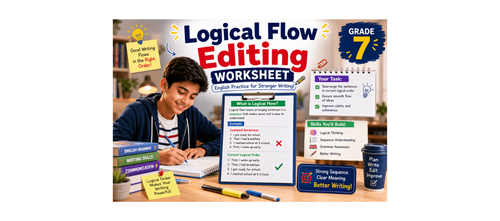

English grammar worksheet for Grade 7: Editing for Logical Relationships
Editing for logical relationships is an essential skill that helps students understand the connections between ideas, enabling clearer and more coherent communication. Grade 7 students can greatly benefit from practicing these concepts to improve their sentence structure, writing clarity, and logical flow. This worksheet focuses on various ways to use connectors, conjunctions, and punctuation marks, which are key to editing sentences logically. Students will learn how to choose the correct connectors, underline nouns and circle verbs, and create meaningful sentences with logical flow.
Download these English grammar worksheets and practice regularly to strengthen your language skills and build a strong foundation. You can also book a free trial to get expert guidance and improve your reading, writing, and comprehension abilities. The worksheets are designed in a simple and structured way to help K–8 students learn grammar concepts easily and use them confidently in everyday communication.
## What is the topic?
In this worksheet, students will explore the topic of "Editing for Logical Relationships." This grammar concept focuses on the correct use of connectors and conjunctions to link ideas logically within sentences. By learning how to use words like "because," "although," "however," and "so," students will be able to improve the flow and meaning of their writing. The main goal of this exercise is to help students understand how connectors work to create smooth transitions between sentences and ideas.
## What’s in this worksheet?
The worksheet contains a variety of exercises designed to test students' understanding of logical relationships in sentences. The key elements include:
1. **Multiple Choice Questions:** These questions require students to choose the correct word that shows a logical relationship between ideas.
2. **Fill in the Blanks:** Students will practice filling in blanks with the correct connectors to complete the sentences meaningfully.
3. **True and False:** Students will read statements about connectors and decide whether they are true or false.
4. **Underline the Words:** This task involves identifying and marking nouns and verbs within sentences.
5. **Sentence Writing:** In this section, students are tasked with writing their own sentences using various connectors.
This worksheet is an excellent tool for reinforcing students' understanding of how to connect ideas logically in both written and spoken language. It also supports exam preparation by testing practical grammar skills that students will likely encounter in assessments.
## Definitions, examples, techniques, and tips
### Definitions:
- **Connectors:** Words like "because," "although," "so," and "however" are used to show relationships between ideas.
- **Conjunctions:** These are words that join sentences or clauses, helping to make writing more cohesive.
### Examples:
- **Because:** Indicates reason or cause.
Example: "Riya studied hard because she wanted to pass the test."
- **Although:** Shows contrast between two ideas.
Example: "Meera tried hard although she did not succeed."
- **So:** Indicates a result or consequence.
Example: "Ravi studied so he could get good marks."
### Quick learning tips:
- **Understand the function:** Before filling in the blanks, make sure you understand the function of each connector.
- **Practice sentence writing:** Write your own sentences to become comfortable with using connectors in different contexts.
## Why is it important to learn this?
Learning how to edit sentences for logical relationships is essential for improving both writing and speaking skills. This concept ensures that students are able to link their ideas clearly and coherently. By using the right connectors, students will:
- Enhance their ability to communicate ideas effectively.
- Develop a strong foundation in sentence structure, making their writing more fluid and readable.
- Strengthen their academic performance by mastering logical relationships between ideas in both written assignments and verbal communication.
## Where will this knowledge help you?
This grammar concept is directly applicable in various academic areas, including:
- **Exams:** Logical connectors are frequently tested in grammar sections of exams.
- **Writing tasks:** Whether it's an essay, report, or any written assignment, using the correct connectors improves the clarity and coherence of the writing.
- **Class participation:** During discussions and debates, the ability to link ideas logically will make students' arguments more convincing and easier to follow.
## How to use this worksheet?
To get the most out of this worksheet, follow these steps:
1. **Attempt independently first:** Try to complete the exercises on your own without any help.
2. **Review answers carefully:** After finishing, go through the answers to see if you chose the right connectors.
3. **Correct mistakes:** If you made any errors, understand why the correct answer is better.
4. **Practice regularly:** Revisit this worksheet periodically to reinforce the concepts.
Remember, the solutions follow the exact worksheet order, so make sure to compare your answers carefully.
## Important tips and tricks
1. **Common mistakes:**
- Using incorrect connectors can confuse the meaning of a sentence. Be sure to understand the function of each connector before using it.
- Mixing up "although" and "because" can lead to inaccurate logical relationships in the sentence.
2. **What examiners expect:**
- Examiners look for correct usage of connectors that logically connect ideas. Pay attention to the meaning of each sentence and choose connectors accordingly.
3. **How to score full marks:**
- Make sure your answers are precise and your sentences are clear. Practice regularly to build a strong grasp of grammar rules.
4. **How to approach activity-based or writing-based tasks:**
- For writing sentences using connectors, first think about the relationship between the two ideas in the sentence. Then, select the correct connector to show that relationship clearly.
## Complete answer key
**Exercise No. 1:**
1. because
2. although
3. and
4. although
5. so
6. although
7. so
8. although
9. because
10. because
Book a free trial!
**Exercise No. 2:**
1. because
2. however
3. and
4. although
5. because
6. so
7. that
8. however
9. although
10. therefore
Book a free trial!
**Exercise No. 3:**
1. True
2. True
3. True
4. False
5. True
6. False
7. True
8. True
9. False
10. True
Book a free trial!
**Exercise No. 4:**
1. Riya (noun) studies (verb) because she wants good marks.
2. Ravi (noun) works (verb) hard although he is tired.
3. Meera (noun) drinks (verb) tea but Raj (noun) prefers (verb) coffee.
4. The team (noun) played (verb) well although they lost.
5. Raj (noun) helps (verb) others so they thank him.
6. The bus (noun) stopped (verb) because it broke down.
7. The teacher (noun) explains (verb) so students learn.
8. Meera (noun) tries (verb) hard although she fails.
9. Ravi (noun) studies (verb) because he wants success.
10. The game (noun) stopped (verb) because it rained.
Book a free trial!
**Exercise No. 5:**
1. I study because I want to learn.
2. She tried hard however she failed.
3. Although he was tired, he finished his homework.
4. The boy likes reading and writing.
5. He went to the store but forgot his wallet.
6. She was late, so she missed the train.
7. He was busy then went to the meeting.
## Conclusion
By mastering logical relationships in grammar, you can significantly improve your writing and speaking skills. Understanding how to use connectors like "because," "although," and "so" will make your sentences clearer and more connected. This worksheet is designed to help Grade 7 students practice and refine these skills to ensure they perform confidently in exams and real-world writing.
Book a free trial!