
Logical Use of Conjunctions Practice Tasks for Grade 8

Logical Use of Conjunctions Practice Tasks for Grade 8 – Complete Worksheet with Answers
Learning how to connect ideas smoothly can make your sentences stronger and clearer. In this English grammar worksheet for Grade 8, students explore conjunctions through engaging and fun exercises. Whether you're trying to join two ideas or show contrast, conjunctions help your thoughts flow logically and effectively.
What Is the Topic?
Conjunctions are words used to connect clauses or sentences or to coordinate words in the same clause. They help ideas flow logically. This worksheet introduces students to different types of conjunctions such as coordinating, subordinating, correlative conjunctions, and transition words.
Students are expected to learn how to identify, choose, and use the correct conjunctions in different sentence structures. They also practice forming meaningful sentences and paragraphs using conjunctions correctly.
What’s in This Worksheet?
1. Multiple-choice questions where students circle the correct conjunction.
2. Fill in the blanks using specific types of conjunctions.
3. Identification of conjunctions and their types.
4. Sentence construction using given conjunctions.
5. Paragraph writing using multiple conjunctions.
6. Practice of logical sentence flow and grammar accuracy.
7. Exercises arranged in increasing difficulty to support learning and revision.
Definitions, Examples, Techniques, and Tips
Definitions:
Conjunctions are words used to connect clauses or sentences or to coordinate words in the same clause.
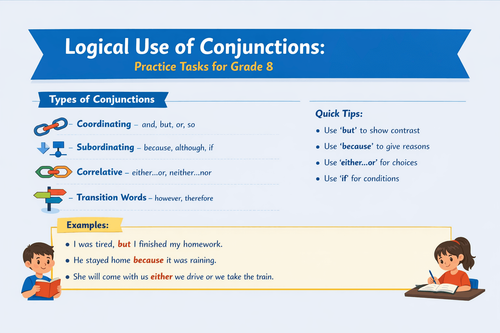
Types of Conjunctions:
Coordinating Conjunctions – connect words, phrases, or clauses that are grammatically equal. Examples: and, but, or, nor, for, so, yet
Subordinating Conjunctions – connect a dependent clause to an independent clause. Examples: because, although, since, unless, while
Correlative Conjunctions – work in pairs to join equal elements. Examples: either...or, neither...nor, not only...but also, both...and
Transition Words – act like conjunctions to show contrast, result, addition, or sequence. Examples: however, therefore, although, nevertheless, furthermore
Examples:
She was tired, but she finished her homework. (Coordinating)
Techniques:
- Identify the relationship between ideas (contrast, cause, choice, result)
- Choose the conjunction that best fits that relationship
- Ensure sentence meaning remains logical
Quick learning tips:
- Use “but” to show contrast
- Use “and” to add ideas
- Use “because” to give reasons
- Use “if” for conditions
- Use paired conjunctions correctly
Why Is It Important to Learn This?
Learning conjunctions helps students form clear and meaningful sentences. It improves writing by connecting ideas smoothly. It also helps in speaking fluently and expressing thoughts logically. Understanding conjunctions is important for exams, grammar accuracy, and effective communication.
Where Will This Knowledge Help You?
This knowledge helps in:
- Writing essays and answers in exams
- Improving sentence structure in school assignments
- Speaking confidently with clear connections between ideas
- Understanding complex sentences in reading
How to Use This Worksheet?
1. Attempt all questions independently first
2. Read each sentence carefully before choosing the answer
3. Review answers and compare with the answer key
4. Correct mistakes and understand why they occurred
5. Practice regularly to improve accuracy
The solutions below follow the exact worksheet order. Students should compare answers carefully.
Important Tips and Tricks
1. Always check the meaning of the sentence before choosing a conjunction
2. Do not confuse similar conjunctions like “although” and “but”
3. Use correlative conjunctions in pairs correctly
4. Ensure sentence flow is logical and complete
5. For writing tasks, include different types of conjunctions
6. Read your sentence aloud to check if it sounds correct
7. Pay attention to punctuation when using conjunctions
Complete Answer Key
Exercise 1:
1. I tried to sleep but the music was too loud.
2. She laughed although she was nervous.
3. We missed the bus so we took a cab.
4. He wanted to leave yet he stayed.
5. I will buy it if it is on sale.
6. Although he was tired, he went to the gym.
7. Either the red shirt or the blue one will look good.
8. She practices daily, so she plays well.
9. The task was hard; nevertheless, he completed it.
10. I will go out if it doesn’t rain.
Exercise 2:
1. He can have tea or coffee.
2. Although he was late, he apologized.
3. She is both rich and generous.
4. I was ill; however, I stayed in bed.
5. Unless you practice daily, you won’t improve.
6. I like pizza, but I don’t like pasta.
7. If it rains, we will cancel the trip.
8. When the teacher entered, everyone stood up.
9. I wanted to help; however, I didn’t know how.
10. We could watch a movie or go for a walk.
Exercise 3:
2. She stayed at home __because__ it was raining. — Subordinating
3. He is __neither__ tall __nor__ short. — Correlative
4. I was hungry, __so__ I made a sandwich. — Coordinating
5. You must study __if__ you want to pass. — Subordinating
6. __Although__ it was late, we kept walking. — Subordinating
7. We can go to the zoo __or__ the park. — Coordinating
8. She is __not only__ smart __but also__ kind. — Correlative
9. __Since__ he left early, he missed the speech. — Subordinating
10. The dress was pretty; __however__, it was pricey. — Transition
Exercise 4:
2. I like apples and bananas.
3. Although it was raining, we went outside.
4. Either you come with us or you stay here.
5. Since I was tired, I went to bed early.
6. I wanted to go out, but I had homework.
7. It was raining, so we stayed indoors.
8. She is not only talented but also hardworking.
9. If you study well, you will pass the exam.
10. The plan was good; however, it failed.
Exercise 5:
__Although__ I faced a difficult challenge, I did not give up. I was scared __but__ I stayed strong. __Because__ I believed in myself, I kept trying. I practiced daily __and__ improved slowly. __If__ I made mistakes, I learned from them. I wanted to quit, __yet__ I continued. __Since__ I worked hard, I succeeded. I felt proud __and__ happy. __Therefore__, I understood that challenges make us stronger.
Practicing conjunctions through this Grade 8 English grammar worksheet helps you become more confident in building strong and meaningful sentences. Keep practicing regularly, and you will master the logical use of conjunctions easily.