
Master Advanced Punctuation with This Class 6 Printable Worksheet
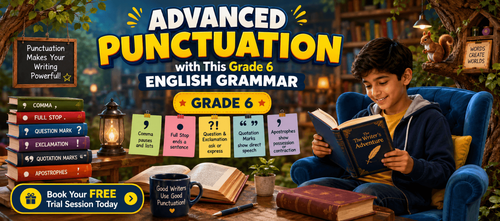

Advanced Punctuation with This Grade 6 English Grammar Worksheet
Punctuation helps readers understand sentences clearly and correctly. Without punctuation marks, writing can become confusing and difficult to read. This Grade 6 English grammar worksheet on advanced punctuation helps students learn how to use commas, full stops, apostrophes, quotation marks, exclamation marks, and question marks properly in sentences. Students also get practice in rewriting sentences, correcting punctuation mistakes, and forming meaningful sentences with correct punctuation marks.
This worksheet is designed in a simple and engaging format so that Grade 6 students can improve their grammar skills step by step. By solving these exercises carefully, students can become more confident while reading, writing, and speaking English. The activities in this worksheet encourage learners to understand sentence structure and improve sentence clarity using the correct punctuation marks.
Download these English grammar worksheets and practice regularly to strengthen your language skills and build a strong foundation. You can also book a free trial to get expert guidance and improve your reading, writing, and comprehension abilities. The worksheets are designed in a simple and structured way to help K–8 students learn grammar concepts easily and use them confidently in everyday communication.
What Is the Topic?
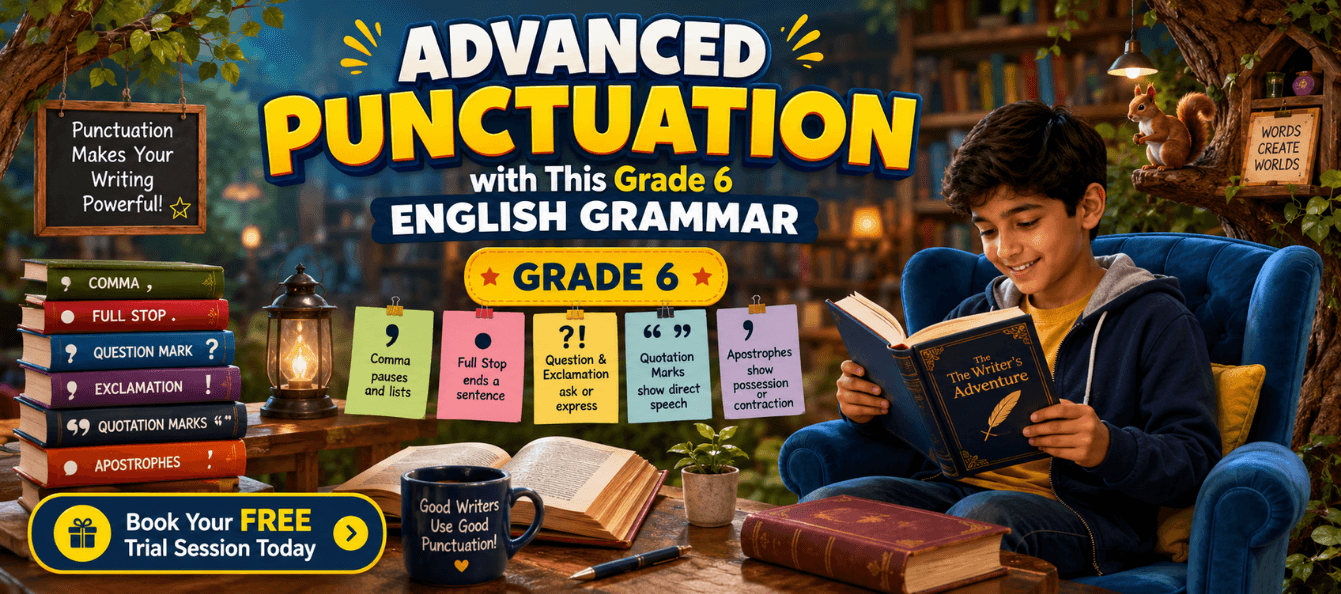
This Grade 6 English grammar worksheet focuses on advanced punctuation. Punctuation marks are symbols used in writing to make sentences clear and meaningful. These marks help readers understand pauses, stops, questions, feelings, and direct speech.
The worksheet explains the following punctuation marks:
Comma (,) – Used to pause or separate words in a list
Example - I bought apples, bananas, and grapes.
Full Stop (.) – Used at the end of a sentence
Example - I like to read books.
Exclamation Mark (!) – Used to show strong feeling
Example - Wow! That’s amazing!
Question Mark (?) – Used at the end of a question
Example - What is your name?
Quotation Marks (“ ”) - Used to show direct speech, quotations, or titles of short works.
Apostrophes (’) - Used to show possession or contractions.
Students are expected to identify punctuation marks, correct punctuation errors, and rewrite sentences correctly using proper punctuation.
What’s in This Worksheet?
1. Students read sentences and underline punctuation marks.
2. Students add the correct punctuation marks to incomplete sentences.
3. Students rewrite sentences using correct punctuation and capitalization.
4. Students practice direct speech punctuation using quotation marks.
5. Students learn the correct use of apostrophes in contractions and possession.
6. Students create sentences using different punctuation marks.
7. The worksheet improves sentence correction and sentence formation skills.
8. The activities help students prepare for grammar-based exams and writing tasks.
Definitions, Examples, Techniques, and Tips
Definitions
Comma (,)
Used to pause or separate words in a list.
Full Stop (.)
Used at the end of a sentence.
Exclamation Mark (!)
Used to show strong feeling.
Question Mark (?)
Used at the end of a question.
Quotation Marks (“ ”)
Used to show direct speech, quotations, or titles of short works.
Apostrophes (’)
Used to show possession or contractions.
Examples
I bought apples, bananas, and grapes.
I like to read books.
Wow! That’s amazing!
What is your name?
Techniques
1. Read the complete sentence before adding punctuation marks.
2. Look carefully for direct speech and quotations.
3. Use apostrophes in contractions like don’t, can’t, and they’re.
4. Add commas where pauses are needed.
5. Use question marks only for questions.
Quick Learning Tips
1. Start every sentence with a capital letter.
2. End complete sentences correctly.
3. Read the sentence aloud to hear pauses.
4. Check quotation marks carefully in speech sentences.
5. Revise contractions and possessive words regularly.
Why Is It Important to Learn This?
Learning punctuation is important because it helps students write clearly and correctly. Proper punctuation improves sentence meaning and helps readers understand writing easily. It also makes communication more effective.
This punctuation worksheet helps Grade 6 students:
1. Improve writing accuracy
2. Understand sentence structure better
3. Learn correct direct speech punctuation
4. Avoid common grammar mistakes
5. Build confidence in English communication
Punctuation skills are useful in exams, classroom writing, creative writing, and daily communication.
Where Will This Knowledge Help You?
Students can use punctuation knowledge in many situations, such as:
1. Writing school assignments and homework
2. Answering grammar questions in exams
3. Improving reading comprehension
4. Writing essays, dialogues, and stories
5. Participating confidently in classroom discussions
6. Understanding direct speech and sentence pauses correctly
How to Use This Worksheet?
1. Read each sentence carefully before answering.
2. Attempt all exercises independently first.
3. Underline or add punctuation marks according to the instructions.
4. Rewrite sentences neatly with proper punctuation and capitalization.
5. Compare your answers carefully with the provided solutions.
6. Follow the exact worksheet order while checking answers.
7. Practice punctuation correction regularly.
8. Revise punctuation rules after completing the worksheet.
Important Tips and Tricks
1. Always begin sentences with capital letters.
2. Use apostrophes correctly in contractions like don’t and they’re.
3. Place quotation marks correctly around spoken words.
4. Use commas carefully to separate phrases and pauses.
5. End questions with question marks.
6. Use exclamation marks only for strong emotions.
7. Avoid missing punctuation at the end of sentences.
8. Read rewritten sentences again to check clarity and correctness.
9. Check both punctuation and capitalization while correcting sentences.
10. Write complete and meaningful sentences in sentence formation exercises.
Complete Answer Key
Exercise 1
Read each sentence and underline the punctuation marks.
1. “It’s time to go,” he whispered.
Underlined punctuation marks: “ ’ , ”
2. That’s Ananya’s new schoolbag.
Underlined punctuation marks: ’ ’ .
3. She said, “I will join you soon.”
Underlined punctuation marks: , “ . ”
4. “My dog’s name is Rocky,” said Ria.
Underlined punctuation marks: “ ’ , ”
5. My father, who is a doctor, works at City Hospital.
Underlined punctuation marks: , ,
6. They’re planning a surprise party.
Underlined punctuation marks: ’ .
7. “Can I come with you?” asked Rohan.
Underlined punctuation marks: “ ? ”
8. My sister’s toy is broken.
Underlined punctuation marks: ’ .
9. Wait, that’s not your seat!
Underlined punctuation marks: , ’ !
10. “We won the match,” shouted the captain.
Underlined punctuation marks: “ , ”
Exercise 2
Add the correct punctuation marks to each sentence.
1. “It’s raining outside,” said Maya.
2. Please don’t forget to bring your notebook.
3. Rahul said, “I can’t come to the party now.”
4. “Who took my sister’s pen?” asked Neha.
5. I think she said, “We’ll meet after school.”
6. Mr. Sharma, our English teacher, is very kind.
7. The dog barked loudly, but it didn’t bite anyone.
8. They’re going to the park, aren’t they?
9. The teacher said, “Clean your desks before you leave.”
10. “Yes,” she replied, “I have finished my homework.”
Exercise 3
Rewrite the sentences with correct punctuation.
1. Maya said, “I will do it later.”
2. They’re not sure if it’s the right bus.
3. “Let’s go now!” shouted Rishi. “Before it’s too late!”
4. Please bring your brother’s jacket; it’s cold outside.
5. “I love reading,” said Ananya, “especially mystery books.”
6. “I know,” said the boy, “that she lives nearby.”
7. He whispered, “Don’t make a sound. Someone is here.”
8. We visited Mrs. Fernandez, our old neighbour, yesterday.
9. “No, I haven’t seen your bag,” replied Riya.
10. “Isn’t this amazing?” she asked with wide eyes.
Exercise 4
Write one sentence using each type of punctuation: Comma, Full Stop, Exclamation Mark, Question Mark, Quotation Marks, Apostrophes.
1. Comma – I packed pencils, erasers, and notebooks for school.
2. Full Stop – My brother plays football every evening.
3. Exclamation Mark – Hurray! We won the competition!
4. Question Mark – Where are you going after school?
5. Quotation Marks – “I will help you,” said Ayaan.
6. Apostrophes – They’re visiting their friend’s house today.
This Grade 6 English grammar worksheet on advanced punctuation is a helpful way to improve sentence-writing and grammar skills. Regular practice helps students understand punctuation rules clearly and use them confidently in writing and speaking. By carefully completing punctuation exercises, students can strengthen their English foundation and become better communicators step by step.