
Master Adverbs of Manner in Grade 3 English Grammar
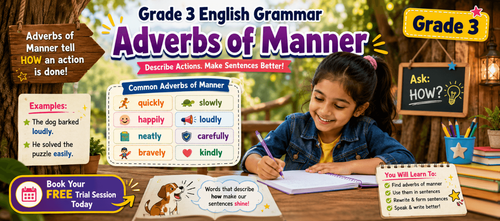

Grade 3 English Grammar Worksheet on Adverbs of Manner
Learning grammar becomes exciting when students understand how words make sentences more meaningful and expressive. This Grade 3 English grammar worksheet on Adverbs of Manner helps children learn how actions are performed in a simple and enjoyable way. Through coloring activities, fill in the blanks, sentence rewriting, and sentence formation tasks, students get plenty of practice using adverbs of manner correctly. These activities are designed to improve grammar understanding while also building confidence in reading, writing, and speaking.
This English grammar worksheet introduces students to common adverbs of manner such as quickly, slowly, happily, loudly, neatly, and carefully. The worksheet uses clear examples and engaging exercises that make learning interactive and easy to follow for Grade 3 students. By practicing regularly, children can improve sentence construction and communicate their ideas more clearly in everyday situations.
Download these English grammar worksheets and practice regularly to strengthen your language skills and build a strong foundation. You can also book a free trial to get expert guidance and improve your reading, writing, and comprehension abilities. The worksheets are designed in a simple and structured way to help K–8 students learn grammar concepts easily and use them confidently in everyday communication.
What Is the Topic?
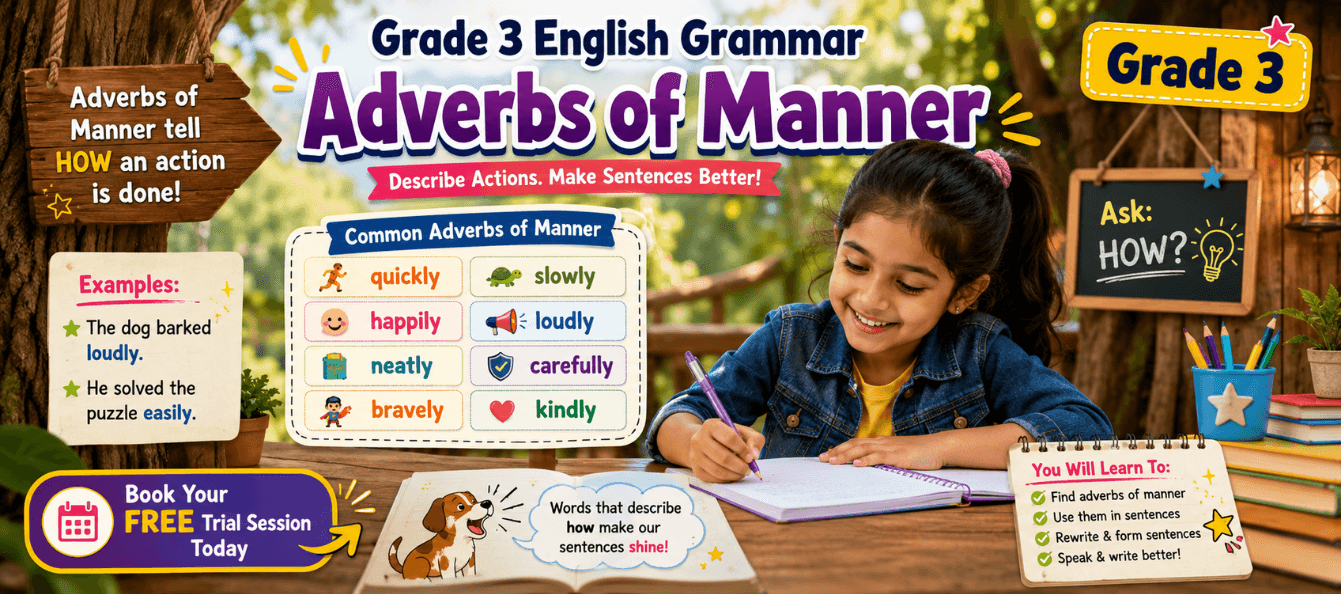
Adverbs of manner describe the way an action is performed. They usually answer the question “How?” and often come after the verb in a sentence.
Some common adverbs of manner included in this Grade 3 English grammar worksheet are:
quickly
slowly
happily
sadly
loudly
neatly
carefully
bravely
The worksheet also provides examples such as:
The dog barked loudly at the strangers.
He solved the puzzle easily.
Students are expected to learn how to identify adverbs of manner, use them correctly in sentences, and understand how they make actions more descriptive.
What’s in This Worksheet?
1. Coloring activity where students identify words that tell how something is done.
2. Underlining activity to recognize adverbs of manner in complete sentences.
3. Fill in the blanks exercises to practice suitable adverbs in sentences.
4. Sentence rewriting tasks where students add words that describe how actions are done.
5. Sentence formation activity using adverbs of manner from a given list.
6. Practice with common Grade 3 English grammar sentence structures.
7. Exercises that improve grammar accuracy, vocabulary, and sentence-building skills.
8. Activities arranged step by step to support better understanding and exam preparation.
Definitions, Examples, Techniques, and Tips
Definition:
Adverbs of manner describe the way an action is performed.
They usually answer the question “How?” and often come after the verb in a sentence.
Examples:
The dog barked loudly at the strangers.
He solved the puzzle easily.
Common Adverbs of Manner:
quickly
slowly
happily
sadly
loudly
neatly
carefully
bravely
Techniques:
1. Read the sentence carefully and identify the action word.
2. Ask the question “How?” to find the adverb of manner.
3. Look for words that describe the action.
4. Practice rewriting sentences by adding suitable adverbs.
Quick Learning Tips:
1. Adverbs of manner often end with “-ly”.
2. These words help make sentences more expressive.
3. Practice reading sentences aloud to understand how the adverb changes the meaning.
4. Use adverbs in daily speaking and writing practice.
Why Is It Important to Learn This?
Learning adverbs of manner is important because they help students explain actions clearly and meaningfully. These words make sentences more detailed and interesting.
This grammar topic helps Grade 3 students:
1. Improve sentence writing.
2. Speak more clearly and confidently.
3. Understand how actions are performed.
4. Build stronger grammar skills.
5. Use better vocabulary in communication.
6. Make storytelling and descriptions more interesting.
Understanding adverbs of manner also supports better performance in grammar exercises, classwork, and English exams.
Where Will This Knowledge Help You?
Students can use adverbs of manner in many real-life and academic situations.
1. During English grammar exams and worksheets.
2. While writing sentences, stories, and paragraphs.
3. During classroom speaking activities.
4. While answering comprehension questions.
5. In daily conversations to explain actions clearly.
6. During creative writing and sentence formation activities.
7. To improve reading and understanding of English sentences.
How to Use This Worksheet?
1. Read the explanation of adverbs of manner carefully before starting the exercises.
2. Attempt each activity independently and identify the words that describe actions.
3. Follow the exercises in the exact worksheet order for better understanding.
4. Compare your answers carefully with the complete answer key.
5. Underline, fill, rewrite, and form sentences exactly as instructed.
6. Correct mistakes and practice difficult sentences again.
7. Revise common adverbs of manner regularly.
8. Practice speaking and writing sentences using these words daily.
Important Tips and Tricks
1. Read every sentence fully before choosing the adverb.
2. Look for words that answer the question “How?”
3. Do not confuse adverbs with naming words or action words.
4. Words ending in “-ly” are often adverbs of manner.
5. Underline only the word that describes the action.
6. In fill in the blanks exercises, choose words that make complete sense in the sentence.
7. Write neat and complete sentences during rewriting activities.
8. Use proper punctuation and capitalization.
9. Practice common adverbs regularly to improve speed and accuracy.
10. During sentence formation tasks, make meaningful and grammatically correct sentences.
Complete Answer Key
Exercise 1
Color the words that tell us how someone does something.
sadly
carefully
rudely
gracefully
neatly
bravely
gently
kindly
loudly
clumsily
quickly
slowly
quietly
angrily
happily
Exercise 2
Underline the word that tells how the action is done in each sentence.
1. He solved the puzzle __EASILY__.
2. She held the puppy __firmly__.
3. Ravi painted the wall __badly__.
4. The baby closed the door __softly__.
5. Meena welcomed the teacher __cheerfully__.
6. The boy asked __politely__ for help.
7. The kitten meowed __loudly__ at night.
8. They danced __happily__ at the party.
9. She replied __sharply__ to the question.
10. He spoke __calmly__ to his friend.
Exercise 3
Fill in the blanks with words that tell how something is done.
1. She wrote her homework NEATLY.
2. The dog barked loudly at the stranger.
3. He jumped quickly into the pool.
4. The children played happily in the room.
5. The teacher spoke kindly to the class.
6. She danced gracefully on the stage.
7. The baby slept quietly during the ride.
8. He drove carefully through the city.
9. My friend shouted loudly from the balcony.
10. They packed their bags neatly.
Exercise 4
Rewrite each sentence by adding a word that tells how something is done. Underline the word you added.
1. He kicked the ball __hard__.
2. She opened the gift __carefully__.
3. The dog barked at the postman __loudly__.
4. They cleaned their desks __neatly__.
5. He sang a song __beautifully__.
6. She drank the soup __quietly__.
7. I painted the wall __carefully__.
8. They answered the questions __politely__.
9. The cat scratched the mat __angrily__.
10. She carried the basket __gently__.
Exercise 5
Write 5 sentences using any 5 words from the list that tell how something is done.
1. The boy ran quickly to school.
2. The baby slept quietly in the room.
3. She spoke kindly to her friend.
4. The old man walked slowly on the road.
5. The children laughed happily during the game.
Practicing this Grade 3 English grammar worksheet on Adverbs of Manner can help students become more confident in grammar and sentence writing. Regular practice with activities such as underlining, filling in the blanks, rewriting sentences, and sentence formation makes learning easier and more enjoyable. By understanding how actions are described, students can improve both their speaking and writing skills. Keep practicing these grammar concepts regularly to build stronger communication skills and greater confidence in English.