
Master Homophones, Homonyms and Homographs in Grade 7


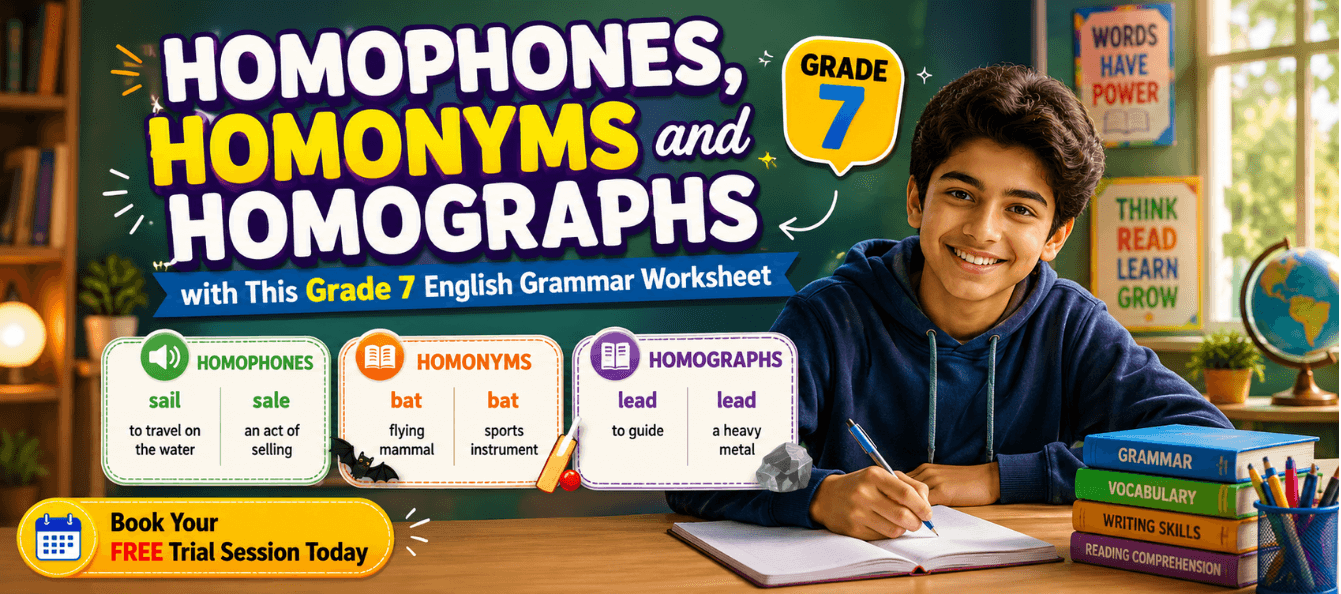
Homophones, Homonyms and Homographs with This Grade 7 English Grammar Worksheet
Words can sometimes sound the same, look the same, or even have different meanings depending on how they are used. Learning to identify these word relationships helps students become stronger readers, writers, and speakers. This Grade 7 English grammar worksheet on Homophones, Homonyms and Homographs provides engaging practice through fill-in-the-blanks questions, multiple-choice exercises, and identification activities. Students get opportunities to examine how words change meaning in different contexts and understand how pronunciation and spelling affect communication. By working through each activity carefully, learners can build confidence in recognizing word usage and applying it correctly in everyday English.
Download these English grammar worksheets and practice regularly to strengthen your language skills and build a strong foundation. You can also book a free trial to get expert guidance and improve your reading, writing, and comprehension abilities. The worksheets are designed in a simple and structured way to help K–8 students learn grammar concepts easily and use them confidently in everyday communication.
What Is the Topic?
This Grade 7 English grammar worksheet focuses on Homophones, Homonyms and Homographs.
Students learn to:
• Understand words that have different meanings depending on context.
• Recognize words that share spelling but differ in meaning.
• Identify words that sound alike.
• Match words with their correct meanings.
• Choose the correct word from similar-sounding options.
• Identify whether word pairs are used as homonyms, homophones, or homographs.
The worksheet helps learners observe how the same word may function differently in different sentences and how context helps determine meaning.
What’s in This Worksheet?
1. Multiple-choice activities that ask students to select the correct meaning of a word based on sentence context.
2. Practice with words such as arm, chair, book, leaves, bank, bat, fever, and spring.
3. Activities focusing on pronunciation-based meaning changes using words such as lead, row, tear, suit, shade, wind, record, and object.
4. Fill-in-the-blank exercises requiring students to choose the correct word from bracketed options.
5. Word-choice practice using homophone pairs such as soles/souls, sail/sale, flower/flour, and others.
6. Identification tasks where students explain meanings and determine whether words are homonyms, homophones, or homographs.
7. Structured exercises that encourage careful reading and accurate interpretation of word meanings.
8. A worksheet format that supports classroom learning, revision practice, and exam preparation.
Definitions, Examples, Techniques, and Tips
Definitions
The worksheet focuses on three categories:
• Homophones
• Homonyms
• Homographs
Examples Included in the Worksheet
• Arm as a body part and arms as weapons.
• Chair as a seat and chair as leading a meeting.
• Bank as the edge of a river and bank as a financial institution.
• Bat as a flying mammal and bat as a sports instrument.
• Lead as guiding and lead as a heavy metal.
• Tear as ripping apart and tear as a drop from the eye.
• Present as a gift and present as being in attendance.
• Close as shutting something and close meaning near.
Techniques
• Read the complete sentence before choosing an answer.
• Use surrounding words to determine meaning.
• Compare both meanings carefully.
• Notice spelling and pronunciation clues provided in the worksheet.
• Examine how the word functions in each sentence.
Quick Learning Tips
• Look for context clues in the sentence.
• Check whether the word is naming something or describing an action.
• Pay attention to pronunciation notes.
• Read each sentence completely before selecting an answer.
• Compare word meanings carefully before deciding.
Why Is It Important to Learn This?
Understanding Homophones, Homonyms and Homographs helps students interpret language more accurately. Many English words can have more than one meaning, and understanding context is necessary for correct comprehension.
This skill helps students:
• Read passages more accurately.
• Understand sentence meanings clearly.
• Improve vocabulary awareness.
• Communicate more effectively.
• Develop stronger grammar knowledge.
Learning these word relationships also prepares students for classroom assessments and everyday communication.
Where Will This Knowledge Help You?
Students can use these skills in many situations:
• Reading comprehension activities where word meanings change according to context.
• Grammar exercises and language practice.
• Classroom discussions and participation.
• Writing assignments that require precise word choice.
• Vocabulary-building activities.
• School examinations and assessments.
• Understanding stories, articles, and informational texts.
How to Use This Worksheet?
1. Attempt each question independently before checking any answers.
2. Read every sentence carefully and identify clues that help determine the meaning of the word.
3. Review the completed answers carefully after finishing the worksheet.
4. Compare your responses with the solutions in the exact worksheet order.
5. Correct any mistakes and note why a different meaning was required.
6. Revisit words that appear in more than one meaning.
7. Practice similar examples regularly to improve recognition skills.
8. Students should compare answers carefully because the solutions follow the exact worksheet order.
Important Tips and Tricks
1. Read the complete sentence before choosing a meaning.
2. Do not select an answer based only on spelling; use the context provided.
3. Pay attention to pronunciation information when it is given.
4. Check whether the word functions as a thing, action, or description within the sentence.
5. Carefully compare both options before making a final choice.
6. In fill-in-the-blank questions, read the entire sentence first.
7. For identification questions, determine the meaning of each word before deciding whether it is a homonym, homophone, or homograph.
8. Examiners expect accurate interpretation of context and correct identification of word usage.
9. Review all answer choices before selecting one.
10. Practice repeatedly with different sentence contexts to improve confidence.
Complete Answer Key
Exercise:1
1.
He hurt his arm — b. body part
The soldiers marched with their arms — a. weapons
2.
The king sat on his chair — b. a seat
She will chair — a. to lead the meeting tomorrow
3.
I must book — a. reserve a ticket for the trip
She is reading a story book — b. collection of pages
4.
The leaves — b. plural of leaf are falling from the trees
He always leaves — a. goes away his bag at home
5.
He sat by the river bank — a. edge of a river
She deposited her money in the bank — b. financial institution
6.
The bat — b. flying mammal flew out of the cave
He hit the ball with a cricket bat — a. sports instrument
7.
The baby has a high fever — b. illness with high temperature
The crowd cheered with great fever — a. intense excitement at the match
8.
The spring — a. source of water water is fresh and cold
We all enjoy the season of spring — b. season of the year
Exercise: 2
1.
The soldier had to lead — a. to guide (rhymes with bead)
The pipes were made of lead — b. a heavy metal (rhymes with red)
2.
The farmer likes to row — b. use oars (rhymes with go)
The students had a loud row — a. a quarrel (rhymes with cow)
3.
Please tear — b. rip apart (rhymes with hair)
A small tear — a. drop from the eye (rhymes with ear)
4.
The knight wore a shiny suit — a. clothing (rhymes with flute) of armor
He will suit — b. be appropriate (rhymes with boot) the job perfectly
5.
We sat in the cool shade — b. shadow (rhymes with made)
She tried to shade — a. add tones (rhymes with trade) her drawing with a pencil
6.
He had to wind — a. to twist (rhymes with find) the rope around the pole
The strong wind — b. moving air (rhymes with pinned) blew open the windows
7.
He tried to record — a. capture sound (stress on 2nd syllable) his speech for the competition
She broke the world record — b. illness with high temperature in swimming
8.
The doctor asked him to object — b. protest (stress on 2nd syllable) to the unfair rules
There was a strange object — a. thing (stress on 1st syllable) in the sky
Exercise: 3
1. soles
2. sword
3. seal
4. sail
5. call
6. sickle
7. seat
8. flower
Exercise:4
1. break
2. accept
3. sun
4. pedal
5. deer
6. plain
7. butter
8. place
Exercise:5
1.
The bat flew out of the cave.
Meaning: flying mammal
He hit the ball with his bat.
Meaning: sports instrument
Type: Homonyms
2.
She will lead the team in the competition.
Meaning: to guide
The pipes were made of lead.
Meaning: a heavy metal
Type: Homographs
3.
I will write a letter to my cousin.
Meaning: write a letter
Did you see that on the right side of the road?
Meaning: right side
Type: Homophones
4.
The singer gave a beautiful present to the audience.
Meaning: a gift
Are all the students present today?
Meaning: being in attendance
Type: Homographs
5.
The farmer dug a deep well for water.
Meaning: a source of water
I hope you are doing well in school.
Meaning: in a good manner
Type: Homonyms
6.
Please close the door when you leave.
Meaning: to shut
The house is very close to the school.
Meaning: near
Type: Homographs
7.
The soldiers will desert their camp.
Meaning: to abandon
I love eating ice cream for dessert.
Meaning: a sweet dish after a meal
Type: Homophones
Practicing this Grade 7 English grammar worksheet on Homophones, Homonyms and Homographs can help students become more confident in recognizing word meanings and understanding context. By completing each activity carefully and reviewing the answer key, learners can strengthen vocabulary skills and improve their overall command of English. Regular practice will make identifying homophones, homonyms, and homographs easier and help students perform better in classwork and assessments.