
Master Parallelism in Grammar: Grade 7 Worksheet for Students

English Grammar Worksheet Grade 7: Parallelism in Complex Sentences
Understanding parallelism in complex sentences is crucial for students to ensure their writing flows smoothly and logically. In this Grade 7 worksheet, students will learn how to structure sentences with parallel elements to enhance readability and coherence. By focusing on parallelism, students can create more effective and well-organized sentences, making their writing both clear and professional.
Download these English grammar worksheets and practice regularly to strengthen your language skills and build a strong foundation. You can also book a free trial to get expert guidance and improve your reading, writing, and comprehension abilities. The worksheets are designed in a simple and structured way to help K–8 students learn grammar concepts easily and use them confidently in everyday communication. Book a free trial!
## What is the topic?
Parallelism in complex sentences refers to using the same grammatical structure in parts of a sentence that are similar or connected. Whether it’s a list of verbs, adjectives, or nouns, ensuring that the elements in a sentence match in structure makes the sentence easier to read and understand. Without parallelism, a sentence can feel awkward or disjointed.
Students will learn:
- How to identify and correct parallel structure errors in sentences.
- How to write sentences with consistent grammatical structures.
- Why parallelism is important for clarity and readability in writing.
## What’s in this worksheet?
This worksheet is designed to help students practice the use of parallelism in complex sentences. It includes various exercises to reinforce this concept:
1. **Underline the words** – Identifying the noun and verb in sentences to understand parallelism.
2. **Multiple choice questions** – Selecting sentences with correct parallel structure.
3. **Sentence rewriting** – Rewriting sentences to ensure parallel elements are used correctly.
4. **Fill in the blanks** – Completing sentences with parallel structures.
5. **Paragraph writing** – Writing a short paragraph while applying the principles of parallelism.
By the end of this worksheet, students will be more confident in their ability to construct clear and well-organized complex sentences.
## Definitions, examples, techniques, and tips
- **Parallelism Definition**: Parallelism is the use of consistent grammatical structures in parts of a sentence that share similar ideas or functions. It ensures clarity and balance in writing.
- **Example of Parallelism**:
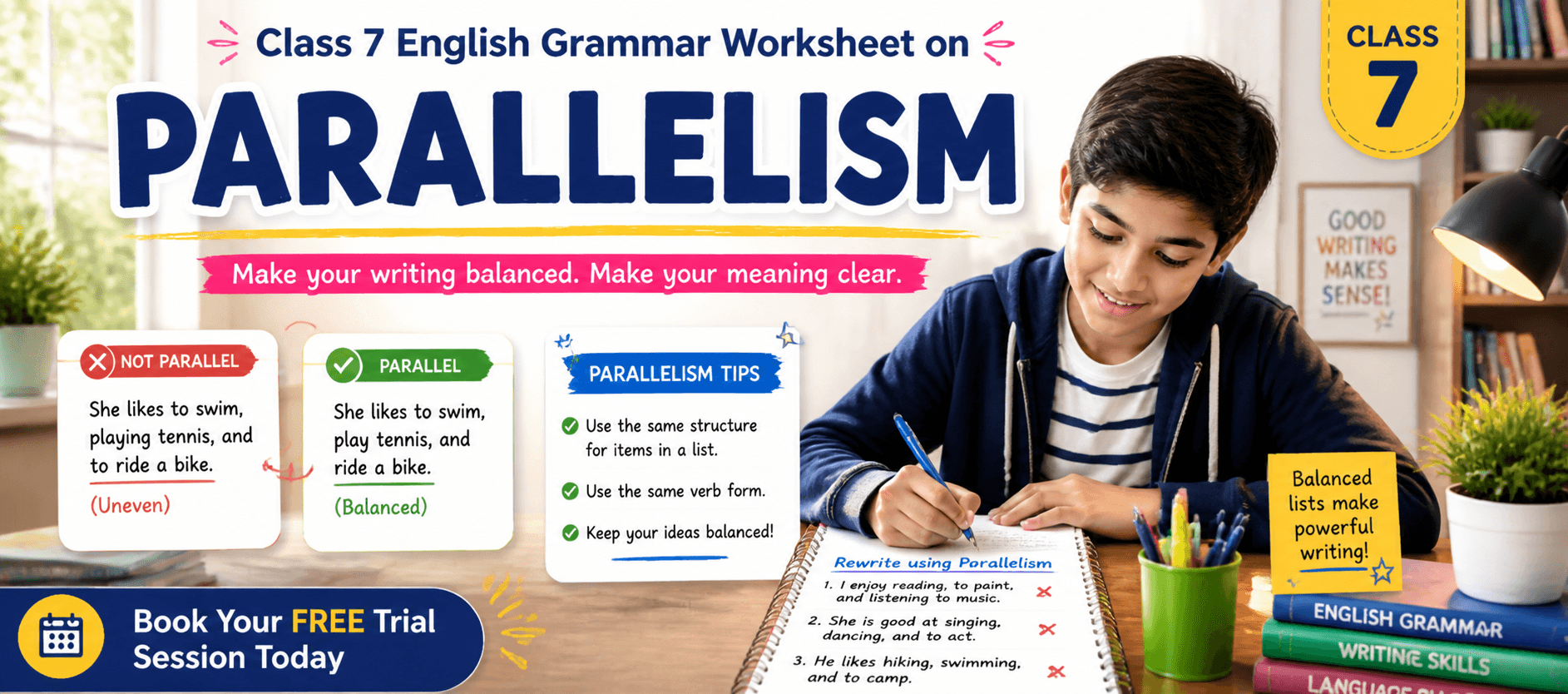
- **Incorrect**: "She likes reading, to write, and drawing."
- **Corrected**: "She likes reading, writing, and drawing."
- **Techniques to ensure parallelism**:
1. Ensure that all elements in a series or list follow the same grammatical structure.
2. In compound sentences, make sure each part follows a similar format (e.g., two verbs, two nouns).
3. Avoid mixing different forms of verbs or nouns in the same list.
- **Quick learning tips**:
- Look for coordinating conjunctions (like “and,” “or,” and “but”) and ensure the parts they connect follow the same pattern.
- If you have a list, ensure that each item in the list follows the same grammatical structure.
## Why is it important to learn this?
Mastering parallelism is essential for creating effective, clear, and engaging writing. By practicing parallel structure, students:
- Improve sentence clarity by ensuring a smooth flow of ideas.
- Avoid awkward or confusing sentences.
- Make their writing more formal and professional, which is especially useful in academic and business contexts.
Learning to use parallelism correctly is a key skill for Grade 7 students as they start to write more complex sentences and develop their academic writing style.
## Where will this knowledge help you?
This knowledge is useful in many different writing contexts:
- **Exams**: Many grammar and writing tests require students to identify and correct parallelism errors.
- **Writing tasks**: Parallelism is essential for writing well-structured essays, reports, and stories.
- **Class participation**: Clear and correct sentence structure can help students express their ideas more effectively during discussions or presentations.
## How to use this worksheet?
1. **Attempt independently first**: Read through each sentence and identify any parallelism errors.
2. **Review answers carefully**: Ensure that each sentence follows parallel structure and make the necessary changes.
3. **Correct mistakes**: If a sentence is incorrect, rewrite it to follow proper parallel structure.
4. **Practice regularly**: Continue practicing with similar exercises to develop a strong understanding of parallelism.
The solutions follow the exact worksheet order. Compare your answers carefully to ensure accuracy.
## Important tips and tricks
- **Common mistakes**:
- Mixing different verb forms or tenses in lists (e.g., "She likes to read, writing, and plays").
- Using inconsistent parts of speech (e.g., "She enjoys running, playing, and to dance").
- **What examiners expect**:
- Clear, consistent sentence structure that makes reading easy.
- Correct use of parallelism, especially in longer sentences and lists.
- **How to score full marks**:
- Review each sentence to ensure all items in a series or list follow the same grammatical structure.
- Be mindful of mixing verbs, adjectives, and nouns in a way that disrupts parallelism.
- **How to approach activity-based or writing-based tasks**:
- For rewriting exercises, focus on correcting parallelism by ensuring the elements are consistent.
- In writing tasks, pay attention to sentence structure and check for parallelism to improve your writing clarity.
## Complete Answer Key
**Exercise No. 1:**
- She enjoys reading, to write, and drawing. (Underline: She, Circle: enjoys)
- He likes to play, swimming, and running. (Underline: He, Circle: likes)
- They enjoy biking, hiking, and to swim. (Underline: They, Circle: enjoy)
- She plans to study, cleaning, and cooking. (Underline: She, Circle: plans)
- John loves to read, writing, and singing. (Underline: John, Circle: loves)
**Exercise No. 2:**
1. a) She enjoys reading, writing, and drawing.
2. b) He likes running and swimming.
3. b) They enjoy biking, hiking, and swimming.
4. a) She plans to study, cleaning, and cooking.
5. a) John loves to read, writing, and singing.
**Exercise No. 3:**
1. She enjoys reading, writing, and drawing. (Ensure same grammatical structure is followed.)
2. He likes running, swimming, and biking. (Ensure same grammatical structure is followed.)
3. They enjoy biking, hiking, and swimming. (Ensure same grammatical structure is followed.)
4. She plans to study, clean, and cook. (Ensure same grammatical structure is followed.)
5. John loves reading, writing, and singing. (Ensure same grammatical structure is followed.)
**Exercise No. 4:**
1. organizing, planning
2. completing, After
3. happy, confident
4. studying, practicing
5. leading, After
6. writing, planning
7. After
**Exercise No. 5**: Answers may vary.
## Outro
By practicing these exercises, students will improve their understanding of parallelism and develop stronger, clearer writing. Mastering this concept will help you write better, more coherent sentences and become a more effective communicator in both written and spoken English.
Book a free trial!