
Mixed Author's Craft Analysis: Printable Worksheet for Grade 7
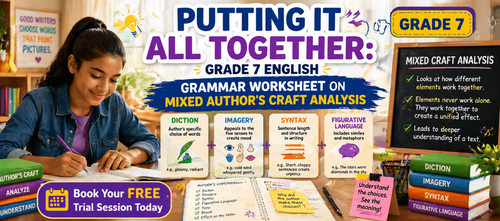

Title: Putting It All Together: Grade 7 English Grammar Worksheet on Mixed Author’s Craft Analysis
Have you ever read a sentence that felt scary just because of the way it was written? Or a paragraph that felt peaceful and slow? That is author’s craft at work. In Grade 7, learning about mixed author’s craft analysis helps you understand how writers use different tools together to create mood, tone, and meaning. Author’s craft includes diction, imagery, syntax, and figurative language. Diction is the author’s specific choice of words. Imagery appeals to the five senses to create mood. Syntax refers to sentence length and structure in writing. Figurative language includes similes and metaphors. Mixed craft analysis looks at how these different elements work together. This Grade 7 English grammar worksheet on mixed author’s craft analysis will teach you to look at all the pieces at once, explain why an author made specific choices, and become a truly sophisticated reader.
Download these English grammar worksheets and practice regularly to strengthen your language skills and build a strong foundation. You can also book a free trial to get expert guidance and improve your reading, writing, and comprehension abilities. The worksheets are designed in a simple and structured way to help K–8 students learn grammar concepts easily and use them confidently in everyday communication.
Book a free trial!
What Is the Topic?
The topic of this worksheet is Mixed Author’s Craft Analysis. Author’s craft includes diction, imagery, syntax, and figurative language. Author’s craft is the collection of writing choices an author makes. Every craft choice has a purpose. Mixed craft analysis looks at how different elements work together. These elements never work alone. They work together to create a unified effect. Diction is the author’s specific choice of words. Word choice is called diction. Imagery is sensory language. Sensory language is called imagery. Imagery appeals to the five senses to create mood. Syntax refers to sentence length and structure in writing. Sentence structure is called syntax. Short, choppy sentences might create a feeling of urgency or panic. Long, flowing sentences often create a sense of slowness or reflection. Figurative language includes similes and metaphors. A writer’s tone is revealed through their craft choices. The feeling the reader experiences is mood. Every craft choice creates a specific effect. Analyzing craft means explaining why an author made specific choices. Good analysis explains why an author made a specific craft choice. Mixed craft analysis looks at how different elements work together. Mixed craft analysis leads to deeper understanding of a text.
Book a free trial!
What’s in This Worksheet?
This worksheet contains five different exercises that help students master mixed author’s craft analysis. Here is what is included:
1. Exercise No. 1 – Multiple Choice Questions – Students choose the correct word to complete each sentence about author’s craft. This exercise tests basic definitions of diction, imagery, syntax, figurative language, tone, mood, and mixed analysis.
2. Exercise No. 2 – Fill in the Blanks – Students complete sentences by filling in missing words related to author’s craft. The exact words are not provided in a word bank; students must use their understanding of the concepts.
3. Exercise No. 3 – True and False – Students read ten statements about author’s craft and decide whether each one is true or false. This helps correct common misunderstandings about how craft elements work together.
4. Exercise No. 4 – Underline the Words – Students read ten sentences. For each sentence, students are told which craft elements to look for (diction, imagery, personification, simile, metaphor, sentence structure, repetition, etc.). Students must underline the specific words that demonstrate each listed element.
5. Exercise No. 5 – Paragraph Writing – Students read a paragraph about author’s craft that has blanks. They must fill in each blank using a word from the word bank provided at the end of the paragraph. This combines reading comprehension with vocabulary application.
This worksheet supports exam preparation by covering all major craft elements and teaching students to analyze how they work together, not just name them separately.
Book a free trial!
Definitions, Examples, Techniques, and Tips
Based only on the content of this worksheet, here are the exact definitions and examples students will learn:
Definitions:
- Author’s craft:Author’s craft includes diction, imagery, syntax, and figurative language. Author’s craft is the collection of writing choices an author makes. Every craft choice has a purpose.
- Diction: Diction is the author’s specific choice of words. Word choice is called diction.
- Imagery: Imagery appeals to the five senses to create mood. Sensory language is called imagery.
- Syntax: Syntax refers to sentence length and structure in writing. Sentence structure is called syntax. Short, choppy sentences might create a feeling of urgency or panic. Long, flowing sentences often create a sense of slowness or reflection.
- Figurative language: Figurative language includes similes and metaphors.
- Tone and mood: A writer’s tone is revealed through their craft choices. The feeling the reader experiences is mood. Every craft choice creates a specific effect.
- Mixed craft analysis: Mixed craft analysis looks at how different elements work together. Different craft elements work independently and never affect each other? (False – they work together.) Mixed craft analysis looks at how elements work together. These elements never work alone. They work together to create a unified effect. Mixed craft analysis leads to deeper understanding of a text. Analyzing craft means explaining why an author made specific choices. Good analysis explains why an author made a specific craft choice.
Examples taken directly from the worksheet (Exercise No. 4):
1. The ancient, crumbling walls whispered secrets of centuries past. (diction/imagery/personification)
– Diction: ancient, crumbling, whispered, secrets, centuries
– Imagery: sight (ancient, crumbling walls) and sound (whispered)
– Personification: walls whispered
2. The bitter wind howled like a wounded wolf across the frozen lake. (simile/imagery/diction)
– Simile: like a wounded wolf
– Imagery: sight (frozen lake), sound (howled), touch (bitter wind)
– Diction: bitter, howled, wounded, frozen
3. The clock ticked. The rain fell. The old man waited. (parallel structure/short sentences/mood)
– Parallel structure: three sentences with the same pattern (noun + verb)
– Short sentences: each is very short
– Mood: calm, patient, or waiting
4. Run. Hide. Survive. (sentence fragments/urgency/imperative verbs)
– Sentence fragments: no subjects, just verbs
– Urgency: quick, sharp commands
– Imperative verbs: Run, Hide, Survive
5. “No way,” she muttered. “Absolutely no way.” (dialogue/repetition/informal diction)
– Dialogue: she muttered
– Repetition: “No way” said twice
– Informal diction: “No way,” “Absolutely no way”
6. Ravi’s heart pounded. Boom. Boom. BOOM. (sentence length/onomatopoeia/repetition)
– Sentence length: very short
– Onomatopoeia: Boom. Boom. BOOM.
– Repetition: Boom repeated
7. Silence. Then footsteps. Then silence again. (sentence fragments/repetition/mood creation)
– Sentence fragments: Silence. Then footsteps. Then silence again.
– Repetition: Silence repeated
– Mood creation: suspenseful, eerie
8. Her eyes were oceans of grief, deep and dark and endlessly sad. (metaphor/imagery/diction)
– Metaphor: eyes were oceans of grief
– Imagery: sight (deep, dark, endlessly sad)
– Diction: oceans, grief, deep, dark, endlessly, sad
9. The classroom was a zoo – noisy, chaotic, and completely out of control. (metaphor/imagery/sentence structure)
– Metaphor: classroom was a zoo
– Imagery: noise, chaos
– Sentence structure: long sentence with a list after the dash
10. Sunlight danced on the water like a million tiny diamonds. (simile/imagery/personification)
– Simile: like a million tiny diamonds
– Imagery: sight (sunlight, water, diamonds)
– Personification: sunlight danced
Key facts from True and False section:
- Author’s craft includes only grammar and spelling. (False)
- Different craft elements work independently and never affect each other. (False)
- Imagery and diction both contribute to the mood of a scene. (True)
- Short sentences always create a calm and peaceful mood. (False)
- Figurative language can reveal the author’s tone. (True)
- Analyzing craft means simply naming the device used. (False)
- Good analysis explains why an author made a specific craft choice. (True)
- The same sentence can be analysed for diction, syntax, and imagery. (True)
- Author’s craft choices are random and have no purpose. (False)
- Mixed craft analysis leads to deeper understanding of a text. (True)
Quick learning tip: When analyzing author’s craft, do not just name the device. Explain why the author chose it. What effect does it create? How does it support the theme? How does it make the reader feel? Mixed analysis shows how everything works together.
Book a free trial!
Why Is It Important to Learn This?
Learning about mixed author’s craft analysis is important for several reasons. First, different craft elements work together. They never work alone. They work together to create a unified effect. If you only look at one element, you miss the bigger picture. Second, every craft choice has a purpose. Nothing an author writes is random. Short, choppy sentences might create a feeling of urgency or panic. Long, flowing sentences often create a sense of slowness or reflection. Diction, imagery, and syntax all contribute to the mood. Third, mixed craft analysis leads to deeper understanding of a text. You move from just saying “this is a simile” to explaining why the simile matters and how it works with other choices. Fourth, good analysis explains why an author made a specific craft choice. This is what examiners want to see. Fifth, this skill makes you a sophisticated reader. You learn to see how every sentence is carefully built to create a specific effect. Mixed analysis shows how everything works together.
Book a free trial!
Where Will This Knowledge Help You?
Knowledge of mixed author’s craft analysis will help you in many academic and real-life situations:
1. Literature exams and reading comprehension tests – Many questions ask you to analyze why an author made a specific craft choice. This worksheet directly prepares you for those questions. You will be able to discuss diction, imagery, syntax, and figurative language together.
2. Writing literary analysis essays – When you write an essay about a book or poem, you need to do more than name devices. You need to explain why the author chose them and how they work together. Mixed analysis shows how everything works together.
3. Class discussions – When your teacher asks, “Why did the author write this sentence this way?” you will be able to answer using multiple craft elements. You can talk about word choice (diction), sentence length (syntax), and sensory details (imagery) all at once.
4. Writing your own stories – When you write, you can make conscious craft choices. Do you want urgency? Use short, choppy sentences. Do you want reflection? Use long, flowing sentences. Do you want to create a specific mood? Choose your diction and imagery carefully.
5. Understanding why some writing feels powerful – Mixed craft analysis helps you understand why certain sentences stick with you. It is not luck – it is careful crafting. The same sentence can be analysed for diction, syntax, and imagery.
6. Becoming a sophisticated reader and thinker – Analyzing craft means explaining why an author made specific choices. This deeper thinking makes you a better student and a more perceptive person.
Book a free trial!
How to Use This Worksheet?
Follow these steps to get the most out of this Grade 7 English grammar worksheet on mixed author’s craft analysis:
1. Attempt independently first – Without looking at any answers, complete all five exercises in order. Start with Exercise No. 1 (Multiple Choice Questions), then move to Exercise No. 2 (Fill in the Blanks), then Exercise No. 3 (True and False), then Exercise No. 4 (Underline the Words), and finally Exercise No. 5 (Paragraph Writing with word bank).
2. Review answers carefully – After you finish all exercises, go to the Complete Answer Key section below. Compare your answers one by one. Pay special attention to Exercise No. 4 – make sure you underlined the correct words for each listed craft element.
3. Correct mistakes – For any answer that is different from the answer key, write the correct answer next to your attempt. Try to understand why you made the mistake. Did you forget that short sentences do not always create calm? Did you forget that analyzing craft means explaining why, not just naming?
4. Practice regularly – Mixed craft analysis takes practice to master. Repeat the worksheet after a few days. For the paragraph writing task (Exercise No. 5), try to fill in the blanks without looking at the word bank first.
The solutions follow the exact worksheet order. Students should compare their answers carefully.
Book a free trial!
Important Tips and Tricks
Here are important tips and tricks based directly on this worksheet to help you master mixed author’s craft analysis and score full marks:
1. Learn the four main elements – Author’s craft includes diction (word choice), imagery (sensory language), syntax (sentence length and structure), and figurative language (similes, metaphors, personification). Mixed craft analysis looks at how these elements work together.
2. Remember: they never work alone – Different craft elements work independently and never affect each other? That statement is false. They work together. These elements never work alone. When you analyze, always ask: How does the diction work with the imagery? How does the syntax support the figurative language?
3. Short sentences do not always mean calm– A common mistake is thinking short sentences always create a calm and peaceful mood. This is false. Short, choppy sentences might create a feeling of urgency or panic. “Run. Hide. Survive.” is urgent and scary, not calm. Always look at the context.
4. Analyzing craft is more than naming – A common mistake is thinking analyzing craft means simply naming the device used. This is false. Good analysis explains why an author made a specific craft choice. To analyze craft, do not just name the device. Explain why the author chose it. What effect does it create? How does it support the theme? How does it make the reader feel?
5. Every craft choice has a purpose – Author’s craft choices are random and have no purpose? That statement is false. Every craft choice has a purpose. Nothing is accidental. If an author uses a simile, there is a reason. If an author uses short sentences, there is a reason.
6. The same sentence can be analyzed multiple ways – The same sentence can be analysed for diction, syntax, and imagery. For example, “The ancient, crumbling walls whispered secrets” has interesting diction (ancient, crumbling, whispered), imagery (sight and sound), and personification (walls whispered). Practice looking at one sentence from three angles.
7. What examiners expect – Examiners expect you to know the definitions of diction, imagery, syntax, and figurative language. They expect you to explain why an author made a specific craft choice. They want you to show how different elements work together to create a unified effect. Mixed craft analysis leads to deeper understanding of a text.
8. How to score full marks – When answering multiple-choice questions, look for keywords like “diction,” “imagery,” “syntax,” “figurative,” “structure,” “senses,” “words,” “choices,” “urgency,” “slowness,” “together,” and “purpose.” For true and false, remember that craft includes more than grammar and spelling, short sentences do not always mean calm, and analyzing craft is more than just naming the device.
9. For underlining tasks (Exercise No. 4) – Each sentence has three craft elements listed in parentheses. You need to underline words that demonstrate each element. For sentence 1 (diction/imagery/personification): underline diction (ancient, crumbling, whispered, secrets, centuries), underline imagery (the whole sentence creates sight and sound), underline personification (whispered). Do your best to show all three.
10. For paragraph writing tasks (Exercise No. 5) – Read the entire paragraph first. Then read the word bank. Then fill in each blank one at a time. The word bank includes: diction, imagery, syntax, figurative, together, sentences, mood, why, theme, reader, faster. Read each sentence with your chosen word to make sure it makes sense. The last blank should be filled with “reader” – “sophisticated reader.” “Faster” is in the word bank but is not needed for this paragraph.
Book a free trial!
Complete Answer Key
Below is the complete answer key for the Grade 7 English grammar worksheet on **Mixed Author’s Craft Analysis**. The answers follow the exact order of the worksheet. Section names and question numbers are reproduced exactly as they appear in the worksheet.
Exercise No. 1
Choose the correct word to complete each sentence.
1. Author’s craft includes diction, imagery, syntax, and ______ language.
Answer: a) figurative
2. Syntax refers to sentence length and ______ in writing.
Answer: a) structure
3. Imagery appeals to the five ______ to create mood.
Answer: b) senses
4. Diction is the author’s specific choice of ______.
Answer: c) words
5. A writer’s tone is revealed through their craft ______.
Answer: b) choices
6. Analyzing craft means explaining ______ an author made specific choices.
Answer: b) why
7. Short, choppy sentences might create a feeling of ______ or panic.
Answer: c) urgency
8. Long, flowing sentences often create a sense of ______ or reflection.
Answer: a) slowness
9. Personification can make the setting feel ______ and active.
Answer: b) alive
10. Mixed craft analysis looks at how different elements work ______.
Answer: a) together
Exercise No. 2
Fill in the blanks. (Note: The worksheet provides sentences with blanks. Based on the content of the worksheet, the expected answers are as follows.)
1. Mixed craft analysis looks at how elements work together.
2. Every craft choice has a purpose.
3. Sensory language is called imagery.
4. Sentence structure is called syntax.
5. The author’s attitude revealed through craft is tone.
6. Similes and metaphors are figurative language.
7. The feeling the reader experiences is mood.
8. Every craft choice creates a specific effect.
9. Word choice is called diction.
10. Author’s craft is the collection of writing choices an author makes.
Exercise No. 3
True and False. Write True or False for each statement.
1. Author’s craft includes only grammar and spelling.
Answer: False
2. Different craft elements work independently and never affect each other.
Answer: False
3. Imagery and diction both contribute to the mood of a scene.
Answer: True
4. Short sentences always create a calm and peaceful mood.
Answer: False
5. Figurative language can reveal the author’s tone.
Answer: True
6. Analyzing craft means simply naming the device used.
Answer: False
7. Good analysis explains why an author made a specific craft choice.
Answer: True
8. The same sentence can be analysed for diction, syntax, and imagery.
Answer: True
9. Author’s craft choices are random and have no purpose.
Answer: False
10. Mixed craft analysis leads to deeper understanding of a text.
Answer: True
Exercise No. 4
Underline the words that demonstrate the listed craft elements.
1. The ancient, crumbling walls whispered secrets of centuries past. (diction/imagery/personification)
Underline diction: ancient, crumbling, whispered, secrets, centuries
Underline imagery: the entire sentence (sight: ancient, crumbling walls; sound: whispered)
Underline personification: whispered
2. The bitter wind howled like a wounded wolf across the frozen lake. (simile/imagery/diction)
Underline simile: like a wounded wolf
Underline imagery: bitter, howled, wounded wolf, frozen lake
Underline diction: bitter, howled, wounded, frozen
3. The clock ticked. The rain fell. The old man waited. (parallel structure/short sentences/mood)
Underline parallel structure: all three sentences have the same pattern (article + noun + verb)
Underline short sentences: each sentence is underlined in full
Underline mood: the entire selection (calm, patient, waiting)
4. Run. Hide. Survive. (sentence fragments/urgency/imperative verbs)
Underline sentence fragments: Run. Hide. Survive. (each is a fragment)
Underline urgency: the entire line
Underline imperative verbs: Run, Hide, Survive
5. “No way,” she muttered. “Absolutely no way.” (dialogue/repetition/informal diction)
Underline dialogue: “No way,” she muttered. “Absolutely no way.”
Underline repetition: “No way” appears twice
Underline informal diction: “No way,” “Absolutely no way”
6. Ravi’s heart pounded. Boom. Boom. BOOM. (sentence length/onomatopoeia/repetition)
Underline sentence length: very short sentences – underline all
Underline onomatopoeia: Boom. Boom. BOOM.
Underline repetition: Boom repeated three times
7. Silence. Then footsteps. Then silence again. (sentence fragments/repetition/mood creation)
Underline sentence fragments: Silence. Then footsteps. Then silence again.
Underline repetition: Silence appears twice
Underline mood creation: the entire sentence (suspenseful, eerie)
8. Her eyes were oceans of grief, deep and dark and endlessly sad. (metaphor/imagery/diction)
Underline metaphor: eyes were oceans of grief
Underline imagery: oceans, grief, deep, dark, endlessly sad
Underline diction: oceans, grief, deep, dark, endlessly, sad
9. The classroom was a zoo – noisy, chaotic, and completely out of control. (metaphor/imagery/sentence structure)
Underline metaphor: classroom was a zoo
Underline imagery: noisy, chaotic, completely out of control
Underline sentence structure: long sentence with a list after the dash
10. Sunlight danced on the water like a million tiny diamonds. (simile/imagery/personification)
Underline simile: like a million tiny diamonds
Underline imagery: sunlight, danced, water, million tiny diamonds
Underline personification: danced
Exercise No. 5
Read the paragraph. Fill in each blank with a word from your understanding. Word bank: (diction, imagery, syntax, figurative, together, sentences, mood, why, theme, reader, faster)
Author’s craft includes many elements. Diction is word choice. Imagery is sensory language. Syntax is sentence structure. Figurative language includes similes and metaphors. These elements never work alone. They work together to create a unified effect. For example, a scary scene might use dark imagery (sight and sound). It might use short, choppy sentences (syntax). It might use words with negative connotations (diction). All these choices create a fearful mood. To analyse craft, do not just name the device. Explain why the author chose it. What effect does it create? How does it support the theme? How does it make the reader feel? Mixed analysis shows how everything works together. This skill makes you a sophisticated reader. (Note: “Faster” is in the word bank but is not used in the paragraph as written. The correct fill for the last blank is “reader.”)
Book a free trial!
You have now completed the entire worksheet on mixed author’s craft analysis. Author’s craft includes diction, imagery, syntax, and figurative language. But these elements never work alone. They work together to create a unified effect. Short, choppy sentences create urgency. Long, flowing sentences create slowness. Dark imagery creates fear. Positive word choice creates hope. Mixed craft analysis looks at how these elements work together. When you analyze a text, do not just name the device. Explain why the author chose it. What effect does it create? How does it support the theme? How does it make the reader feel? This is what sophisticated readers do. You are building skills that will make you a thoughtful, analytical, and confident reader in Grade 7 and beyond. Keep practicing, and soon mixed craft analysis will feel natural every time you read.
Book a free trial!