
Mood Creation Through Imagery: Grade 7 Printable ELA Worksheet
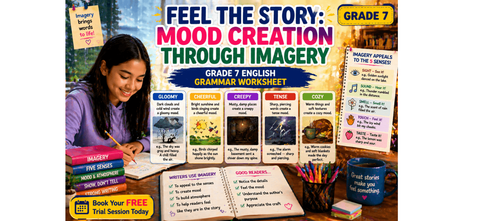

Title: Feel the Story: Grade 7 English Grammar Worksheet on Mood Creation Through Imagery
Have you ever read a description that made you feel cold, scared, happy, or peaceful just from the words on the page? That is mood creation through imagery. In Grade 7, learning about mood creation through imagery helps you understand how writers make you feel without telling you how to feel. Imagery uses sensory details to create a specific mood in the reader. Imagery can appeal to sight, sound, smell, touch, and taste. Dark clouds and cold wind create a gloomy mood. Bright sunshine and birds singing create a cheerful mood. Effective imagery helps readers feel themselves in the story. This Grade 7 English grammar worksheet on mood creation through imagery will teach you how writers use the five senses to make you laugh, cry, shiver, or smile – all through carefully chosen words.
Download these English grammar worksheets and practice regularly to strengthen your language skills and build a strong foundation. You can also book a free trial to get expert guidance and improve your reading, writing, and comprehension abilities. The worksheets are designed in a simple and structured way to help K–8 students learn grammar concepts easily and use them confidently in everyday communication.
Book a free trial!
What Is the Topic?
The topic of this worksheet is Mood Creation Through Imagery. Imagery is language that appeals to the five senses. Imagery uses sensory details to create a specific mood in the reader. Mood is the feeling the reader experiences. Another word for mood is atmosphere. The emotional feeling a reader experiences is called mood. Imagery appeals to the five physical senses. Imagery can appeal to sight, sound, smell, touch, and taste. Dark clouds and cold wind create a gloomy mood. Bright sunshine and birds singing create a cheerful mood. The crunch of leaves underfoot appeals to the sense of sound. The bitter cold stung my cheeks appeals to the sense of touch. A writer describing a "musty, damp basement" creates a creepy mood. Words like "sharp" and "piercing" create a tense and urgent mood. Imagery of warm cookies and soft blankets creates a cozy mood. Effective imagery helps readers feel themselves in the story. Writers use imagery to create a specific mood or atmosphere. Writers choose sensory details carefully. They want you to feel like you are in the story. When you read, notice how imagery makes you feel. That feeling is the mood. Understanding mood helps you appreciate the author's craft.
Book a free trial!
What’s in This Worksheet?
This worksheet contains five different exercises that help students master mood creation through imagery. Here is what is included:
1. Exercise No. 1 – Multiple Choice Questions – Students choose the correct word to complete each sentence about imagery and mood. This exercise tests basic definitions of imagery, mood, and how sensory details create feelings.
2. Exercise No. 2 – Fill in the Blanks – Students complete sentences by filling in missing words related to imagery and mood. Students must use their understanding of the concepts and the five senses.
3. Exercise No. 3 – True and False – Students read ten statements about imagery and mood and decide whether each one is true or false. This helps correct common misunderstandings about what imagery can do and how it affects readers.
4. Exercise No. 4 – Underline the Words – Students read ten sentences that each contain imagery appealing to one of the five senses. For each sentence, students must underline the specific words that create the imagery and identify which sense it appeals to.
5. Exercise No. 5 – Paragraph Writing – Students read a paragraph about mood creation through imagery that has blanks. They must fill in each blank using a word from the word bank provided at the end of the paragraph. This combines reading comprehension with vocabulary application.
This worksheet supports exam preparation by covering the five senses, how different types of imagery create different moods, and why writers choose specific sensory details.
Book a free trial!
Definitions, Examples, Techniques, and Tips
Based only on the content of this worksheet, here are the exact definitions and examples students will learn:
Definitions:
- Imagery: Imagery uses sensory details to create a specific mood in the reader. Imagery is language that appeals to the five senses. Imagery appeals to the five physical senses. Imagery can appeal to sight, sound, smell, touch, and taste.
- Mood: Mood is the feeling the reader experiences. Another word for mood is atmosphere. The emotional feeling a reader experiences is called mood. Mood is the feeling the reader experiences.
- The five senses in imagery: Seeing a rainbow after rain appeals to the sense of sight. Hearing thunder in the distance appeals to the sense of sound. Smelling fresh bread baking appeals to the sense of smell. Feeling rough sandpaper appeals to the sense of touch. Tasting sour lemon appeals to the sense of taste.
- How imagery creates mood: Dark clouds and cold wind create a gloomy mood. Bright sunshine and birds singing create a cheerful mood. A writer describing a "musty, damp basement" creates a creepy mood. Words like "sharp" and "piercing" create a tense and urgent mood. Imagery of warm cookies and soft blankets creates a cozy mood. Descriptive words like "soft" and "warm" create a cozy mood. The smell of rain can create a peaceful mood. The sound of laughter can create a joyful mood. The taste of bitter medicine could create an unpleasant mood. Imagery of rotting food would create a pleasant mood? (False – it would create an unpleasant mood).
Examples taken directly from the worksheet (Exercise No. 4 – each sentence appeals to a specific sense)
1. The crisp apple exploded with sweet juice on my tongue.
– Sense: taste
2. Riya heard the distant wail of a train whistle at midnight.
– Sense: sound
3. Ravi's fingers touched the cold, slimy surface of the frog.
– Sense: touch
4. The aroma of spicy curry filled the entire kitchen.
– Sense: smell
5. Meera watched the crimson sunset bleed across the horizon.
– Sense: sight
6. Raj tasted the bitter medicine and immediately made a sour face.
– Sense: taste
7. Asha heard the gentle patter of rain on the tin roof.
– Sense: sound
8. Kunal felt the rough bark of the old banyan tree.
– Sense: touch
9. The sweet scent of jasmine drifted through the open window.
– Sense: smell
10. Priya saw the lightning split the dark sky in two.
– Sense: sight
Key facts from True and False section (Page 5):
- Imagery only appeals to the sense of sight. (False)
- Imagery can help create a scary mood in a story. (True)
- The smell of rain can create a peaceful mood. (True)
- Imagery has no effect on how the reader feels. (False)
- The sound of laughter can create a joyful mood. (True)
- Imagery of rotting food would create a pleasant mood. (False)
- A writer uses imagery to make the reader feel like they are in the story. (True)
- The taste of bitter medicine could create an unpleasant mood. (True)
- Imagery is only important in poetry, not in novels. (False)
- Descriptive words like "soft" and "warm" create a cozy mood. (True)
Key terms from Fill in the Blanks (Page 4):
- Another word for mood is atmosphere.
- Feeling rough sandpaper appeals to the sense of touch.
- The emotional feeling a reader experiences is called mood.
- Imagery uses sensory details to create a mood.
- Seeing a rainbow after rain appeals to the sense of sight.
- Hearing thunder in the distance appeals to the sense of sound.
- Smelling fresh bread baking appeals to the sense of smell.
- Imagery appeals to the five physical senses.
- Words like "shadowy" and "foggy" create a gloomy mood (or creepy/mysterious mood).
- Tasting sour lemon appeals to the sense of taste.
Quick learning tip: To identify imagery, ask: Which of the five senses does this description appeal to? Sight, sound, smell, touch, or taste? Then ask: What mood does that create? Dark sights and cold touches create gloomy moods. Bright sights and sweet smells create cheerful moods.
Book a free trial!
Why Is It Important to Learn This?
Learning about mood creation through imagery is important for several reasons. First, imagery uses sensory details to create a specific mood in the reader. Writers do not want you to just understand the story – they want you to feel it. Second, effective imagery helps readers feel themselves in the story. When you read about a musty, damp basement, you can almost smell it. When you read about warm cookies, you can almost taste them. This makes reading immersive and exciting. Third, imagery has a huge effect on how the reader feels. A writer uses imagery to make the reader feel like they are in the story. The smell of rain can create a peaceful mood. The sound of laughter can create a joyful mood. The taste of bitter medicine could create an unpleasant mood. Fourth, this skill is tested in literature exams where you may be asked to identify what mood a passage creates and which sensory details create that mood. Finally, understanding mood helps you appreciate the author's craft. When you read, notice how imagery makes you feel. That feeling is the mood. Understanding mood helps you appreciate the author's craft.
Book a free trial!
Where Will This Knowledge Help You?
Knowledge of mood creation through imagery will help you in many academic and real-life situations:
1. Literature exams and reading comprehension tests – Many questions ask you to identify the mood of a passage or explain which sensory details create that mood. This worksheet directly prepares you for those questions.
2. Writing your own stories – When you write, you can use imagery to make your readers feel exactly what you want them to feel. Want them to feel scared? Describe dark, shadowy, cold things. Want them to feel happy? Describe bright, warm, sweet things.
3. Class discussions – When your teacher asks, “What mood does this passage create?” you will be able to answer. You can point to specific sensory details: “The crunch of leaves” creates sound imagery. “The bitter cold” creates touch imagery.
4. Reading novels and poems – Once you learn to notice imagery, reading becomes a richer experience. You will notice how authors appeal to your senses on every page. You will feel more connected to the story.
5. Analyzing advertisements and media – Advertisers use imagery to make you feel a certain way about their product. A food ad uses taste and smell imagery. A travel ad uses sight and sound imagery. Understanding this helps you see how media tries to influence you.
6. Becoming a more mindful reader – When you read, notice how imagery makes you feel. That feeling is the mood. Understanding mood helps you appreciate the author's craft. You will enjoy reading more and understand it better.
Book a free trial!
How to Use This Worksheet?
Follow these steps to get the most out of this Grade 7 English grammar worksheet on mood creation through imagery:
1. Attempt independently first – Without looking at any answers, complete all five exercises in order. Start with Exercise No. 1 (Multiple Choice Questions), then move to Exercise No. 2 (Fill in the Blanks), then Exercise No. 3 (True and False), then Exercise No. 4 (Underline the Words), and finally Exercise No. 5 (Paragraph Writing with word bank).
2. Review answers carefully – After you finish all exercises, go to the Complete Answer Key section below. Compare your answers one by one. Pay special attention to Exercise No. 4 – make sure you correctly identified which sense each sentence appeals to and underlined the correct words.
3. Correct mistakes – For any answer that is different from the answer key, write the correct answer next to your attempt. Try to understand why you made the mistake. Did you confuse sound imagery with sight imagery? Did you think imagery only appeals to sight?
4. Practice regularly – Imagery and mood can take practice to master. Repeat the worksheet after a few days. For the paragraph writing task (Exercise No. 5), try to fill in the blanks without looking at the word bank first.
The solutions follow the exact worksheet order. Students should compare their answers carefully.
Book a free trial!
Important Tips and Tricks
Here are important tips and tricks based directly on this worksheet to help you master mood creation through imagery and score full marks:
1. Remember all five senses – A common mistake is thinking imagery only appeals to the sense of sight. This is false. Imagery can appeal to sight, sound, smell, touch, and taste. Always check all five. The crunch of leaves is sound. The bitter cold is touch. The aroma of curry is smell. The sweet juice is taste. The crimson sunset is sight.
2. Match the imagery to the mood – Dark clouds and cold wind create a gloomy mood. Bright sunshine and birds singing create a cheerful mood. A musty, damp basement creates a creepy mood. Warm cookies and soft blankets create a cozy mood. Sharp and piercing words create a tense and urgent mood. Shadowy and foggy words create a mysterious or gloomy mood.
3. Imagery affects feelings – Imagery has a strong effect on how the reader feels. The smell of rain can create a peaceful mood. The sound of laughter can create a joyful mood. The taste of bitter medicine could create an unpleasant mood. Imagery of rotting food would create an unpleasant mood (not pleasant). Always think about how the sensory detail makes you feel.
4. Imagery is for all literature – A common mistake is thinking imagery is only important in poetry, not in novels. This is false. Imagery appears in poems, novels, short stories, and even nonfiction. Any writer who wants you to feel something will use imagery.
5. Use your own senses as a reader – When you read imagery, try to imagine the sensation. If the text says “the bitter cold stung my cheeks,” pretend you feel that cold. If it says “the sweet scent of jasmine,” pretend you smell it. This makes the mood much stronger.
6. What examiners expect – Examiners expect you to identify imagery and name which sense it appeals to. They expect you to explain what mood that imagery creates. They may ask you why the author chose that specific sensory detail. Writers choose sensory details carefully. They want you to feel like you are in the story.
7. How to score full marks – When answering multiple-choice questions, look for keywords like “sensory details,” “mood,” “gloomy,” “cheerful,” “creepy,” “tense,” “cozy,” “sight,” “sound,” “smell,” “touch,” “taste.” For true and false, remember that imagery appeals to all five senses, not just sight, and that imagery has a strong effect on the reader’s feelings.
8. For underlining tasks (Exercise No. 4) – Read each sentence. Identify which sense it appeals to. Then underline the specific words that create that sensory experience. For taste, underline words like “crisp,” “sweet juice,” “exploded on my tongue,” “bitter,” “sour face.” For sound, underline “distant wail,” “train whistle,” “gentle patter.” For touch, underline “cold, slimy surface,” “rough bark.” For smell, underline “aroma of spicy curry,” “sweet scent of jasmine.” For sight, underline “crimson sunset bleed across the horizon,” “lightning split the dark sky.”
9. For paragraph writing tasks (Exercise No. 5) – Read the entire paragraph first. Then read the word bank. Then fill in each blank one at a time. The word bank includes: atmosphere, reader, musty, scared, sea, joyful, feel, feel, craft, ignore. Read each sentence with your chosen word to make sure it makes sense. “Atmosphere” fits the first blank (mood or atmosphere). “Reader” fits the second blank. “Musty” fits the third blank. “Scared” fits the fourth blank. “Sea” fits the fifth blank. “Joyful” fits the sixth blank. “Feel” fits the seventh and eighth blanks. “Craft” fits the last blank. “Ignore” is in the word bank but is not used.
Book a free trial!
Complete Answer Key
Below is the complete answer key for the Grade 7 English grammar worksheet on **Mood Creation Through Imagery**. The answers follow the exact order of the worksheet. Section names and question numbers are reproduced exactly as they appear in the worksheet.
Exercise No. 1
Choose the correct word to complete each sentence.
1. Imagery uses sensory details to create a specific ______ in the reader.
Answer: a) mood
2. Dark clouds and cold wind create a ______ mood.
Answer: a) gloomy
3. Bright sunshine and birds singing create a ______ mood.
Answer: c) cheerful
4. Imagery can appeal to sight, sound, smell, touch, and ______.
Answer: b) taste
5. The crunch of leaves underfoot appeals to the sense of ______.
Answer: a) sound
6. The bitter cold stung my cheeks appeals to the sense of ______.
Answer: b) touch
7. A writer describing a “musty, damp basement” creates a ______ mood.
Answer: a) creepy
8. Words like “sharp” and “piercing” create a ______ and urgent mood.
Answer: c) tense
9. Imagery of warm cookies and soft blankets creates a ______ mood.
Answer: b) cozy
10. Effective imagery helps readers ______ themselves in the story.
Answer: a) feel
Exercise No. 2
Fill in the blanks. (Note: The worksheet provides sentences with blanks. Based on the content of the worksheet, the expected answers are as follows.)
1. Another word for mood is atmosphere.
2. Feeling rough sandpaper appeals to the sense of touch.
3. The emotional feeling a reader experiences is called mood.
4. Imagery uses sensory details to create a mood.
5. Seeing a rainbow after rain appeals to the sense of sight.
6. Hearing thunder in the distance appeals to the sense of sound.
7. Smelling fresh bread baking appeals to the sense of smell.
8. Imagery appeals to the five physical senses.
9. Words like “shadowy” and “foggy” create a gloomy (or mysterious) mood.
10. Tasting sour lemon appeals to the sense of taste.
Exercise No. 3
True and False. Write True or False for each statement.
1. Imagery only appeals to the sense of sight.
Answer: False
2. Imagery can help create a scary mood in a story.
Answer: True
3. The smell of rain can create a peaceful mood.
Answer: True
4. Imagery has no effect on how the reader feels.
Answer: False
5. The sound of laughter can create a joyful mood.
Answer: True
6. Imagery of rotting food would create a pleasant mood.
Answer: False
7. A writer uses imagery to make the reader feel like they are in the story.
Answer: True
8. The taste of bitter medicine could create an unpleasant mood.
Answer: True
9. Imagery is only important in poetry, not in novels.
Answer: False
10. Descriptive words like “soft” and “warm” create a cozy mood.
Answer: True
Exercise No. 4
Underline the words that create imagery and identify the sense.
1. The crisp apple exploded with sweet juice on my tongue.
Sense: taste
Underline: crisp apple exploded with sweet juice on my tongue
2. Riya heard the distant wail of a train whistle at midnight.
Sense: sound
Underline: distant wail of a train whistle
3. Ravi's fingers touched the cold, slimy surface of the frog.
Sense: touch
Underline: cold, slimy surface
4. The aroma of spicy curry filled the entire kitchen.
Sense: smell
Underline: aroma of spicy curry
5. Meera watched the crimson sunset bleed across the horizon.
Sense: sight
Underline: crimson sunset bleed across the horizon
6. Raj tasted the bitter medicine and immediately made a sour face.
Sense: taste
Underline: bitter medicine, sour face
7. Asha heard the gentle patter of rain on the tin roof.
Sense: sound
Underline: gentle patter of rain
8. Kunal felt the rough bark of the old banyan tree.
Sense: touch
Underline: rough bark
9. The sweet scent of jasmine drifted through the open window.
Sense: smell
Underline: sweet scent of jasmine
10. Priya saw the lightning split the dark sky in two.
Sense: sight
Underline: lightning split the dark sky
Exercise No. 5
Read the paragraph. Fill in each blank with a word from your understanding. Word bank: (atmosphere, reader, musty, scared, sea, joyful, feel, feel, craft, ignore)
Imagery is language that appeals to the five senses. Writers use imagery to create a specific mood or atmosphere. Mood is the feeling the reader experiences. For example, imagine a dark, damp basement. The air smells musty and old. Your skin feels cold and sticky. You hear dripping water and squeaking rats. This imagery creates a scared or fearful mood. Now imagine a sunny beach. You see bright blue water. You smell salty sea. You feel warm sand between your toes. This imagery creates a calm or joyful mood. Writers choose sensory details carefully. They want you to feel like you are in the story. When you read, notice how imagery makes you feel. That feeling is the mood. Understanding mood helps you appreciate the author's craft. (Note: “Ignore” is in the word bank but is not used. The word “feel” appears twice – once in “feel like you are in the story” and once in “how imagery makes you feel.”)
Book a free trial!
You have now completed the entire worksheet on mood creation through imagery. Imagery is language that appeals to the five senses: sight, sound, smell, touch, and taste. Writers use imagery to create a specific mood or atmosphere. Mood is the feeling the reader experiences. Dark, cold, musty details create gloomy or scared moods. Bright, warm, sweet details create cheerful or cozy moods. Writers choose sensory details carefully. They want you to feel like you are in the story. When you read, notice how imagery makes you feel. That feeling is the mood. Understanding mood helps you appreciate the author's craft. Keep practicing, and soon you will notice imagery and mood in every story, poem, and even advertisement you see. You are building skills that will make you a thoughtful, analytical, and confident reader in Grade 7 and beyond.
Book a free trial!