
Must and Should Helping Verbs Activities for Grade 3

Practice with English Grammar Worksheet Grade 3: Must and Should Helping Verbs Activities
Learning helping verbs can make sentence building easy and fun for children. This English grammar worksheet Grade 3 on Must and Should Helping Verbs Activities helps students understand how to use helping verbs correctly in everyday communication. Students learn the difference between rules, strong needs, and good advice through engaging activities like underlining helping verbs, fill in the blanks, multiple-choice questions, sentence rewriting, and sentence formation.
This worksheet is designed in a simple and interactive way so Grade 3 students can confidently practice helping verbs while improving their grammar and sentence construction skills. By completing these activities carefully, students can strengthen their understanding of when to use “must” and when to use “should” in different situations.
Download these English grammar worksheets and practice regularly to strengthen your language skills and build a strong foundation. You can also book a free trial to get expert guidance and improve your reading, writing, and comprehension abilities. The worksheets are designed in a simple and structured way to help K–8 students learn grammar concepts easily and use them confidently in everyday communication.
What Is the Topic?
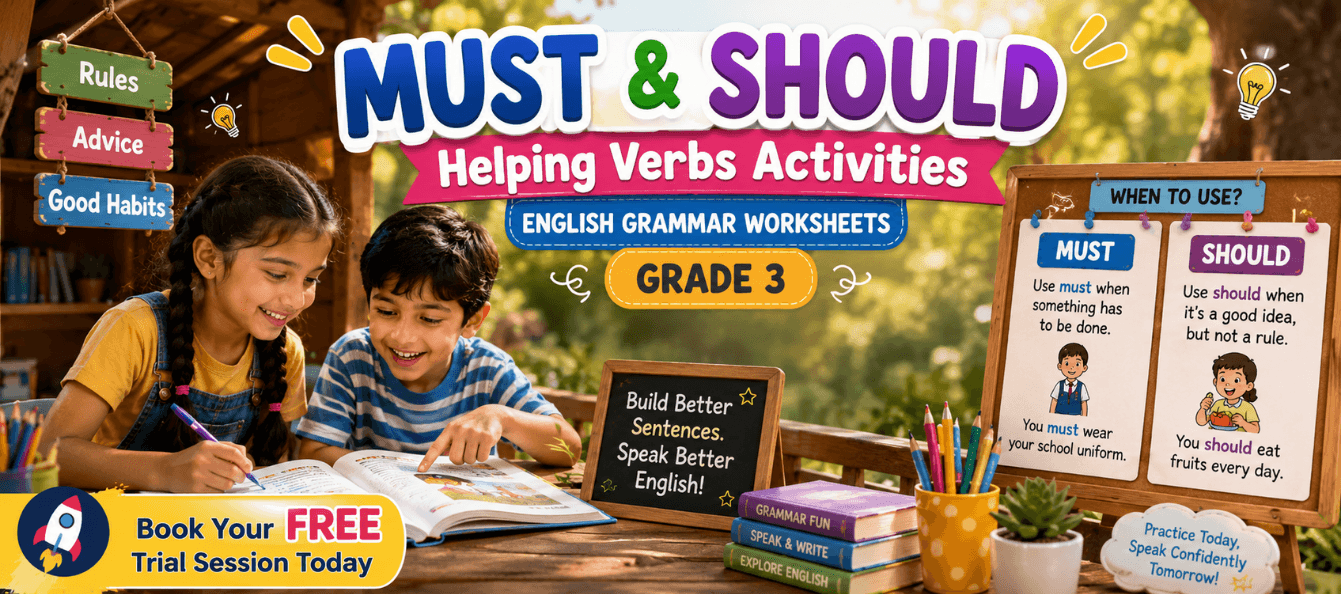
This English grammar worksheet Grade 3 focuses on helping verbs “must” and “should.” These helping verbs are used to talk about rules, strong needs, or advice.
The worksheet explains:
• Use must when you have to do something.
• Use should when it’s a good thing to do, but not a rule.
Students also learn through examples:
• You must wear your school uniform.
• You should eat fruits every day.
By practicing these helping verbs in different sentence types, students learn how to use them correctly in speaking and writing.
What’s in This Worksheet?
1. Underline the helping verbs in sentences to identify “must” and “should.”
2. Fill in the blanks with the correct helping verb.
3. Multiple-choice questions to choose between “must” and “should.”
4. Rewrite sentences by changing the helping verb.
5. Sentence formation activity based on a picture.
6. Practice with rules, advice, polite behavior, cleanliness, and classroom habits.
7. Exercises arranged step-by-step to help students understand helping verbs clearly.
8. Activities that support grammar revision and exam preparation for Grade 3 students.
Definitions, Examples, Techniques, and Tips
Definitions
• Must is used when something has to be done.
• Should is used when something is a good idea but not compulsory.
Examples
• You must wear your school uniform.
• You should eat fruits every day.
• We must keep our room clean.
• You should be kind to others.
Techniques
• Read the sentence carefully before choosing the helping verb.
• Use “must” for rules and important duties.
• Use “should” for advice and good habits.
• Practice identifying helping verbs by underlining them.
Quick Learning Tips
• Helping verbs come before the main verb.
• Look for words showing rules or advice.
• Read every sentence fully before answering.
• Practice sentence writing regularly to improve grammar skills.
Why Is It Important to Learn This?
Learning helping verbs like “must” and “should” helps students speak and write correctly. These helping verbs are commonly used in daily conversations, school instructions, and classroom communication.
This topic helps students:
• Understand rules and responsibilities.
• Give advice politely.
• Build meaningful sentences.
• Improve grammar confidence.
• Develop better speaking and writing habits.
Strong grammar skills also help students perform well in school activities and English exams.
Where Will This Knowledge Help You?
Students can use helping verbs in many real-life situations.
• In school while following rules and instructions.
• During exams and grammar practice activities.
• In sentence writing and paragraph writing.
• While speaking politely with teachers and friends.
• During classroom participation and reading activities.
• In everyday communication at home and school.
How to Use This Worksheet?
1. Read each sentence carefully before answering.
2. Attempt every activity independently first.
3. Underline the helping verbs properly wherever asked.
4. Fill in the blanks using the correct helping verb.
5. Choose the correct option carefully in MCQs.
6. Rewrite the sentences neatly and correctly.
7. Compare your answers carefully with the solutions.
8. The solutions follow the exact worksheet order for easy checking.
9. Correct mistakes and practice again for better understanding.
10. Practice regularly to improve helping verb usage confidently.
Important Tips and Tricks
1. Use “must” for strong rules or important actions.
Example: You must wear your uniform.
2. Use “should” for advice or good habits.
Example: You should eat fruits every day.
3. Read the meaning of the sentence carefully before choosing the helping verb.
4. Underline only the helping verb asked in the sentence.
5. In rewrite exercises, replace the old helping verb carefully with “must” or “should.”
6. Write neat and complete sentences in sentence formation activities.
7. Examiners expect correct helping verb usage and proper sentence structure.
8. Practice common classroom and daily-life sentences regularly to score full marks.
Complete Answer Key
Exercise 1
Underline the helping verbs in each sentence.
1. You __must__ do your homework.
2. They __must__ wear their uniforms.
3. He __should__ wash his hands.
4. She __must__ pack her bag.
5. We __should__ speak politely.
6. I __should__ finish my food.
7. He __must__ bring his book.
8. You __should__ be kind to others.
9. We __must__ keep our room clean.
10. She __should__ tie her hair.
Exercise 2
Fill in the blanks with the correct helping verb: must or should.
1. We MUST wear clean clothes.
2. I should brush my teeth.
3. She must do her work.
4. He must follow the rules.
5. They should sit quietly.
6. You should eat your fruits.
7. He should say thank you.
8. She must come on time.
9. You should listen to teacher.
10. We should help our friends.
Exercise 3
Choose the correct helping verb from the options given below and fill in the blanks.
1. You SHOULD wear your cap in the sun.
Answer: Should
2. We should say sorry when we are wrong.
Answer: Should
3. She must finish her meal.
Answer: Must
4. He must listen in class.
Answer: Must
5. They must sit in their places.
Answer: Must
6. I should keep my books neat.
Answer: Should
7. We should share our toys.
Answer: Should
8. He should share his tiffin.
Answer: Should
Exercise 4
Rewrite each sentence by changing the helping verb to must or should. Underline the helping verb.
1. You __should__ do your homework.
2. We __should__ speak politely.
3. She __must__ pack her bag.
4. He __should__ wash his hands.
5. They __must__ wear their uniforms.
6. I __should__ finish my food.
7. We __must__ keep our room clean.
8. You __should__ be kind to others.
9. He __must__ bring his book.
10. She __should__ tie her hair.
Exercise 5
Write 5 sentences using helping verbs must, should on the picture given below.
1. Children should cross the road carefully.
2. We must follow traffic rules.
3. Children should hold hands while crossing the road.
4. We must look at the traffic signal.
5. Children should walk on the zebra crossing.
Practicing this English grammar worksheet Grade 3 on Must and Should Helping Verbs Activities helps students improve sentence building, grammar understanding, and everyday communication skills. By regularly solving helping verb exercises, students become more confident in identifying rules, giving advice, and writing correct sentences. Keep practicing these activities to build strong grammar skills and become a confident English learner.