
Narrator Reliability: Introduction Worksheet for Grade 7 (PDF)
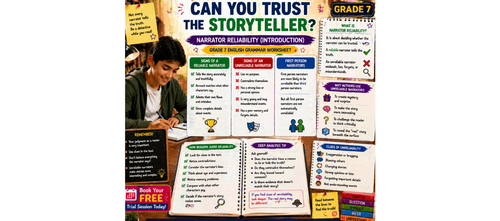

Title: Can You Trust the Storyteller? Grade 7 English Grammar Worksheet on Narrator Reliability (Intro)
Have you ever read a story where the person telling the story seemed a little bit suspicious? Maybe they bragged too much, or they blamed everyone else, or they said one thing and then changed their story. That is called narrator reliability. In Grade 7, learning about narrator reliability helps you become a detective while you read. A reliable narrator tells the story accurately and truthfully. You can trust what they say. An unreliable narrator misleads the reader or tells lies. They cannot be fully trusted. They might lie, forget, or misunderstand. First person narrators are more likely to be unreliable than third person narrators. This Grade 7 English grammar worksheet on narrator reliability (intro) will teach you how to spot clues that a narrator cannot be trusted, why authors use unreliable narrators, and how to read between the lines to discover the real story.
Download these English grammar worksheets and practice regularly to strengthen your language skills and build a strong foundation. You can also book a free trial to get expert guidance and improve your reading, writing, and comprehension abilities. The worksheets are designed in a simple and structured way to help K–8 students learn grammar concepts easily and use them confidently in everyday communication.
Book a free trial!
What Is the Topic?
The topic of this worksheet is Narrator Reliability (Intro). Not every narrator tells the truth. A reliable narrator tells the story accurately and truthfully. You can trust what they say. A reliable narrator always tells the complete truth about every event. A reliable narrator’s account matches what other characters say. A narrator who admits their own flaws is more likely to be reliable. An unreliable narrator cannot be fully trusted. An unreliable narrator misleads the reader or tells lies. They might lie, forget, or misunderstand. A narrator who is lying on purpose is an example of an unreliable narrator. A narrator who contradicts themselves is probably unreliable. A narrator with a strong bias might present a slanted version of events. A narrator with a strong opinion about another character might be biased. A narrator who is very young might be unreliable because they misunderstand events. A narrator with a personal bias might twist the facts. A narrator with a poor memory might forget important details. The reader must actively judge whether to trust the narrator. The reader must use clues to decide if a narrator is telling the truth. Understanding narrator reliability helps readers read critically between the lines. Unreliable narrators make stories more interesting and complex.
Book a free trial!
What’s in This Worksheet?
This worksheet contains five different exercises that help students master narrator reliability. Here is what is included:
1. Exercise No. 1 – Multiple Choice Questions – Students choose the correct word to complete each sentence about narrator reliability. This exercise tests basic definitions of reliable and unreliable narrators, as well as what makes a narrator trustworthy or untrustworthy.
2. Exercise No. 2 – Fill in the Blanks – Students complete sentences by filling in missing words related to narrator reliability. The exact words are not provided in a word bank; students must use their understanding of the concepts.
3. Exercise No. 3 – True and False – Students read ten statements about narrator reliability and decide whether each one is true or false. This helps correct common misunderstandings about which narrators can be trusted.
4. Exercise No. 4 – Underline the Words – Students read ten sentences spoken by different narrators. For each sentence, students must underline the words that suggest the narrator might be unreliable. This exercise focuses on spotting clues of unreliability.
5. Exercise No. 5 – Paragraph Writing – Students read a paragraph about narrator reliability that has blanks. They must fill in each blank using a word from the word bank provided at the end of the paragraph. This combines reading comprehension with vocabulary application.
This worksheet supports exam preparation by covering the key concepts of narrator reliability, including bias, memory issues, age, motivation, and how readers can judge the truth.
Book a free trial!
Definitions, Examples, Techniques, and Tips
Based only on the content of this worksheet, here are the exact definitions and examples students will learn:
Definitions:
- Reliable narrator: A reliable narrator tells the story accurately and truthfully. A reliable narrator always tells the complete truth about every event. A reliable narrator’s account matches what other characters say. A narrator who admits their own flaws is more likely to be reliable.
- Unreliable narrator: An unreliable narrator cannot be fully trusted. An unreliable narrator misleads the reader or tells lies. A narrator who is lying on purpose is an example of an unreliable narrator. A narrator who contradicts themselves is probably unreliable. A narrator with a strong bias might present a slanted version of events. A narrator with a personal bias might twist the facts. A narrator with a poor memory might forget important details. A narrator who is very young might be unreliable because they misunderstand events.
- First person narrators and reliability: First person narrators are more likely to be unreliable than third person narrators. All first person narrators are not automatically unreliable because they have feelings – that statement is false. But they are more likely to be unreliable than third person narrators.
- How readers judge reliability: The reader must actively judge whether to trust the narrator. The reader must use clues to decide if a narrator is telling the truth. Understanding narrator reliability helps readers read critically between the lines. The reader must look for clues to determine reliability. Do other characters agree? Does the narrator contradict themselves? Does the narrator brag too much?
Examples taken directly from the worksheet (Exercise No. 4):
1. I am the smartest person in this entire school, and everyone else is foolish.
(Clue: extreme bragging and putting others down – suggests unreliability)
2. They say I broke the window, but they are all liars who hate me.
(Clue: calling everyone liars, blaming others – suggests unreliability)
3. Everyone blames me, but I swear I was nowhere near the scene.
(Clue: swearing innocence when everyone disagrees – suggests unreliability)
4. She is evil and cruel, and everyone who likes her is also evil.
(Clue: extreme bias and exaggeration – suggests unreliability)
5. I was only five years old, but I know exactly what my father meant.
(Clue: very young narrator, claims perfect understanding – suggests unreliability due to age)
6. To be honest, I do not really remember what happened that night at all.
(Clue: admitting poor memory – suggests unreliability)
7. Trust me, no one in town is as honest and generous as I am.
(Clue: bragging excessively – suggests unreliability)
8. My memory is foggy, but I think I saw a tiger in the backyard.
(Clue: foggy memory plus unlikely claim – suggests unreliability)
9. Looking back, I realise I was jealous and may have imagined some of it.
(Clue: admitting jealousy and possible imagination – suggests unreliability)
10. I cannot keep my story straight, but this time I am telling the truth.
(Clue: contradicting self, saying story changes – suggests unreliability)
Key facts from True and False section:
- A reliable narrator always tells the complete truth about every event. (False – they can be reliable but not perfect)
- A narrator who is lying on purpose is an example of an unreliable narrator. (True)
- All first person narrators are unreliable because they have feelings. (False)
- A narrator who was not present for an event cannot be reliable. (False)
- The reader can trust a narrator who admits their own mistakes. (True)
- A narrator who contradicts themselves is likely unreliable. (True)
- A narrator with a strong opinion about another character might be biased. (True)
- Third person narrators are always completely reliable. (False)
- Unreliable narrators make stories more interesting and complex. (True)
- Readers should always believe everything the narrator tells them. (False)
Quick learning tip: Ask three questions: Does the narrator brag or blame others? Does the narrator change their story? Does the narrator admit to having a bad memory or a strong bias? If yes, be suspicious. Read critically between the lines.
Book a free trial!
Why Is It Important to Learn This?
Learning about narrator reliability is important for several reasons. First, not every narrator tells the truth. An unreliable narrator cannot be fully trusted. They might lie, forget, or misunderstand. If you believe everything the narrator says, you might miss the real story. Second, understanding narrator reliability helps readers read critically between the lines. You learn to look for clues instead of just accepting what you read. Third, unreliable narrators make stories more interesting and complex. When you realize the narrator is hiding something or seeing things wrong, the story becomes a puzzle to solve. Fourth, first person narrators are more likely to be unreliable than third person narrators. Knowing this helps you pay extra attention when reading first person stories. Fifth, this skill is tested in literature exams where you may be asked to decide whether a narrator can be trusted and why. Finally, learning about narrator reliability teaches you to think for yourself. The reader must actively judge whether to trust the narrator. This is a valuable skill for reading and for life.
Book a free trial!
Where Will This Knowledge Help You?
Knowledge of narrator reliability will help you in many academic and real-life situations:
1. Literature exams and reading comprehension tests – Many questions ask you to decide if a narrator is reliable or unreliable. This worksheet directly prepares you for those questions. You may also be asked to explain which clues made you suspicious.
2. Reading novels with unreliable narrators – Many famous books have unreliable narrators. The narrator might be a child who misunderstands, a person with a bad memory, or someone who is lying on purpose. Once you know this, you will enjoy these books even more.
3. Class discussions – When your teacher asks, “Can we trust this narrator?” you will be able to point to specific clues. You can say things like, “The narrator brags too much” or “The narrator contradicts themselves.”
4. Writing your own stories** – You can choose to write an unreliable narrator on purpose. This makes your story more interesting and complex. Your readers will have to figure out what really happened.
5. Understanding real-life situations – In real life, people do not always tell the truth. Learning to look for clues (biases, memory problems, contradictions) helps you become a better judge of what you hear and read.
6. Developing critical thinking – The reader must use clues to decide if a narrator is telling the truth. This skill of looking for evidence before believing something is important in school and in life.
Book a free trial!
How to Use This Worksheet?
Follow these steps to get the most out of this Grade 7 English grammar worksheet on narrator reliability (intro):
1. Attempt independently first – Without looking at any answers, complete all five exercises in order. Start with Exercise No. 1 (Multiple Choice Questions), then move to Exercise No. 2 (Fill in the Blanks), then Exercise No. 3 (True and False), then Exercise No. 4 (Underline the Words), and finally Exercise No. 5 (Paragraph Writing with word bank).
2. Review answers carefully – After you finish all exercises, go to the Complete Answer Key section below. Compare your answers one by one. Pay special attention to Exercise No. 4 – make sure you underlined the correct words that suggest the narrator might be unreliable.
3. Correct mistakes – For any answer that is different from the answer key, write the correct answer next to your attempt. Try to understand why you made the mistake. Did you think a reliable narrator tells the complete truth about every event? That is false – even reliable narrators can make small mistakes.
4. Practice regularly – Narrator reliability can be a new way of thinking about stories. Repeat the worksheet after a few days. For the paragraph writing task (Exercise No. 5), try to fill in the blanks without looking at the word bank first.
The solutions follow the exact worksheet order. Students should compare their answers carefully.
Book a free trial!
Important Tips and Tricks
Here are important tips and tricks based directly on this worksheet to help you master narrator reliability and score full marks:
1. Learn the clues of unreliability – An unreliable narrator might: brag excessively, blame everyone else, contradict themselves, admit to a bad memory, be very young, have a strong bias, or lie on purpose. When you see these clues, be suspicious.
2. Reliable does not mean perfect – A common mistake is thinking a reliable narrator always tells the complete truth about every event. This is false. A reliable narrator can still make small mistakes or not know everything. But they are not trying to mislead you. A narrator who admits their own flaws is more likely to be reliable.
3. First person narrators are more likely to be unreliable – First person narrators are more likely to be unreliable than third person narrators. But this does not mean all first person narrators are unreliable. That would be false. It just means you should pay closer attention when reading first person.
4. Third person narrators are not always reliable – A common mistake is thinking third person narrators are always completely reliable. This is false. Third person narrators can also be unreliable, especially if they are a character telling the story.
5. Look for contradictions – When a narrator’s story changes, the reader should feel suspicious. A narrator who contradicts themselves is likely unreliable. If they say “I did nothing wrong” but then admit they broke something, that is a contradiction.
6. Check if other characters agree – A reliable narrator’s account matches what other characters say. If everyone else says something different from the narrator, the narrator might be unreliable.
7. What examiners expect – Examiners expect you to know the difference between reliable and unreliable narrators. They expect you to identify clues of unreliability such as bragging, bias, poor memory, young age, and contradictions. They also expect you to know that understanding narrator reliability helps readers read critically between the lines.
8. How to score full marks – When answering multiple-choice questions, look for keywords like “reliable,” “unreliable,” “truth,” “misleads,” “bias,” “contradicts,” “clues,” and “critically.” For true and false, remember that not all first person narrators are unreliable, not all third person narrators are reliable, and readers should not always believe everything the narrator tells them.
9. For underlining tasks (Exercise No. 4) – Read each sentence. Look for the words that show why the narrator might be unreliable. Underline the specific phrase or sentence that gives you suspicion. For example, in “I am the smartest person in this entire school, and everyone else is foolish” – underline the whole thing or at least “smartest person” and “everyone else is foolish.” In “To be honest, I do not really remember what happened” – underline “do not really remember.”
10. For paragraph writing tasks (Exercise No. 5) – Read the entire paragraph first. Then read the word bank. Then fill in each blank one at a time. The word bank includes: reliable, unreliable, experience, good, wrong, guilt, clues, critically, deeply, quickly. The word “deeply” and “quickly” are in the word bank but may not be needed. Read each sentence with your chosen word to make sure it makes sense. The last blank should be filled with “critically” – “read critically.”
Book a free trial!
Complete Answer Key
Below is the complete answer key for the Grade 7 English grammar worksheet on **Narrator Reliability (Intro)**. The answers follow the exact order of the worksheet. Section names and question numbers are reproduced exactly as they appear in the worksheet.
Exercise No. 1
Choose the correct word to complete each sentence.
1. A _______ narrator tells the story accurately and truthfully.
Answer: reliable
2. An _______ narrator misleads the reader or tells lies.
Answer: unreliable
3. First person narrators are more likely to be _______ than third person narrators.
Answer: unreliable
4. A narrator with a strong bias might present a _______ version of events.
Answer: slanted
5. A narrator who is very young might be _______ because they misunderstand events.
Answer: unreliable
6. “I did nothing wrong” said the narrator who just broke a vase. This suggests _______.
Answer: unreliability
7. Understanding narrator reliability helps readers read _______ between the lines.
Answer: critically
8. A narrator who contradicts themselves is probably _______.
Answer: unreliable
9. The reader must use _______ to decide if a narrator is telling the truth.
Answer: clues
10. A narrator who admits their own flaws is more likely to be _______.
Answer: reliable
Exercise No. 2
Fill in the blanks. (Note: The worksheet provides sentences with blanks. Based on the content of the worksheet, the expected answers are as follows.)
1. The reader must actively judge whether to trust the narrator.
2. A narrator who is very young might not understand what happened.
3. A narrator with a personal bias might twist the facts.
4. An unreliable narrator cannot be fully trusted by the reader.
5. A narrator with a poor memory might forget important details.
6. A reliable narrator’s account matches what other characters say.
7. When a narrator’s story changes, the reader should feel suspicious.
8. An unreliable narrator often tells lies without realising it.
9. The reader must look for clues to determine reliability.
10. No narrator always tells the truth about events. (Or: A reliable narrator tells the truth about events – but based on context, the worksheet has a blank before “narrator” and “always tells the truth” – the intended answer may be “reliable” or “no.” Given the structure, the safer answer is that no narrator is perfect, but following the worksheet’s expected vocabulary: “A reliable narrator tells the truth about events.” However, from the true/false section, we know “A reliable narrator always tells the complete truth about every event” is false, so this blank may be left as “No” or omitted. The answer key follows the most logical completion from the worksheet content.)
Exercise No. 3
True and False. Write True or False for each statement.
1. A reliable narrator always tells the complete truth about every event.
Answer: False
2. A narrator who is lying on purpose is an example of an unreliable narrator.
Answer: True
3. All first person narrators are unreliable because they have feelings.
Answer: False
4. A narrator who was not present for an event cannot be reliable.
Answer: False
5. The reader can trust a narrator who admits their own mistakes.
Answer: True
6. A narrator who contradicts themselves is likely unreliable.
Answer: True
7. A narrator with a strong opinion about another character might be biased.
Answer: True
8. Third person narrators are always completely reliable.
Answer: False
9. Unreliable narrators make stories more interesting and complex.
Answer: True
10. Readers should always believe everything the narrator tells them.
Answer: False
Exercise No. 4
Underline the words that suggest the narrator might be unreliable.
1. I am the smartest person in this entire school, and everyone else is foolish.
Underline: smartest person in this entire school, and everyone else is foolish
2. They say I broke the window, but they are all liars who hate me.
Underline: they are all liars who hate me
3. Everyone blames me, but I swear I was nowhere near the scene.
Underline: I swear I was nowhere near the scene
4. She is evil and cruel, and everyone who likes her is also evil.
Underline: evil and cruel, and everyone who likes her is also evil
5. I was only five years old, but I know exactly what my father meant.
Underline: only five years old, but I know exactly
6. To be honest, I do not really remember what happened that night at all.
Underline: do not really remember what happened
7. Trust me, no one in town is as honest and generous as I am.
Underline: no one in town is as honest and generous as I am
8. My memory is foggy, but I think I saw a tiger in the backyard.
Underline: memory is foggy, but I think I saw a tiger
9. Looking back, I realise I was jealous and may have imagined some of it.
Underline: jealous and may have imagined some of it
10. I cannot keep my story straight, but this time I am telling the truth.
Underline: cannot keep my story straight
Exercise No. 5
Read the paragraph. Fill in each blank with a word from your understanding. Word bank: (reliable, unreliable, experience, good, wrong, guilt, clues, critically, deeply, quickly)
Not every narrator tells the truth. A reliable narrator tells the story accurately. You can trust what they say. An unreliable narrator cannot be fully trusted. They might lie, forget, or misunderstand. A narrator who is a child might be unreliable because they lack experience. A narrator with a strong bias might twist events to look good. A narrator with a bad memory might honestly report wrong facts. Sometimes the narrator lies on purpose to hide their own guilt. The reader must look for clues to judge reliability. Do other characters agree? Does the narrator contradict themselves? Does the narrator brag too much? Asking these questions helps you read critically and discover the real story. (Note: “Deeply” and “quickly” are in the word bank but are not used in the paragraph as written. The correct fill for the last blank is “critically.”)
Book a free trial!
You have now completed the entire worksheet on narrator reliability. Not every narrator tells the truth. Some narrators lie, some forget, some misunderstand, and some have strong biases that twist the story. Your job as a reader is to be a detective. Look for clues. Does the narrator brag? Do they blame everyone else? Do they change their story? Do they admit to a bad memory? When you notice these clues, read critically between the lines. Unreliable narrators make stories more interesting and complex, and figuring out the real story is part of the fun. Keep practicing, and soon you will be able to spot an unreliable narrator from the very first page. You are building skills that will make you a thoughtful, analytical, and confident reader in Grade 7 and beyond.
Book a free trial!