
Point of View (1st, 2nd, 3rd): Printable Worksheet for Class 7
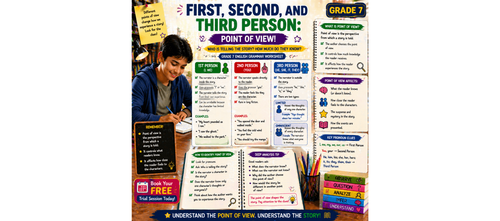

Title: First, Second, and Third Person: Grade 7 English Grammar Worksheet on Point of View
Have you ever noticed how some stories make you feel like you are right inside the character’s head, while others make you feel like you are watching from far away? That is the power of point of view. In Grade 7, learning about point of view (first, second, and third person) helps you understand who is telling the story and how much they know. In first person point of view, the narrator is a character using “I” or “we.” In second person, the narrator says “you” and speaks directly to the reader. In third person, the narrator uses pronouns like “he,” “she,” “it,” and “they.” The author chooses the point of view to control what readers know. This Grade 7 English grammar worksheet on point of view will teach you how to spot each type, understand the difference between limited and omniscient, and explain how point of view affects your reading experience.
Download these English grammar worksheets and practice regularly to strengthen your language skills and build a strong foundation. You can also book a free trial to get expert guidance and improve your reading, writing, and comprehension abilities. The worksheets are designed in a simple and structured way to help K–8 students learn grammar concepts easily and use them confidently in everyday communication.
Book a free trial!
What Is the Topic?
The topic of this worksheet is Point of View (First, Second, Third). Point of view is the perspective from which a story is told. First person point of view uses pronouns like “I” and “we.” The narrator is a character inside the story. “My heart pounded as I ran” is an example of first person. “I saw the ghost” is an example of first person point of view. Second person point of view uses the pronoun “you.” It speaks directly to the reader as if they are the character. “You opened the door and walked inside” uses second person. “You feel the cold wind on your face” is written in second person. “You should try the mango” uses second person point of view. Second person point of view is rare in long fiction. Third person point of view uses pronouns like “he,” “she,” “it,” and “they.” The narrator is outside the story. “She ran faster than him” uses third person point of view. There are two main types of third person point of view. Third person limited knows the thoughts of only one character. “Riya thought about her mistake” shows third person limited. Third person omniscient knows the thoughts of every character. The author chooses the point of view to control what readers know. The point of view affects how the reader experiences the story. The point of view controls how much knowledge the reader receives. The point of view affects how close the reader feels to the characters.
Book a free trial!
What’s in This Worksheet?
This worksheet contains five different exercises that help students master point of view (first, second, and third person). Here is what is included:
1. Exercise No. 1 – Multiple Choice Questions – Students choose the correct word to complete each sentence about point of view. This exercise tests basic definitions of first, second, and third person, as well as the difference between limited and omniscient.
2. Exercise No. 2 – Fill in the Blanks – Students complete sentences by filling in missing words related to point of view. A word bank is provided at the bottom of the page with words like first, second, third, limited, omniscient, I, you, they, reader, and knowledge.
3. Exercise No. 3 – True and False – Students read ten statements about point of view and decide whether each one is true or false. This helps correct common misunderstandings about pronouns and narration types.
4. Exercise No. 4 – Underline the Words – Students read ten sentences. For each sentence, students must identify the point of view and underline the pronoun clues that helped them decide. This exercise focuses on recognizing point of view from context.
5. Exercise No. 5 – Paragraph Writing – Students read a paragraph about point of view that has blanks. They must fill in each blank using a word from the word bank provided at the end of the paragraph. This combines reading comprehension with vocabulary application.
This worksheet supports exam preparation by covering all three points of view, the difference between limited and omniscient, and how point of view affects reader experience.
Book a free trial!
Definitions, Examples, Techniques, and Tips
Based only on the content of this worksheet, here are the exact definitions and examples students will learn:
Definitions:
- First person point of view: In first person point of view, the narrator is a character using “I” or “we.” First person narration uses the pronoun “I” throughout the story. “My heart pounded as I ran” is an example of first person. “I saw the ghost” is an example of first person point of view. “We walked to the park” uses first person point of view. First person narration can be unreliable because the character has limited knowledge.
- Second person point of view: Second person point of view uses the pronoun “you.” It speaks directly to the reader as if they are the character. “You opened the door and walked inside” uses second person. “You feel the cold wind on your face” is written in second person. “You should try the mango” uses second person point of view. The pronoun “you” is a clue for second person narration. Second person point of view is rare in long fiction.
- Third person point of view: Third person point of view uses pronouns like “he,” “she,” “it,” and “they.” The narrator is outside the story. “She ran faster than him” uses third person point of view. The pronoun “they” is a clue for third person narration. Third person narration never uses the pronoun “I” for the narrator.
- Third person limited: In third person limited, the narrator knows only one character’s thoughts. When the narrator knows only one character’s thoughts, it is third person limited. “Riya thought about her mistake” shows third person limited.
- Third person omniscient: Third person omniscient knows the thoughts of all characters. When the narrator knows every character’s thoughts, it is third person omniscient. Third person omniscient knows the thoughts of every character.
- How point of view affects reading: The author chooses the point of view to control what readers know. The point of view affects how the reader experiences the story. The point of view controls how much knowledge the reader receives. The point of view affects how close the reader feels to the characters.
Examples taken directly from the worksheet (Exercise No. 4):
1. I walked to school alone and felt nervous about the test. (First person – pronoun “I”)
2. She wondered if he would ever call her back again. (Third person – pronouns “she” and “he”)
3. They searched the entire house but found no trace of the missing key. (Third person – pronoun “they”)
4. She whispered to herself, knowing that no one else would ever understand. (Third person – pronoun “she”)
5. We gathered around the fire and told scary stories until midnight. (First person – pronoun “we”)
6. You open the door and see a strange package on the step. (Second person – pronoun “you”)
7. He looked at himself in the mirror and did not recognise his own face. (Third person – pronoun “he”)
8. I could not believe what my own eyes were showing me at that moment. (First person – pronoun “I”)
9. You have won the championship, and the crowd is cheering for you. (Second person – pronoun “you”)
10. You turn the corner and suddenly everything goes completely dark. (Second person – pronoun “you”)
Key facts from True and False section:
- First person narration uses the pronoun “you” throughout the story. (False)
- Second person narration speaks directly to the reader as if they are the character. (True)
- Third person omniscient knows the thoughts of all characters. (True)
- In third person limited, the reader knows what every character is thinking. (False)
- “I saw the ghost” is an example of first person point of view. (True)
- “You won the prize” is an example of third person point of view. (False – it is second person)
- Third person narration never uses the pronoun “I” for the narrator. (True)
- First person narration can be unreliable because the character has limited knowledge. (True)
- Second person point of view is the most common in fiction. (False)
- The point of view affects how close the reader feels to the characters. (True)
Quick learning tip: Look for the pronouns! “I” or “we” = first person. “You” = second person. “He,” “she,” “it,” or “they” = third person. Then ask: Does the narrator know one character’s thoughts (limited) or everyone’s thoughts (omniscient)?
Book a free trial!
Why Is It Important to Learn This?
Learning about point of view (first, second, and third person) is important for several reasons. First, the author chooses the point of view to control what readers know. If the author wants you to be inside one character’s head, they use first person or third person limited. If the author wants you to see everything, they use third person omniscient. Second, the point of view affects how the reader experiences the story. First person makes you feel close to the character. Second person puts you directly into the action. Third person lets you watch from outside. Third, the point of view affects how close the reader feels to the characters. A first person narrator can be unreliable because the character has limited knowledge. This creates mystery and surprise. Fourth, the point of view controls how much knowledge the reader receives. A limited point of view can create mystery and suspense. An omniscient point of view can show a bigger picture. Finally, this skill is tested in literature exams, where you may be asked to identify the point of view or explain why the author chose it.
Book a free trial!
Where Will This Knowledge Help You?
Knowledge of point of view (first, second, and third person) will help you in many academic and real-life situations:
1. Literature exams and reading comprehension tests – Many questions ask you to identify the point of view of a passage. This worksheet directly prepares you for those questions. You may also be asked to explain why the author chose that point of view.
2. Writing your own stories – When you write a story, you get to choose the point of view. Do you want the reader to be inside the main character’s head? Use first person. Do you want the reader to feel like they are in the story? Use second person. Do you want to show many characters’ thoughts? Use third person omniscient.
3. Class discussions – When your teacher asks, “From which point of view is this story told?” you will be able to answer confidently. You can also explain how the point of view affects your experience as a reader.
4. Reading novels and short stories – Once you learn to identify point of view, you will notice how different authors make different choices. Some stories feel very personal (first person). Some feel like a movie camera watching from outside (third person).
5. Analyzing why a story works – A limited point of view can create mystery and suspense. An omniscient point of view can show a bigger picture. Understanding these choices helps you appreciate what the author is doing.
6. Writing analysis essays – When you write about a book, you can discuss the point of view as part of your analysis. Explain how the author’s choice affects what the reader knows and feels.
Book a free trial!
How to Use This Worksheet?
Follow these steps to get the most out of this Grade 7 English grammar worksheet on point of view (first, second, and third person):
1. Attempt independently first – Without looking at any answers, complete all five exercises in order. Start with Exercise No. 1 (Multiple Choice Questions), then move to Exercise No. 2 (Fill in the Blanks), then Exercise No. 3 (True and False), then Exercise No. 4 (Underline the Words), and finally Exercise No. 5 (Paragraph Writing with word bank).
2. Review answers carefully – After you finish all exercises, go to the Complete Answer Key section below. Compare your answers one by one. Pay special attention to Exercise No. 4 – make sure you correctly identified the point of view for each sentence and underlined the correct pronoun clues.
3. Correct mistakes – For any answer that is different from the answer key, write the correct answer next to your attempt. Try to understand why you made the mistake. Did you confuse first person with third person? Did you forget the difference between limited and omniscient?
4. Practice regularly – Point of view can take practice to master. Repeat the worksheet after a few days. For the paragraph writing task (Exercise No. 5), try to fill in the blanks without looking at the word bank first.
The solutions follow the exact worksheet order. Students should compare their answers carefully.
Book a free trial!
Important Tips and Tricks
Here are important tips and tricks based directly on this worksheet to help you master point of view and score full marks:
1. Use the pronoun test – Look for the pronouns. “I” or “we” = first person. “You” = second person. “He,” “she,” “it,” or “they” = third person. This is the fastest way to identify point of view. The pronoun “I” is a clue for first person narration. The pronoun “you” is a clue for second person narration. The pronoun “they” is a clue for third person narration.
2. Remember: second person speaks to YOU – Second person narration speaks directly to the reader as if they are the character. It says “you” and puts you inside the action. “You open the door” means YOU are doing the opening. This point of view is rare in long fiction, so if you see “you,” think carefully.
3. Limited vs omniscient – ask “how many minds?” – In third person limited, the narrator knows only one character’s thoughts. In third person omniscient, the narrator knows every character’s thoughts. To tell the difference, ask: Can we hear what only one character is thinking, or can we hear everyone? “Riya thought about her mistake” (only Riya’s thoughts) = limited. “Riya thought about her mistake, and Raj wondered if she was okay” (two characters’ thoughts) = omniscient.
4. **First person can be unreliable** – A common mistake is thinking first person narrators always tell the truth. First person narration can be unreliable because the character has limited knowledge. The character might not understand everything that is happening, or they might be mistaken. This is not a flaw – authors do this on purpose to create mystery.
5. Third person never uses “I” for the narrator – Remember: third person narration never uses the pronoun “I” for the narrator. If you see “I” or “we” inside the story, the narrator is a character, so it is first person. If the narrator is outside the story using “he,” “she,” or “they,” it is third person.
6. What examiners expect – Examiners expect you to identify first, second, and third person correctly. They also expect you to know the difference between third person limited and third person omniscient. They may ask you to explain how point of view affects the reader. Remember: the point of view affects how close the reader feels to the characters.
7. How to score full marks – When answering multiple-choice questions, look for keywords like “I,” “we,” “you,” “he,” “she,” “it,” “they,” “limited,” “omniscient,” “narrator,” and “author.” For true and false, remember that second person is not the most common in fiction (false) and that “you won the prize” is second person, not third person (false).
8. For underlining tasks (Exercise No. 4) – Read each sentence. Decide which point of view it is. Then underline the pronoun or pronouns that gave you the clue. For first person, underline “I” or “we.” For second person, underline “you.” For third person, underline “he,” “she,” “it,” “they,” or character names.
9. For paragraph writing tasks (Exercise No. 5) – Read the entire paragraph first. Then read the word bank. Then fill in each blank one at a time. The word bank includes: story, you, they, limited, omniscient, reader, suspense, picture, emotions, connect. Read each sentence with your chosen word to make sure it makes sense.
Book a free trial!
Complete Answer Key
Below is the complete answer key for the Grade 7 English grammar worksheet on Point of View (First, Second, Third). The answers follow the exact order of the worksheet. Section names and question numbers are reproduced exactly as they appear in the worksheet.
Exercise No. 1
Choose the correct word to complete each sentence.
1. In ______ point of view, the narrator is a character using “I” or “we”.
Answer: a) first
2. “You opened the door and walked inside” uses ______ person.
Answer: b) second
3. Third person uses pronouns like “he”, “she”, “it”, and ______.
Answer: c) they
4. In third person limited, the narrator knows ______ character’s thoughts.
Answer: a) one
5. Third person omniscient knows the thoughts of ______ characters.
Answer: c) all
6. “My heart pounded as I ran” is an example of ______ person.
Answer: b) first
7. “You feel the cold wind on your face” is written in ______ person.
Answer: a) second
8. The narrator who is outside the story and uses “they” is ______ person.
Answer: c) third
9. “Riya thought about her mistake” shows ______ person limited.
Answer: b) third
10. The ______ chooses the point of view to control what readers know.
Answer: c) author
Exercise No. 2
Fill in the blanks. (Note: The worksheet provides sentences with blanks and a word bank at the bottom of the page: first, second, third, limited, omniscient, I, you, they, reader, knowledge. Based on the content of the worksheet, the expected answers are as follows.)
1. “We walked to the park” uses first person point of view.
2. The point of view affects how the reader experiences the story.
3. The pronoun you is a clue for second person narration.
4. When the narrator knows only one character’s thoughts, it is third person limited.
5. When the narrator knows every character’s thoughts, it is third person omniscient.
6. The pronoun they is a clue for third person narration.
7. “She ran faster than him” uses third person point of view.
8. The pronoun I is a clue for first person narration.
9. The point of view controls how much knowledge the reader receives.
10. “You should try the mango” uses second person point of view.
Exercise No. 3
True and False. Write True or False for each statement.
1. First person narration uses the pronoun “you” throughout the story.
Answer: False
2. Second person narration speaks directly to the reader as if they are the character.
Answer: True
3. Third person omniscient knows the thoughts of all characters.
Answer: True
4. In third person limited, the reader knows what every character is thinking.
Answer: False
5. “I saw the ghost” is an example of first person point of view.
Answer: True
6. “You won the prize” is an example of third person point of view.
Answer: False
7. Third person narration never uses the pronoun “I” for the narrator.
Answer: True
8. First person narration can be unreliable because the character has limited knowledge.
Answer: True
9. Second person point of view is the most common in fiction.
Answer: False
10. The point of view affects how close the reader feels to the characters.
Answer: True
Exercise No. 4
Identify the point of view and underline the pronoun clues.
1. I walked to school alone and felt nervous about the test.
Point of view: First person
Underline: I
2. She wondered if he would ever call her back again.
Point of view: Third person
Underline: She, he, her
3. They searched the entire house but found no trace of the missing key.
Point of view: Third person
Underline: They
4. She whispered to herself, knowing that no one else would ever understand.
Point of view: Third person
Underline: She, herself
5. We gathered around the fire and told scary stories until midnight.
Point of view: First person
Underline: We
6. You open the door and see a strange package on the step.
Point of view: Second person
Underline: You
7. He looked at himself in the mirror and did not recognise his own face.
Point of view: Third person
Underline: He, himself, his
8. I could not believe what my own eyes were showing me at that moment.
Point of view: First person
Underline: I, my, me
9. You have won the championship, and the crowd is cheering for you.
Point of view: Second person
Underline: You (both instances)
10. You turn the corner and suddenly everything goes completely dark.
Point of view: Second person
Underline: You
Exercise No. 5
Read the paragraph. Fill in each blank with a word from your understanding. Word bank: (story, you, they, limited, omniscient, reader, suspense, picture, emotions, connect)
Point of view is the perspective from which a story is told. First person uses pronouns like “I” and “we”. The narrator is a character inside the story. Second person uses the pronoun “you”. It speaks directly to the reader. This POV is rare in long fiction. Third person uses pronouns like “he”, “she”, and “they”. The narrator is outside the story. There are two main types of third person POV. Third person limited knows the thoughts of only one character. Third person omniscient knows the thoughts of every character. The author chooses a POV to control what the reader knows. A limited POV can create mystery and suspense. An omniscient POV can show a bigger picture. Each choice affects how readers experience the story. (Note: Based on the word bank and paragraph structure, “story” fits the first blank, “you” fits the second blank, “they” fits the third blank, “limited” and “omniscient” fit the next two blanks, “reader” fits the next blank, “suspense” fits the next blank, and “picture” fits the following blank. “Emotions” and “connect” are in the word bank but are not required for this paragraph as written.)
Book a free trial!
You have now completed the entire worksheet on point of view (first, second, and third person). Point of view is one of the most important choices an author makes. It decides who tells the story, how much the reader knows, and how close the reader feels to the characters. First person puts you inside a character’s head. Second person puts you directly into the action. Third person lets you watch from outside, and the author decides whether you see one character’s thoughts or everyone’s thoughts. Every time you read a story, ask yourself: Who is telling this story? What pronouns do I see? How much does the narrator know? The more you practice, the faster you will recognize point of view. Keep going – you are building skills that will make you a thoughtful, analytical, and confident reader in Grade 7 and beyond.
Book a free trial!