
Polly Put the Kettle On KG English Activity Sheet for Kids
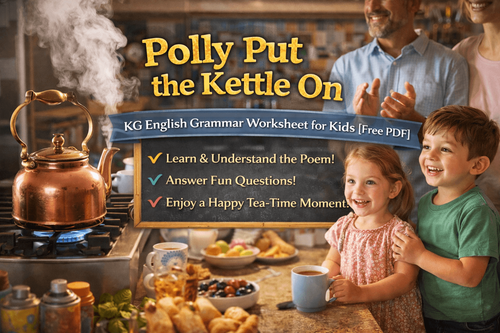

Polly Put the Kettle On – KG English Grammar Worksheet for Kids [Free PDF]
Learning English through poems can be exciting for young learners. In Grade KG, poems and rhymes help children enjoy language while building early reading and comprehension skills. One such cheerful rhyme is “Polly Put the Kettle On.” This English grammar worksheet helps children read a simple poem and answer questions about it. By understanding the story in the rhyme and recalling details, students strengthen their listening, reading, and thinking skills while having fun.
What Is Understanding Poems in English Grammar?
Understanding poems means reading a rhyme carefully and answering questions based on what happens in the poem. In Grade KG, this skill focuses on listening to simple lines, remembering events, and identifying characters and actions.
In the “Polly Put the Kettle On” English grammar worksheet, students read a short poem about a family gathering for tea. The poem shows simple actions like putting the kettle on, washing a cup, helping pick something up, and sharing tea and snacks.
Through this activity, children learn to:
• Read simple rhyming sentences
• Recognize characters in a poem
• Understand what happens in the story
• Answer questions based on the poem
This helps students develop early comprehension skills, which are important for both grammar learning and reading development.
What’s in This Worksheet?
This Grade KG English grammar worksheet includes simple poem comprehension activities designed for early learners.
1. Read the poem
Students first read the rhyme “Polly Put the Kettle On.” The poem tells a small story about a family preparing tea together.
2. Answer the questions
After reading the poem, students answer questions related to the characters and actions mentioned in the rhyme.
3. Recall important details
The questions help students remember who did certain actions in the poem and what happened during the tea-time moment.
4. Practice reading comprehension
By answering questions based on the poem, students practice understanding what they read.
5. Build vocabulary and listening skills
Words like kettle, steam, whistle, tea, and snacks help young learners connect everyday actions with language.
Definitions, Examples, Techniques, and Tips
Definition of a poem
A poem is a short piece of writing that often uses rhythm and rhyme. Poems are fun to read aloud and easy for children to remember.
Example from the worksheet
The poem in this worksheet tells a small story where:
Polly puts the kettle on.
Mummy comes smiling.
Brother washes a cup.
Sister helps and picks it up.
Steam goes up from the kettle.
The whistle sings.
Papa claps his hands.
The tea is hot.
The family shares snacks.
The children laugh together.
Technique for understanding poems
When reading a poem, students should:
• Read the poem slowly
• Notice the characters in the poem
• Look for actions happening in the poem
• Remember the order of events
This makes answering questions easier.
Tip for KG students
If a question asks “Who did something?”, look back at the poem and find the person who performed that action.
If a question asks “What happened?”, look for the line in the poem that explains it.
Why Is It Important to Learn This?
Learning through poems is very helpful for young learners.
First, poems help children improve their listening and reading skills. The rhythm and repetition make words easier to remember.
Second, poems introduce new vocabulary. Words like kettle, steam, whistle, and snacks help children learn everyday English words.
Third, answering questions about a poem builds comprehension. Students learn how to find information from what they read.
Finally, poems make learning enjoyable. When children enjoy reading, they become more confident learners.
Where Will This Knowledge Help You?
Understanding poems is useful in many situations.
In school exams
Students are often asked questions based on poems or short passages. Practicing worksheets like this helps them answer correctly.
In reading practice
When children read stories or rhymes, comprehension skills help them understand what they read.
In classroom participation
Students who understand poems can answer teacher questions confidently during class discussions.
In speaking and storytelling
When children remember events from a poem, they can retell the story in their own words.
How to Use This Worksheet?
Follow these steps to use this English grammar worksheet effectively.
1. Read the poem carefully
Start by reading the poem “Polly Put the Kettle On.” Try to understand what is happening in the rhyme.
2. Identify the characters
Notice the people mentioned in the poem, such as Polly, Mummy, Brother, Sister, and Papa.
3. Attempt the questions independently
Try to answer each question based on what you remember from the poem.
4. Check the answers carefully
Compare your responses with the answer key provided below.
5. Practice regularly
Reading more poems and answering questions will improve comprehension and vocabulary.
The solutions below follow the exact worksheet order so students can compare their answers easily.
Important Tips and Tricks
1. Read the poem more than once
Reading the poem again helps you remember the details.
2. Look for names in the poem
Many questions ask about people. Identifying names helps answer them correctly.
3. Pay attention to actions
Notice who performs each action in the poem.
4. Focus on key words
Words like kettle, steam, whistle, tea, and snacks are important clues for answering questions.
5. Think about the story
The poem describes a family tea-time moment. Understanding the story makes the questions easier.
Complete Answer Key
Exercise 1 – Read the Poem
Polly put the kettle on, quick and neat,
Mummy came smiling, time to eat.
Brother washed the little cup,
Sister helped and picked it up.
Steam went dancing from the spout,
Whistle sang so loud and stout.
Papa clapped his hands in glee,
“Pour the hot and tasty tea!”
Snacks were shared for everyone,
Children laughed and had such fun.
Exercise 2 – Answer the Questions
1. Who put the kettle on?
Polly
2. Who came smiling to the room?
Mummy
3. What did Brother wash?
Cup
4. Who helped and picked it up?
Sister
5. What went up from the kettle?
Steam
6. What did the whistle do?
Sang
7. Who clapped his hands?
Papa
8. How was the tea?
Hot
9. What did the family share?
Snacks
10. How did the children feel?
Laughing
Practicing poems like “Polly Put the Kettle On” helps Grade KG students build strong reading and comprehension skills. This English grammar worksheet encourages children to enjoy rhymes while learning how to understand simple stories and answer questions based on what they read. With regular practice, students become more confident readers and develop a love for language learning.