
Practice Vocabulary in Short Passages: Free Grade 8 Worksheet
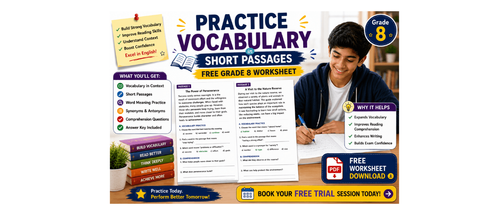

Strengthen Reading Skills With This Grade 8 English Grammar Worksheet on Vocabulary in Short Passages
Reading short passages carefully helps students improve vocabulary, understanding, and interpretation skills. This Grade 8 English grammar worksheet on Vocabulary in Short Passages is designed to help learners understand how words, tone, mood, clues, and context work together in small reading sections. Through engaging vocabulary-based grammar exercises, students practice identifying meaningful words and understanding how vocabulary shapes the message of a passage.
The worksheet introduces learners to important vocabulary concepts such as interpret, relevant, positive, attentive, concise, and emotion. Students also practice understanding clues, identifying mood and tone, and using context to infer meaning from short passages. These activities help learners become stronger readers and more confident writers.
With multiple-choice questions, fill in the blanks, true and false activities, vocabulary review, and sentence writing tasks, this worksheet supports vocabulary development in a clear and structured way. The exercises are useful for grammar practice, reading comprehension improvement, and exam preparation.
Download these English grammar worksheets and practice regularly to strengthen your language skills and build a strong foundation. You can also book a free trial to get expert guidance and improve your reading, writing, and comprehension abilities. The worksheets are designed in a simple and structured way to help K–8 students learn grammar concepts easily and use them confidently in everyday communication.
What Is the Topic?
Vocabulary in Short Passages focuses on understanding important words and meanings within small reading sections. This topic helps students improve comprehension by teaching them how to use context clues, identify tone and mood, and understand the purpose of vocabulary in passages.
In this Grade 8 English grammar worksheet, students learn how to analyze short passages using meaningful vocabulary words. Learners practice identifying clues, understanding emotions in diction, interpreting meanings, and recognizing how titles and phrases guide understanding.
Students are also expected to understand how concise writing works and how vocabulary helps improve clarity and communication. By practicing short-passage vocabulary regularly, students strengthen reading skills, comprehension abilities, and sentence understanding.
What’s in This Worksheet?
1. Multiple-choice questions that help students select the best vocabulary word for each short passage sentence.
2. Fill in the blanks activities that use vocabulary words connected to clues, meanings, mood, tone, and interpretation.
3. True and false statements that check understanding of context clues, concise writing, vocabulary usage, and meaning.
4. Vocabulary review exercises that focus on understanding short passages and improving clarity in meaning.
5. Sentence-writing activities that encourage students to create meaningful sentences using words such as context, tone, mood, infer, concise, and emotion.
6. Structured grammar and vocabulary activities that support reading comprehension and vocabulary improvement.
7. Exercises that help students prepare for grammar-based and comprehension-based exam questions.
Definitions, Examples, Techniques, and Tips
Vocabulary in short passages refers to the important words and clues that help readers understand meaning in a small text section. These words guide readers toward understanding tone, mood, context, and overall meaning.
The worksheet includes examples such as:
“Riya analyzed the short passage.”
“The title gives a valuable hint.”
“Ravi can interpret the meaning.”
These examples help students understand how vocabulary supports reading comprehension.
Students also practice vocabulary words such as:
• context
• clue
• tone
• mood
• infer
• concise
• emotion
The worksheet teaches students how vocabulary can reveal ideas, feelings, and meaning in a short passage.
One useful technique while solving short-passage vocabulary exercises is to read the full sentence carefully before selecting an answer. Students should focus on clue words and sentence meaning.
Another helpful strategy is to use context to understand unfamiliar words. Nearby words and sentence tone often help readers identify correct meanings.
Students should also practice identifying mood and tone because emotions and attitudes are often expressed through vocabulary choices in passages.
Why Is It Important to Learn This?
Learning vocabulary in short passages helps students improve reading comprehension and interpretation skills. Strong vocabulary understanding allows learners to understand meanings quickly and accurately.
This topic also teaches students how context and clues support understanding. These skills are useful in reading comprehension tasks, grammar exercises, and academic writing activities.
By practicing short-passage vocabulary regularly, students become more confident while reading stories, informational texts, and exam passages. Learners also improve their ability to identify emotions, meanings, and key ideas in short texts.
For Grade 8 students, understanding vocabulary in passages also strengthens communication skills and improves sentence analysis abilities.
Where Will This Knowledge Help You?
1. In reading comprehension sections during school exams.
2. While answering vocabulary-based grammar questions.
3. During classroom discussions related to passages and stories.
4. In paragraph writing and comprehension activities.
5. While identifying tone, mood, and meaning in reading tasks.
6. During grammar revision and vocabulary improvement exercises.
7. In improving overall reading fluency and interpretation skills.
How to Use This Worksheet?
1. Read each sentence and passage carefully before answering.
2. Attempt all multiple-choice questions independently using context clues.
3. Use the word bank carefully while solving the fill in the blanks section.
4. Review every true and false statement properly before selecting the answer.
5. Focus on important vocabulary words related to tone, mood, clues, and meaning.
6. Practice writing clear and meaningful sentences in the sentence-writing section.
7. Compare your answers carefully with the answer key after completing the worksheet.
8. The solutions follow the exact worksheet order, so students should review answers step by step.
9. Correct mistakes carefully and practice difficult vocabulary regularly for improvement.
Important Tips and Tricks
1. Read the full sentence carefully before selecting a vocabulary word.
2. Use context clues to understand unfamiliar words.
3. Pay attention to tone and mood while reading passages.
4. Titles and phrases often provide useful hints about meaning.
5. Concise writing avoids unnecessary words and improves clarity.
6. Emotion and diction help readers understand the writer’s attitude.
7. Examiners usually expect students to identify vocabulary meaning correctly from context.
8. Practice inference skills regularly to improve reading comprehension.
9. While writing sentences, use vocabulary naturally and clearly.
10. Regular passage reading improves vocabulary understanding and confidence.
Complete Answer Key
Exercise No. 1
1. analyzed
2. evidence
3. attentive
4. positive
5. relevant
6. interpret
7. valuable
8. abruptly
9. feelings
10. briefness
Exercise No. 2
1. analyzed
2. evidence
3. attentive
4. positive
5. relevant
6. interpret
7. valuable
8. abruptly
9. feelings
10. briefness
Exercise No. 3
1. Short passages can contain clues. – True
2. Context helps word meaning. – True
3. Tone is never shown by words. – False
4. A title may guide meaning. – True
5. Relevant details support ideas. – True
6. Readers can infer meanings. – True
7. Every word has one meaning. – False
8. Concise writing avoids extra words. – True
9. Emotion can appear in diction. – True
10. Short texts never need vocabulary. – False
Exercise No. 4
1. short passage
2. word meanings
3. tone
4. title
5. useful clue
6. guides reading
7. paragraph
8. reading event
9. compares meanings
10. teaches vocabulary
Exercise No. 5 – Sample Sentence Answers
1. Context – The context helped me understand the difficult word.
2. Clue – The title gave a clue about the story.
3. Tone – The speaker used a friendly tone during the discussion.
4. Mood – The passage created a cheerful mood.
5. Infer – Readers can infer the meaning from the sentence.
6. Concise – Her answer was concise and clear.
7. Emotion – The poem showed strong emotion.
8. Title – The title explains the main idea of the passage.
9. Passage – The short passage teaches an important lesson.
10. Clue – The final sentence gives a clue about the ending.
This Grade 8 English grammar worksheet on Vocabulary in Short Passages helps students strengthen vocabulary understanding, reading comprehension, and interpretation skills through engaging grammar activities. Regular practice with short-passage vocabulary improves confidence in reading, sentence analysis, and understanding context clues. By solving these structured exercises, learners become more skilled at identifying meaning, tone, mood, and important details in passages.
Book a free trial!