
Precision in Language Worksheet Grade 7 – Grammar Practice PDF
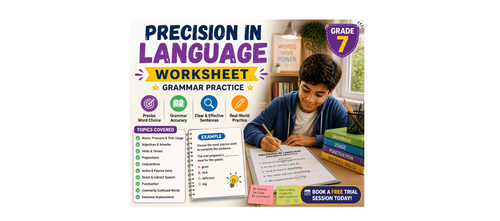

Mastering Editing for Precision in Language: English Grammar Worksheet for Grade 7 Students
Have you ever written an answer that felt unclear or confusing, even though you knew the topic well? This often happens when we use words that are not precise. In Grade 7, learning how to choose the right words is an important step in improving writing skills. The topic Editing for Precision in Language helps students understand how to make their sentences clearer, more accurate, and easier to understand.
This English grammar worksheet for Grade 7 focuses on helping students improve their ability to edit sentences by choosing the most precise and meaningful words. Through different types of exercises, students learn how to replace vague words with clear and specific ones. This makes writing stronger and more effective in both school assignments and real-life communication.
Download these English grammar worksheets and practice regularly to strengthen your language skills and build a strong foundation. You can also book a free trial to get expert guidance and improve your reading, writing, and comprehension abilities. The worksheets are designed in a simple and structured way to help K–8 students learn grammar concepts easily and use them confidently in everyday communication.
What Is the Topic?
Editing for Precision in Language means choosing the most accurate and clear words while writing. Instead of using vague or confusing words, students learn to select words that clearly express their ideas.
This topic teaches students how to:
- Use precise words instead of vague ones
- Improve clarity in sentences
- Make writing more meaningful and easy to understand
- Avoid confusion in communication
Students are expected to understand the importance of clear language and how editing can improve the quality of their writing.
What’s in This Worksheet?
This worksheet includes different types of exercises to help students practice precision in language:
1. Multiple Choice Questions
Students choose the most precise word for each sentence.
2. Fill in the Blanks
Students complete sentences using precise words from a given word bank.
3. True and False
Students read statements and decide whether they are true or false.
4. Underline the Words
Students identify nouns and verbs by underlining and circling them.
5. Sentence Writing
Students create their own sentences using given words related to precision.
These exercises help students build strong grammar skills and prepare for exams by improving their understanding of clear and accurate language.
Definitions, Examples, Techniques, and Tips
Definitions:
- Precise words are words that give clear and exact meaning.
- Vague words are words that are unclear or confusing.
- Specific words give detailed and clear meaning.
Examples:
- The report gives accurate data on rainfall.
- Riya used precise words in her answer.
- Ravi added specific details to his paragraph.
Techniques:
- Choose words that clearly explain your idea.
- Avoid using confusing or random words.
- Use accurate and specific details in writing.
Quick learning tips:
- Clear language helps readers understand better.
- Editing improves the quality of writing.
- Precision avoids confusion.
Why Is It Important to Learn This?
Learning Editing for Precision in Language is important because it helps students communicate clearly. When writing is clear, readers can easily understand the message.
This topic:
- Improves writing skills
- Helps in giving clear explanations
- Makes answers more accurate
- Builds confidence in communication
It is especially useful in exams where clear and precise answers are required.
Where Will This Knowledge Help You?
This knowledge is useful in many areas:
- Exams: Writing clear and correct answers helps score better marks.
- Writing tasks: Essays, reports, and paragraphs become more effective.
- Class participation: Students can explain ideas clearly during discussions.
Using precise language makes communication strong and meaningful.
How to Use This Worksheet?
Follow these steps to get the best results:
1. Attempt independently first
Try to answer all questions on your own.
2. Review answers carefully
Check each answer after completing the worksheet.
3. Correct mistakes
Identify errors and understand why they are incorrect.
4. Practice regularly
Regular practice will improve your accuracy and confidence.
The solutions follow the exact worksheet order, so students should compare answers carefully.
Important Tips and Tricks
1. Avoid vague words
Words like “something” or “things” make sentences unclear.
2. Use specific details
Always try to add clear and exact information.
3. Focus on clarity
Choose words that are easy to understand.
4. Do not use confusing language
Avoid random or unclear words in sentences.
5. Practice sentence writing
Writing your own sentences helps improve precision.
6. Understand question instructions
Read each instruction carefully before answering.
7. Be accurate in answers
Use correct and meaningful words.
Complete Answer Key
Exercise No. 1
Choose the most precise word for each sentence.
1. The report gives ______ data on rainfall.
c) accurate
2. Riya used ______ words in her answer.
b) precise
3. The guide gives ______ steps to follow.
b) clear
4. Ravi added ______ details to his paragraph.
b) specific
5. Meera explained the topic ______.
a) clear
6. The article presents ______ facts.
c) accurate
7. The teacher used ______ language in class.
b) simplified
8. The chart shows ______ results of the survey.
b) precise
9. The paragraph needs ______ sentences.
b) clear
10. The brochure provides ______ instructions.
c) specific
Exercise No. 2
Fill the blanks using precise words from the bank.
1. The report gives ______ data.
2. Riya wrote ______ answers.
3. The guide explains steps ______.
4. Ravi added ______ points.
5. Meera used ______ language.
6. The article presents facts ______.
7. The teacher gives ______ explanations.
8. The chart shows results ______.
9. The paragraph uses ______ sentences.
10. The brochure shares ______.
accurately precisely specificity detailedly information clearly now clear words simplified correctly process
Exercise No. 3
Read each statement and mark True or False.
1. Precise words improve clarity. – True
2. Vague words help understanding. – False
3. Specific words give clear meaning. – True
4. Precision is not important in writing. – False
5. Clear language helps readers. – True
6. Reports need accurate details. – True
7. Long words are always precise. – False
8. Editing improves precision. – True
9. Precision avoids confusion. – True
10. All writing must be vague. – False
Exercise No. 4
Underline the noun and circle the verb in each sentence.
1. Riya writes precise answers in class.
2. Meera reads the article carefully.
3. Asha draws a neat diagram.
4. The class learns new ideas daily.
5. The teacher gives clear instructions.
6. Ravi explains the topic clearly.
7. The guide shows steps clearly.
8. Raj prepares notes for exams.
9. Students complete tasks accurately.
10. The report shows correct data.
Exercise No. 5
Write sentences using words about precision.
1. Use precise in a sentence about writing.
Answers may vary.
2. Use clear in a sentence about explanation.
Answers may vary.
3. Use specific in a sentence about details.
Answers may vary.
4. Use explain in a sentence about teaching.
Answers may vary.
5. Use data in a sentence about reports.
Answers may vary.
6. Use report in a sentence about information.
Answers may vary.
7. Use accurate in a sentence about facts.
Answers may vary.
8. Write a sentence about clear language.
Answers may vary.
9. Write a sentence about precise words.
Answers may vary.
10. Write a sentence about accuracy.
Answers may vary.
This Grade 7 English grammar worksheet on Editing for Precision in Language is a great way to build strong writing skills. By practicing regularly, students can learn to express their ideas clearly and confidently. Keep practicing, stay focused, and you will see improvement in your writing abilities over time.
Book a free trial!