
Prefixes and Suffixes Activities for Class 3 Learners
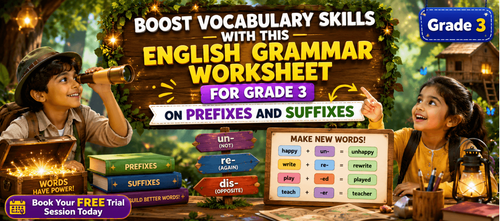

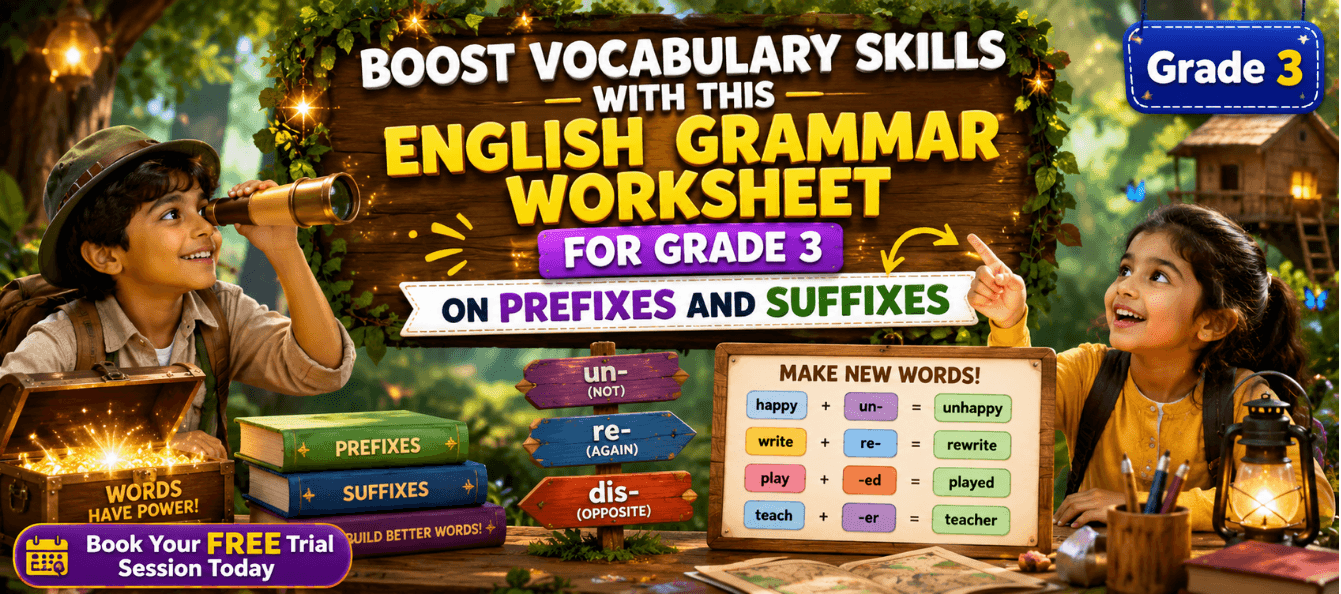
Boost Vocabulary Skills with This English Grammar Worksheet for Grade 3 on Prefixes and Suffixes
Learning prefixes and suffixes can be exciting when students practice through fun and simple activities. This English grammar worksheet for Grade 3 on Prefixes and Suffixes helps young learners understand how words change when letters are added at the beginning or end of base words. Through fill-in-the-blanks, sorting activities, and sentence-based exercises, students get the chance to improve vocabulary, reading, and writing skills in an engaging way.
Prefixes and suffixes are important building blocks in English grammar. By practicing them regularly, Grade 3 learners can easily understand word meanings, improve spelling, and become more confident while reading sentences and writing answers in class. This worksheet includes multiple activities that make learning interactive and enjoyable for children.
Download these English grammar worksheets and practice regularly to strengthen your language skills and build a strong foundation. You can also book a free trial to get expert guidance and improve your reading, writing, and comprehension abilities. The worksheets are designed in a simple and structured way to help K–8 students learn grammar concepts easily and use them confidently in everyday communication.
What Is the Topic?
This worksheet focuses on prefixes and suffixes. A prefix is a group of letters added to the beginning of a word. It changes the meaning of the word. A suffix is a group of letters added to the end of a word. It can change the word’s form or meaning.
The worksheet explains different examples of prefixes and suffixes in a simple way. Students learn how words can change by adding prefixes such as un-, re-, and dis-. They also learn suffixes like -ed, -ing, and -er.
Students are expected to:
• Identify prefixes and suffixes
• Form new words correctly
• Understand base words
• Use prefixes and suffixes in sentences
• Improve vocabulary and grammar skills
What’s in This Worksheet?
1. Word-building activities where students add prefixes or suffixes to base words.
2. Sorting activities where students place words under the correct prefix or suffix group.
3. Sentence completion exercises using the correct prefix or suffix.
4. Base word identification practice.
5. Vocabulary-building exercises that improve reading and writing skills.
6. Structured grammar activities that help students prepare for school assignments and exams.
7. Simple and engaging exercises suitable for Grade 3 learners.
Definitions, Examples, Techniques, and Tips
A prefix is added at the beginning of a word.
Examples:
• un- + happy = unhappy
• re- + write = rewrite
• dis- + like = dislike
A suffix is added at the end of a word.
Examples:
• play + ed = played
• read + ing = reading
• teach + er = teacher
Students can learn prefixes and suffixes better by:
• Reading each base word carefully
• Looking at the instruction before answering
• Understanding whether a prefix or suffix is needed
• Practicing word formation regularly
Quick learning tips:
• Prefixes usually come before the word.
• Suffixes usually come after the word.
• Read the sentence carefully before choosing the correct word form.
• Identify the base word first.
Why Is It Important to Learn This?
Learning prefixes and suffixes helps students understand new words more easily. It improves vocabulary and strengthens reading comprehension. Students can also write better sentences when they know how words change with prefixes and suffixes.
This topic is important because:
• It improves spelling skills.
• It helps students understand word meanings.
• It builds stronger grammar knowledge.
• It improves sentence formation.
• It supports better reading and writing skills.
Students who practice prefixes and suffixes regularly become more confident in communication and classroom activities.
Where Will This Knowledge Help You?
Students can use prefixes and suffixes in many everyday learning situations.
This knowledge helps in:
• School grammar tests
• Reading comprehension exercises
• Creative writing tasks
• Sentence construction
• Vocabulary-building activities
• Classroom discussions
• Homework assignments
Understanding prefixes and suffixes also helps students learn new words faster while reading books and stories.
How to Use This Worksheet?
1. Read the instructions carefully before starting each activity.
2. Attempt every question independently first.
3. Check whether the exercise asks for a prefix, suffix, or base word.
4. Complete the exercises in the correct order.
5. Compare your answers carefully with the solutions.
6. Practice difficult words again to improve understanding.
7. Revise prefixes and suffixes regularly for better grammar skills.
8. The solutions follow the exact worksheet order, so students should compare answers carefully.
Important Tips and Tricks
1. Read the instruction before answering each question.
2. Do not confuse prefixes with suffixes.
3. Prefixes come before the word, while suffixes come after the word.
4. Check the spelling after adding a prefix or suffix.
5. Identify the base word carefully before forming a new word.
6. In sentence-based questions, read the complete sentence before answering.
7. Practice word-building activities regularly to improve vocabulary.
8. Examiners expect correct spelling and proper word formation.
9. Write answers neatly and in the correct order.
10. Review mistakes carefully and practice similar words again.
Complete Answer Key
Exercise 1
1. Help → helper
2. Use → misuse
3. Teach → teacher
4. Read → reread
5. Walk → walked
6. Kind → unkind
7. Pack → unpack
8. Thank → thankful
9. Play → replay
10. Fair → unfair
Exercise 2
UN-
• unfair
• unwell
• unkind
• unsafe
• unlock
DIS-
• dislike
• disable
• disobey
• disown
-ED
• walked
• painted
• smiled
• cooked
-ING
• singing
• dancing
• reading
• writing
• drawing
Exercise 3
1. She was very unfair to her brother.
2. I will reread the book again.
3. He is a good helper.
4. Please don’t disobey your teacher.
5. We are playing a fun game.
6. I have finished my homework.
7. He felt unhappy in the morning.
8. Let’s reopen the gift box.
9. She is drawing a flower.
10. He cleaned the table after dinner.
Exercise 4
1. Unhappy → happy
2. Replay → play
3. Helper → help
4. Cleaned → clean
5. Drawing → draw
6. Unfair → fair
7. Dislike → like
8. Reread → read
9. Jumped → jump
10. Singer → sing
Practicing this English grammar worksheet for Grade 3 on Prefixes and Suffixes is a wonderful way for students to improve vocabulary, spelling, and sentence-building skills. Regular grammar practice helps learners become more confident readers and writers. By solving activities in the correct order and understanding how prefixes and suffixes work, students can strengthen their grammar foundation and perform better in school activities and exams.