
Prepositions with Pictures Worksheet for Class 1 English
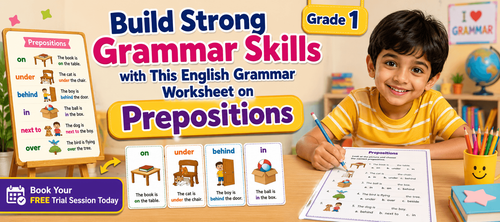

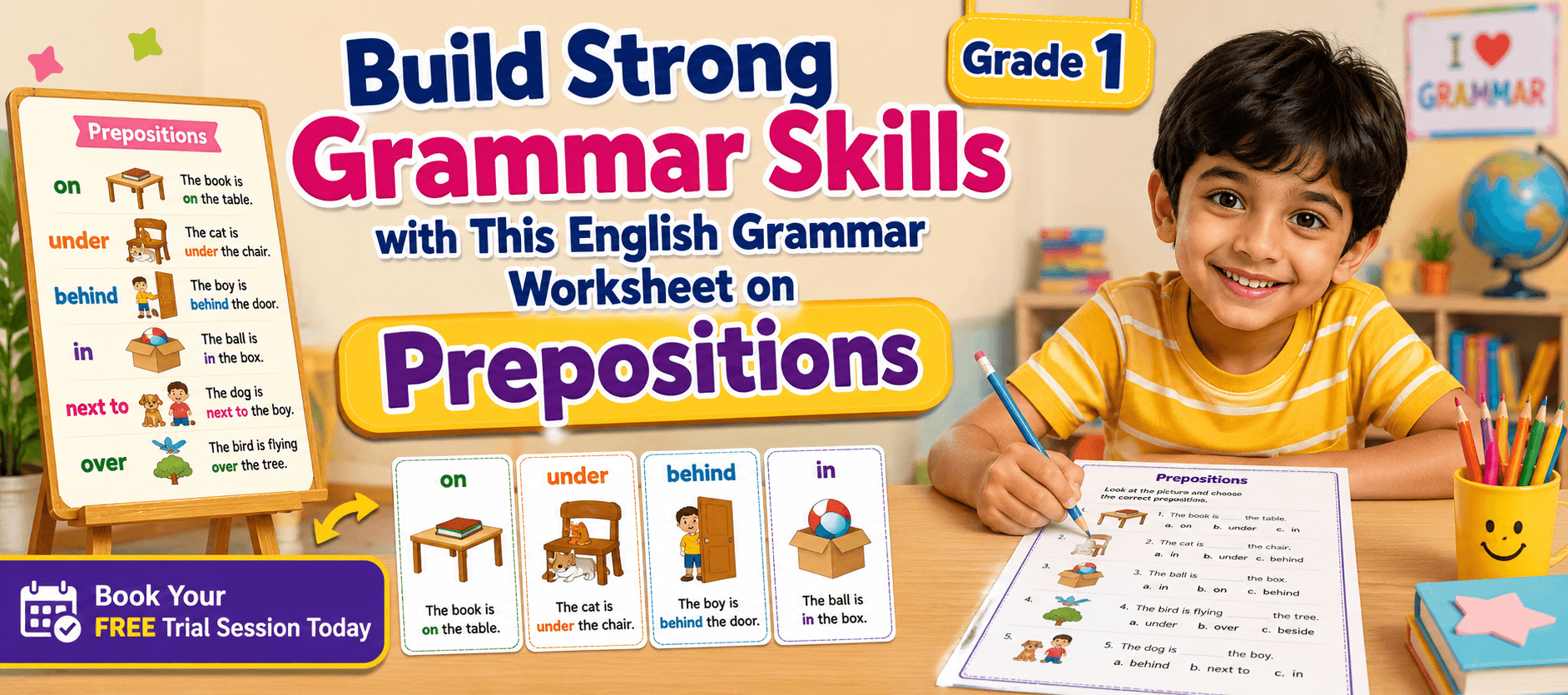
Build Strong Grammar Skills with This English Grammar Worksheet for Grade 1 on Prepositions
Understanding prepositions is an important part of learning English grammar in early classes. Young learners use words like “on,” “under,” and “behind” every day while speaking, reading, and describing things around them. This English grammar worksheet for Grade 1 on Prepositions helps children learn how to describe the position of objects and people in a simple and engaging way.
For Grade 1 students, grammar learning becomes easier when examples are connected to everyday life. This worksheet introduces common prepositions using clear examples and practice exercises. Students learn how to identify where something is placed and how to use the correct preposition in sentences. Through multiple-choice questions, fill-in-the-blanks, crossword activities, and true or false exercises, children get structured practice that strengthens their understanding of grammar concepts.
Download these English grammar worksheets and practice regularly to strengthen your language skills and build a strong foundation. You can also book a free trial to get expert guidance and improve your reading, writing, and comprehension abilities. The worksheets are designed in a simple and structured way to help K–8 students learn grammar concepts easily and use them confidently in everyday communication.
What Is the Topic?
Prepositions are words that tell us where something is.
In this Grade 1 English grammar worksheet, students learn common prepositions that describe position and location. The worksheet introduces simple prepositions with examples that are easy for children to understand.
Some examples included in the worksheet are:
• in – The ball is in the box.
• behind – The boy is behind the door.
• under – The cat is under the chair.
• on – The book is on the table.
• next to – The dog is next to the boy.
• over – The bird is flying over the tree.
Students are expected to understand how prepositions are used in sentences and choose the correct word based on the position described.
What’s in This Worksheet?
1. A simple introduction explaining what prepositions are with easy examples.
2. Multiple-choice questions where students choose the correct preposition to complete sentences.
3. Fill in the blanks activities using suitable prepositions from given options.
4. A crossword activity based on prepositions and clues.
5. A true or false activity where students read sentences and match them with an image.
6. Exercises that focus on understanding position words like on, under, behind, over, beside, and next to.
7. Structured grammar practice designed especially for Grade 1 students.
8. Activities that help students improve sentence understanding and grammar skills for school exercises and exams.
Definitions, Examples, Techniques, and Tips
Definition:
Prepositions are words that tell us where something is.
Examples from the worksheet:
• in – The ball is in the box.
• behind – The boy is behind the door.
• under – The cat is under the chair.
• on – The book is on the table.
• next to – The dog is next to the boy.
• over – The bird is flying over the tree.
Techniques:
• Read the complete sentence carefully before choosing the preposition.
• Look at the position being described.
• Practice identifying the location of objects around you.
• Match the sentence with the correct place or direction word.
Quick learning tips:
• “On” shows something placed above a surface.
• “Under” shows something below another object.
• “Behind” shows something at the back.
• “In” shows something inside.
• “Next to” and “beside” show closeness.
• “Over” shows movement above something.
Why Is It Important to Learn This?
Learning prepositions is important because they help students describe positions and locations clearly. These words are used regularly in speaking, writing, and reading activities. Prepositions make sentences more meaningful and help children communicate correctly.
This grammar topic also helps students:
• Describe objects and places correctly
• Improve sentence formation
• Understand directions and positions
• Build better communication skills
• Strengthen grammar understanding
For Grade 1 learners, prepositions build a strong foundation for future grammar learning and everyday communication.
Where Will This Knowledge Help You?
Prepositions are useful in many daily situations and school activities.
• In classroom activities, students use prepositions while describing pictures and objects.
• During grammar exams and worksheets, prepositions are commonly tested.
• In conversations, prepositions help children explain positions clearly.
• While reading stories, students understand locations and actions better.
• During writing tasks, prepositions make sentences more complete and meaningful.
This knowledge helps students both in academics and in daily communication.
How to Use This Worksheet?
1. Read the examples of prepositions carefully before attempting the exercises.
2. Observe the sentence and identify the position being described.
3. Attempt all questions independently first.
4. Complete the exercises in the exact order given in the worksheet.
5. Review your answers carefully after completing each section.
6. Compare your responses with the complete answer key below.
7. Correct mistakes and practice difficult questions again.
8. For crossword and image-based activities, follow the worksheet instructions carefully.
9. Practice regularly to improve grammar and sentence-building skills.
Important Tips and Tricks
1. Read every sentence carefully before selecting a preposition.
2. Focus on position words such as:
• on
• under
• behind
• beside
• over
• in
3. Do not confuse “in” and “on.”
4. Observe picture-based clues carefully in image activities.
5. In multiple-choice questions, eliminate incorrect options first.
6. Practice describing the location of objects around you.
7. Examiners expect students to understand the meaning of each preposition correctly.
8. Follow worksheet instructions carefully in crossword and true or false activities.
9. Review all answers before submitting the worksheet.
Complete Answer Key
PREPOSITIONS
Prepositions are words that tell us where something is.
in – The ball is in the box.
behind – The boy is behind the door.
under – The cat is under the chair.
on – The book is on the table.
next to – The dog is next to the boy.
over – The bird is flying over the tree.
Exercise 1
Choose the correct preposition to complete each sentence.
1. The book is on the table.
a. of
b. on
c. if
2. He sat next to his friend.
a. next to
b. above
c. inside
3. The ball went into the box.
a. around
b. on
c. into
4. The bird flew over the tree.
a. over
b. under
c. in
5. The toy is behind the bag.
a. behind
b. in
c. beside
6. She walked through the door.
a. under
b. between
c. through
7. The puppy is hiding under the bed.
a. under
b. over
c. of
8. The keys are on the table.
a. of
b. on
c. inside
Exercise 2
Fill in the blanks with the correct preposition.
1. The cat is under the table. (under/on)
2. The book is in the bag. (in/on)
3. The ball is behind the chair. (behind/above)
4. She is sitting on the sofa. (on/in)
5. The stars shine in the sky. (in/under)
6. The puppy is hiding under the bed. (under/between)
7. The clock is on the wall. (on/beside)
8. He is standing beside his friend. (beside/in)
Exercise 3
Look at the clues given below and fill the prepositions in the crossword.
Clues:
Down
Across
Answers may vary.
Exercise4
Read each sentence and tick True or False based on the image given below.
1. The lamp is on the table.
True False
2. The mirror is behind the bed.
True False
3. The rug is under the bed.
True False
4. The plant is next to the bed.
True False
5. The window is above the bed.
True False
6. The pillow is on the bed.
True False
This English grammar worksheet for Grade 1 on Prepositions gives students an easy and enjoyable way to practice important grammar skills. Through regular practice, children can learn how to describe positions clearly and use correct prepositions in sentences confidently. The exercises in this worksheet support better speaking, reading, and writing skills while making grammar learning simple and engaging for young learners.