
Printable Informative Writing Worksheet for Grade 2 Kids
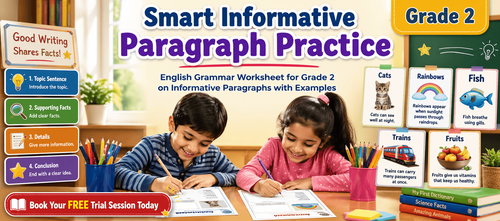

Smart Informative Paragraph Practice: English Grammar Worksheet for Grade 2 on Informative Paragraphs with Examples
Learning to share facts clearly is an important step in a child’s writing journey. In Grade 2, students begin writing informative paragraphs where they explain real topics using simple sentences, facts, and clear ideas. Informative writing helps children understand how to organize information so readers can easily learn something new.
This English grammar worksheet for Grade 2 on Informative Paragraphs with Examples gives young learners structured practice in writing about familiar topics such as cats, rainbows, fish, trains, and fruits. Each activity focuses on building the ability to introduce a topic, include facts, and complete a paragraph properly.
Students learn how to write topic sentences, add supporting facts, and conclude their ideas clearly. These exercises encourage logical thinking, improve sentence structure, and help children gain confidence in presenting information through writing.
Download these English grammar worksheets and practice regularly to strengthen your language skills and build a strong foundation. You can also book a free trial to get expert guidance and improve your reading, writing, and comprehension abilities. The worksheets are designed in a simple and structured way to help K–8 students learn grammar concepts easily and use them confidently in everyday communication.
What Is Informative Paragraph Writing?
Informative paragraph writing teaches students how to explain a topic using facts and clear sentences. In Grade 2, students learn to organize information into a paragraph that begins with a topic sentence, includes supporting facts, and ends with a conclusion.
The purpose of informative writing is to share knowledge. Students focus on real information rather than storytelling. They learn to introduce a topic, provide facts related to it, and complete the paragraph with a clear ending statement.
This worksheet helps students practice informative writing by guiding them to include specific parts such as topic sentences, facts, and conclusions while writing about everyday subjects.
What’s in This Worksheet?
1. Informative paragraph writing tasks based on familiar topics.
2. Activities that guide students to write using topic sentences and supporting facts.
3. Exercises that require two facts to support the main idea.
4. Practice in writing conclusion sentences to complete paragraphs properly.
5. Structured writing prompts that help students understand paragraph organization.
6. Activities designed to strengthen writing skills useful for school assignments and exams.
Definitions, Examples, Techniques, and Tips
Definitions
An informative paragraph is a group of sentences that explain a topic using facts and clear information.
Examples From the Worksheet
Students write about Cats using two facts.
Students write about Rainbows with a topic sentence and facts.
Students explain Fish using a topic sentence, facts, and a conclusion.
Students describe Trains using organized paragraph structure.
Students explain Fruits using informative facts and a conclusion.
Techniques Used in the Worksheet
Writing a clear topic sentence to introduce the subject.
Adding facts that support the topic.
Using examples provided in the worksheet.
Ending the paragraph with a conclusion sentence.
Quick Learning Tips
Read the topic carefully before writing.
Include all required parts mentioned in the instructions.
Keep information simple and clear.
Make sure facts relate directly to the topic.
Why Is It Important to Learn This?
Informative writing helps students communicate ideas clearly and confidently. It improves thinking skills because learners must select correct facts and arrange them logically.
This skill supports academic growth by helping students answer descriptive questions in exams. Informative paragraph writing also strengthens reading comprehension and speaking skills because students learn to present information in an organized way.
Where Will This Knowledge Help You?
Students use informative writing in many learning situations:
During school exams that require paragraph writing.
In classroom assignments based on facts and explanations.
While participating in discussions where information must be shared clearly.
When explaining real-world topics in projects and presentations.
How to Use This Worksheet?
1. Read each instruction carefully before starting.
2. Write the paragraph independently using the required format.
3. Include topic sentences, facts, and conclusions exactly as instructed.
4. Check your writing after completing each exercise.
5. Compare your work carefully with the worksheet instructions.
6. Practice regularly to improve clarity and writing confidence.
The solutions follow the exact worksheet order, so students should compare answers carefully and ensure every requirement is completed correctly.
Important Tips and Tricks
1. Always begin with a clear topic sentence when instructed.
2. Include the exact number of facts required in the question.
3. Make sure each sentence gives useful information.
4. Finish the paragraph with a proper conclusion sentence whenever asked.
5. Stay focused on facts rather than storytelling.
6. Read your paragraph again to check if all instructions are followed.
Complete Answer Key
Exercise No. 1
Write an informative paragraph about Cats. Write two facts.
Example fact: Cats can see well at night.
Cats are small animals that are kept as pets. Cats can see well at night. Cats have soft fur and sharp claws.
Exercise No. 2
Write an informative paragraph about Rainbows. Include a topic sentence and two facts. Example fact: Rainbows appear when sunlight passes through raindrops.
Rainbows are colorful arcs seen in the sky after rain. Rainbows appear when sunlight passes through raindrops. Rainbows show many beautiful colors.
Exercise No. 3
Write an informative paragraph about Fish. Include a topic sentence, two facts, and a conclusion. Example fact: Fish breathe using gills.
Topic Sentence: Fish live in water.
One Example Fact: Fish breathe using gills.
Second Example Fact: Fish use fins to swim.
Conclusion Sentence: Fish are important water animals.
Exercise No. 4
Write an informative paragraph about Trains. Include a topic sentence, two facts, and a conclusion. Example fact: Trains can carry many passengers at once.
Topic Sentence: Trains are a common mode of transport.
One Example Fact: Trains can carry many passengers at once.
Second Example Fact: Trains travel on railway tracks.
Conclusion Sentence: Trains help people travel long distances easily.
Exercise No. 5
Write an informative paragraph about Fruits. Include a topic sentence, two facts, and a conclusion. Example fact: Fruits give us vitamins that keep us healthy.
Topic Sentence: Fruits are healthy foods.
One Example Fact: Fruits give us vitamins that keep us healthy.
Second Example Fact: Fruits come in many colors and tastes.
Conclusion Sentence: Eating fruits helps us stay strong and healthy.
Practicing this English grammar worksheet for Grade 2 on Informative Paragraphs with Examples helps students understand how to organize ideas clearly using facts and structured sentences. Regular practice builds confidence in writing informative paragraphs and prepares young learners for academic success.