
Punctuating Dialogue Correctly Worksheet for Grade 3 Students
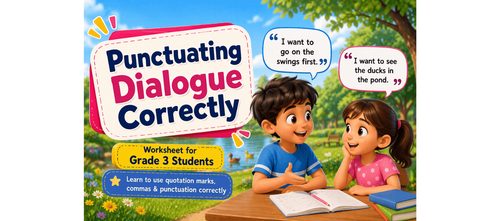

Punctuating Dialogue Correctly Worksheet for Grade 3 Students
Have you ever read a story and wondered how you know who is speaking? That’s where punctuation comes in! This English grammar worksheet for Grade 3 helps students understand how to correctly punctuate dialogue, making conversations in writing clear and easy to read.
Download these English grammar worksheets and practice regularly to strengthen your language skills and build a strong foundation. You can also book a free trial to get expert guidance and improve your reading, writing, and comprehension abilities. The worksheets are designed in a simple and structured way to help K–8 students learn grammar concepts easily and use them confidently in everyday communication.
What Is The Topic?
Punctuating dialogue means using punctuation marks correctly when writing what someone says. It includes using quotation marks, commas, question marks, and exclamation marks properly.
In this worksheet, students learn:
• How to place quotation marks around spoken words
• Where to use commas in dialogue
• How to end sentences with correct punctuation
• How to structure sentences when someone is speaking
What’s In This Worksheet?
1. Multiple-choice questions to identify correct dialogue punctuation
2. True or False questions to check correct punctuation usage
3. Sentence completion with missing letters
4. Adding punctuation to given sentences
5. Rewriting sentences using correct punctuation
6. A passage where students add correct punctuation
This worksheet supports exam preparation by helping students practice real examples and improve accuracy in writing.
Definitions, Examples, Techniques, And Tips
Definitions:
Dialogue is the exact words spoken by a person.
Examples:
Sentences in the worksheet show how dialogue is written with quotation marks and punctuation.
Techniques:
• Place quotation marks around spoken words
• Use commas before dialogue when needed
• Use capital letters at the beginning of speech
Tips:
• Always check where the punctuation goes
• Make sure sentences are complete
• Read sentences aloud to understand them better
Why Is It Important To Learn This?
Learning dialogue punctuation helps students:
• Write clearly and correctly
• Understand stories better
• Improve grammar skills
• Score better in exams
Where Will This Knowledge Help You?
This knowledge helps in:
• Writing stories and essays
• Answering grammar questions in exams
• Speaking and reading confidently in class
How To Use This Worksheet?
1. Attempt each question independently
2. Read each sentence carefully
3. Compare your answers with the correct ones
4. Practice similar sentences regularly
The solutions follow the exact worksheet order, so students should compare answers carefully.
Important Tips And Tricks
1. Always use quotation marks for spoken words
2. Place punctuation marks inside quotation marks
3. Start dialogue with a capital letter
4. Use question marks for questions and exclamation marks for strong feelings
5. Do not forget commas before or after dialogue
Complete Answer Key
Exercise No. 1
1. Kabir asked, “What time is lunch?”
2. Sana said, “Look at the rainbow.”
3. Vikram said, “We should hurry home!”
4. Tara asked, “Can you pass the ball?”
5. Arav said, “We are late for assembly!”
6. Leela asked, “Where is my notebook?”
7. Dev said, “I like this painting!”
8. Mira asked, “Should we take the bus?”
9. Rohan said, “I can hear the drums!”
10. Asha asked, “Can we go to the market?”
Exercise No. 2
1. True
2. False
3. False
4. False
5. False
6. False
7. False
8. False
9. True
10. False
Exercise No. 3
1. Tara asked, “Where is my phone?”
2. “Please walk slowly,” said Asha.
3. Kabir said, “Can you write this?”
4. Sana asked, “Do you like it?”
5. “Why is it blank?” asked Dev.
6. “Can we cook here?” asked Mira.
7. “Will you work with me?” asked Rohan.
8. Leela said, “Pack your bag now.”
9. Arav asked, “Is this formula correct?”
10. “Shall we visit the Taj tomorrow?” asked Anya.
Exercise No. 4
1. Arun shouted, “Look at the puppy!”
2. Riya asked, “Do you want to draw with me?”
3. Dad said, “We will go later.”
4. Mom whispered, “The baby is sleeping.”
5. Neha cried, “I lost my pen!”
6. Rohan replied, “I can help you.”
7. Grandpa called, “Come and sit with me.”
8. Leela told, “Clean the desk today.”
9. Arav said, “Wait near the door.”
10. Mira said, “Move your chair gently.”
Exercise No. 5
Liam and his sister Emma were walking to the park. Liam said, “I want to go on the swings first.” Emma replied, “I want to see the ducks in the pond.” Their mother reminded them, “Stay close and watch out for the other children.” Liam shouted, “I can swing higher than anyone else.” Emma laughed and told him, “Don’t be too loud.” A boy called out, “The slide is free.” Liam ran and asked, “Can I wait for my turn?” Emma ran to the swings and said, “I will meet you there.” Suddenly, a dog barked loudly, and Liam asked, “Whose dog is that?” Emma ran over and said, “I have seen this dog before near our neighbor’s house.”
Practicing dialogue punctuation becomes easier with regular effort. This Grade 3 English grammar worksheet helps you build confidence and accuracy step by step. Keep practicing and you will master it!