
Quantitative Adjectives Grammar Practice for Class 3
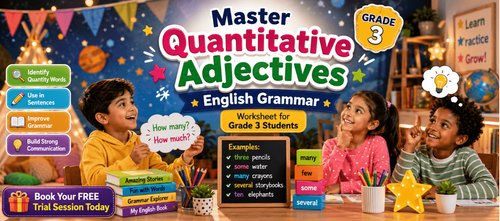

Master Quantitative Adjectives English Grammar Worksheet for Grade 3 Students
Learning quantitative adjectives can make sentences clearer, more meaningful, and more interesting. In this Grade 3 English grammar worksheet, students practice identifying and using words that tell how many or how much. Through fun and engaging activities like underlining adjectives, filling in blanks, rewriting sentences, and picture description exercises, children can improve their grammar skills in an enjoyable way. This worksheet helps Grade 3 students build confidence while learning how quantitative adjectives are used in daily communication.
Download these English grammar worksheets and practice regularly to strengthen your language skills and build a strong foundation. You can also book a free trial to get expert guidance and improve your reading, writing, and comprehension abilities. The worksheets are designed in a simple and structured way to help K–8 students learn grammar concepts easily and use them confidently in everyday communication.
What Is the Topic?
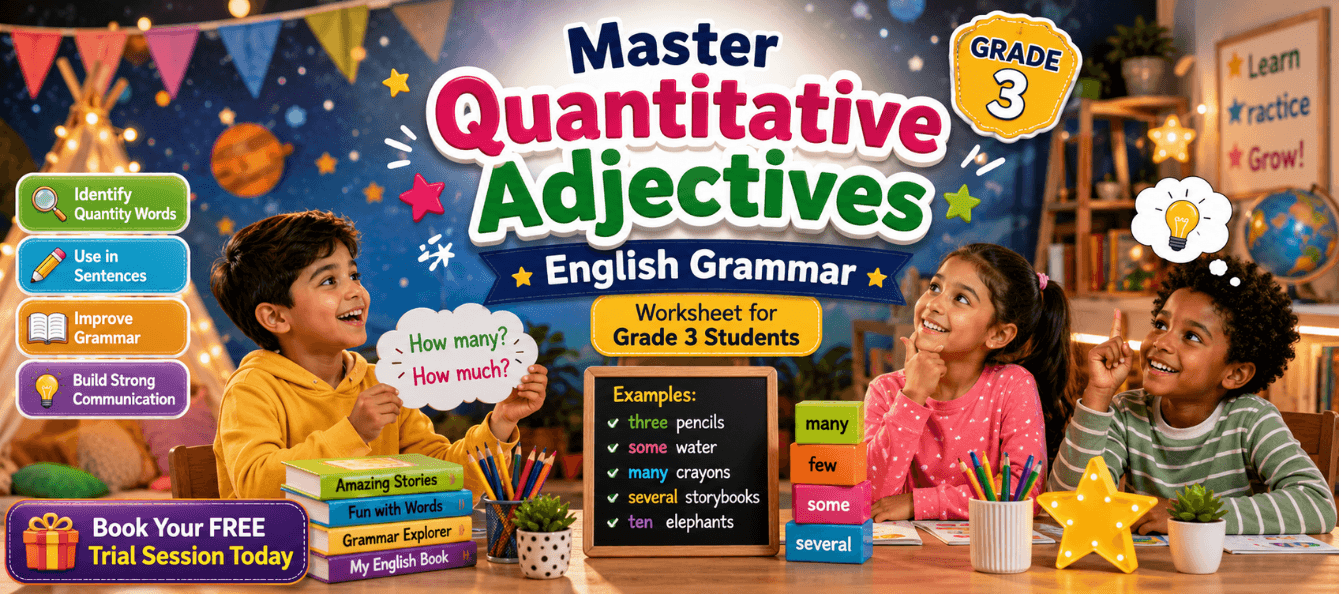
Quantitative adjectives are words that tell us how many or how much of something there is. These words help us talk about numbers and amounts. They add detail to sentences and make communication clearer.
In this Grade 3 English grammar worksheet, students learn how to:
• Identify quantitative adjectives
• Use them correctly in sentences
• Understand how they describe numbers and amounts
• Improve sentence formation using quantity words
Some examples given in the worksheet are:
• I have three pencils in my box.
• She drank some water after running.
What’s in This Worksheet?
1. Color the adjectives activity where students identify words that tell how many or how much.
2. Underline the adjectives exercise that helps students recognize quantitative adjectives in complete sentences.
3. Fill in the blanks section that gives practice in choosing suitable quantity words.
4. Rewrite the sentences activity where students add quantitative adjectives to simple sentences.
5. Picture description exercise that encourages students to create meaningful sentences using quantity words.
6. The worksheet supports grammar improvement, sentence construction, reading comprehension, and writing practice.
7. The activities are arranged in a simple step-by-step format suitable for Grade 3 learners.
Definitions, Examples, Techniques, and Tips
Definition:
A quantitative adjective is a word that tells us how much or how many of something there is.
Examples from the worksheet:
• three pencils
• some water
• many crayons
• few apples
• several storybooks
• half the chocolate
• ten elephants
Techniques:
• Read the sentence carefully and look for words that show number or amount.
• Check if the word answers “How many?” or “How much?”
• Underline or identify only the quantity word in the sentence.
Quick Learning Tips:
• Words like many, few, some, several, all, most, and ten are quantitative adjectives.
• These adjectives help describe nouns better.
• Practice identifying quantity words in daily conversations and reading passages.
Why Is It Important to Learn This?
Learning quantitative adjectives is important because they help students describe things clearly. These words improve both speaking and writing skills by giving better information about quantity and amount.
Quantitative adjectives also help students:
• Write more meaningful sentences
• Understand grammar rules better
• Improve communication skills
• Perform better in grammar exercises and exams
• Build confidence while speaking and writing English
Where Will This Knowledge Help You?
Students can use quantitative adjectives in many situations such as:
• School grammar exercises
• Writing paragraphs and essays
• Answering comprehension questions
• Classroom speaking activities
• Daily conversations
• Describing objects, people, and situations clearly
Understanding quantitative adjectives also helps students avoid incomplete or unclear sentences.
How to Use This Worksheet?
1. Read each question carefully before answering.
2. Identify the words that tell how many or how much.
3. Attempt every exercise independently first.
4. Underline, fill, rewrite, or complete the sentences according to the instructions.
5. Compare your answers carefully with the solutions.
6. The answers follow the exact worksheet order, so check every answer step by step.
7. Correct mistakes and practice similar sentences regularly.
8. Revise quantity words often to improve grammar accuracy.
Important Tips and Tricks
1. Always look for words that describe quantity or amount.
2. Do not confuse describing words like color or size with quantitative adjectives.
3. Words such as red, thick, old, and green are not quantitative adjectives.
4. Read the complete sentence carefully before choosing an answer.
5. In fill-in-the-blank exercises, use words that make grammatical and logical sense.
6. In rewriting exercises, add only suitable quantity words.
7. Underline only the quantitative adjective in each sentence.
8. Practice picture description regularly to improve sentence-writing skills.
Complete Answer Key
Exercise 1
Color all the words that tell us how many or how much.
twenty
few
much
hundred
one
many
every
three
some
some
several
eight
all
ten
little
Exercise 2
Underline the words that tell us how many things there are or how much of something there is.
1. Riya drank _SOME_ water after playing in the sun.
2. I have _two_ pencils in my box.
3. _Many_ children visited the zoo yesterday.
4. There are _few_ apples left in the basket.
5. He read _several_ storybooks during the holidays.
6. Grandma gave me _half_ the chocolate.
7. The teacher asked _each_ of us a question.
8. _Most_ of the mangoes were ripe.
9. They rescued _all_ the puppies.
10. We saw _ten_ elephants at the park.
Exercise 3
Fill in the blanks with words that tell how many or how much.
1. There are MANY crayons in my pencil box.
2. We saw _three_ camels at the fair.
3. _Some_ of the cake is left after the party.
4. She has _many_ friends in her new class.
5. _Several_ children were playing in the garden.
6. I ate _all_ of the rice on my plate.
7. _Most_ students finished their homework.
8. _Some_ of the milk spilled on the floor.
9. _Many_ monkeys were jumping on the trees.
10. He bought _ten_ balloons for his sister.
Exercise 4
Rewrite each sentence by adding a word that tells how many or how much. Underline the word you added.
1. _Few_ children are playing in the park.
2. She bought _some_ oranges from the market.
3. There are _many_ stars in the sky.
4. _Most_ students answered the questions.
5. He has _three_ pencils in his box.
6. We saw _several_ parrots on the tree.
7. They brought _some_ snacks for the picnic.
8. I finished _all_ work before lunch.
9. My friend gave me _two_ stickers.
10. _Many_ ducks swim in the pond.
Exercise 5
Write 5 sentences that tell how many people and things you can see in the picture. Underline the quantitative adjective in each sentence.
1. _Three_ children are sitting near the table.
2. I can see _four_ balloons in the picture.
3. There are _many_ gifts on the table.
4. The cake has _three_ candles on it.
5. _Several_ decorations are hanging in the room.
This Grade 3 quantitative adjectives English grammar worksheet is a fun and effective way for students to improve grammar skills through engaging practice activities. By completing exercises like identifying, underlining, filling in blanks, rewriting sentences, and picture description, students can become more confident in using quantitative adjectives correctly. Regular practice will help children strengthen their writing, speaking, and comprehension abilities while making grammar learning enjoyable and meaningful.