
Recurring Symbols & Motifs: Literary Practice for Class 7
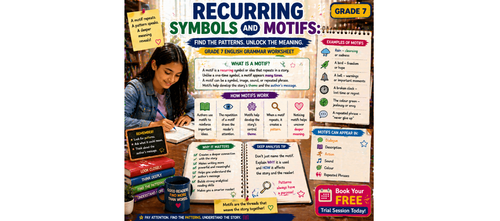

Title: Recurring Symbols and Motifs: Grade 7 English Grammar Worksheet for Literature Skills
Have you ever noticed that in some stories, the same bird appears again and again, or the same colour shows up whenever something important happens? That is not a coincidence – that is a motif. In Grade 7, learning about recurring symbols and motifs helps you unlock hidden patterns in every story you read. A motif is a recurring symbol or idea that repeats in a story. Unlike a one-time symbol, a motif repeats across the text. A motif can be a symbol, image, sound, or repeated phrase. When a bird appears many times, it becomes a motif. The repeated use of rain could be a motif for cleansing or sadness. This Grade 7 English grammar worksheet on recurring symbols and motifs will teach you how to spot these repeating elements, understand what they mean, and become a more analytical reader. Whether you are reading a novel, a short story, or even watching a film, finding motifs helps you understand the author’s deeper message.
Download these English grammar worksheets and practice regularly to strengthen your language skills and build a strong foundation. You can also book a free trial to get expert guidance and improve your reading, writing, and comprehension abilities. The worksheets are designed in a simple and structured way to help K–8 students learn grammar concepts easily and use them confidently in everyday communication.
Book a free trial!
What Is the Topic?
The topic of this worksheet is Recurring Symbols and Motifs. A motif is a recurring symbol or idea that repeats in a story. A motif is a symbol or idea that repeats throughout a text. Unlike a one-time symbol, a motif appears many times. A motif can be a symbol, image, sound, or repeated phrase. A motif can be an image, a sound, a colour, or a repeated phrase. A specific image like a broken clock can be a motif. A repeated phrase like “never give up” can also be a motif. A motif can appear in dialogue, description, or action. One story might have a motif of thunder whenever danger appears. A motif can be a repeated colour, like green representing jealousy. A motif can be a sound, like a bell ringing at key moments. A motif helps develop the story’s theme. Motifs often help develop the story’s central theme. The author uses motifs to reinforce important ideas. The repetition of a motif draws the reader’s attention. When a motif repeats, it creates a pattern that catches the reader’s eye. Paying attention to motifs helps uncover deeper meaning. Noticing motifs helps readers understand the author’s message. Noticing motifs is a skill that makes readers more analytical.
Book a free trial!
What’s in This Worksheet?
This worksheet contains five different exercises that help students master recurring symbols and motifs. Here is what is included:
1. Exercise No. 1 – Multiple Choice Questions – Students choose the correct word to complete each sentence about motifs. This exercise tests basic definitions of motifs, how they differ from one-time symbols, and how they help develop themes.
2. Exercise No. 2 – Fill in the Blanks – Students complete sentences by filling in missing words related to motifs. The exact words are not provided in a word bank; students must use their understanding of the concepts. A word bank is provided at the bottom of the page with words like motif, recurring, symbol, image, phrase, theme, pattern, attention, meaning, and author.
3. Exercise No. 3 – True and False – Students read ten statements about motifs and decide whether each one is true or false. This helps correct common misunderstandings about what motifs are and how they work in stories.
4. Exercise No. 4 – Underline the Words – Students read ten sentences that each describe a recurring motif in a story. For each sentence, students must underline the specific recurring element (the symbol, sound, image, or phrase that repeats). This exercise focuses on identifying motifs in context.
5. Exercise No. 5 – Paragraph Writing – Students read a paragraph about motifs that has blanks. They must fill in each blank using a word from the word bank provided at the end of the paragraph. This combines reading comprehension with vocabulary application.
This worksheet supports exam preparation by covering definitions, examples, and the important difference between a one-time symbol and a recurring motif.
Book a free trial!
Definitions, Examples, Techniques, and Tips
Based only on the content of this worksheet, here are the exact definitions and examples students will learn:
Definitions:
- Motif: A motif is a recurring symbol or idea that repeats in a story. A motif is a symbol or idea that repeats throughout a text. A motif can be a symbol, image, sound, or repeated phrase. Unlike a one-time symbol, a motif repeats across the text. A repeating element is called a recurring element. A motif can appear in dialogue, description, or action. The repeated use of rain could be a motif for cleansing or sadness. A motif can be a repeated colour, like green representing jealousy. A motif can be a sound, like a bell ringing at key moments. The same motif can appear in different forms throughout a text.
- How motifs work: A motif helps develop the story’s theme. Motifs often help develop the story’s central theme. The author uses motifs to reinforce important ideas. The repetition of a motif draws the reader’s attention. When a motif repeats, it creates a pattern that catches the reader’s eye. Paying attention to motifs helps uncover deeper meaning. Noticing motifs helps readers understand the author’s message.
- Motif vs one-time symbol: Unlike a one-time symbol, a motif repeats across the text. A motif is different from a one-time symbol. All symbols in a story are not automatically motifs. A motif must appear many times, not just once.
Examples taken directly from the worksheet (Exercise No. 4):
1. Every time Riya lied, a crow cawed outside her window.
- Motif: crow cawing (repeats every time Riya lies)
2. Whenever danger approached, the wind suddenly stopped blowing completely.
- Motif: wind stopping (repeats whenever danger approaches)
3. Raj found feathers on the ground before each important victory in his life.
- Motif: feathers (repeats before each important victory)
4. The word “remember” was spoken by a different character in each chapter.
- Motif: the word “remember” (repeats in each chapter)
5. Ravi dreamed of water in every chapter before making a big decision.
- Motif: dreaming of water (repeats before big decisions)
6. The clock stopped at midnight in three different chapters of the novel.
- Motif: clock stopping at midnight (repeats in three chapters)
7. Meera heard a bell ring each time a character told the truth.
- Motif: bell ringing (repeats each time a character tells the truth)
8. Fog rolled in during every scene where a character felt confused or lost.
- Motif: fog (repeats in every scene with confusion or loss)
9. The colour red appeared on every page where violence was about to happen.
- Motif: the colour red (repeats on every page with violence)
10. A single candle flickered in every scene where hope was nearly gone.
- Motif: a single candle flickering (repeats in every scene where hope is nearly gone)
Key facts from True and False section:
- A motif appears only once in a story. (False)
- A repeated image of birds flying could be a motif for freedom. (True)
- A motif can be a sound, like a bell ringing at key moments. (True)
- All symbols in a story are automatically motifs. (False)
- A motif helps reinforce the theme of a story. (True)
- Readers should ignore repeated elements because they are accidents. (False)
- The same motif can appear in different forms throughout a text. (True)
- A motif can be a colour that appears whenever a character lies. (True)
- A motif must be a physical object and cannot be an idea. (False)
- Noticing motifs is a skill that makes readers more analytical. (True)
Quick learning tip: A motif repeats. If it happens only once, it is a symbol, not a motif. Look for patterns – the same image, sound, colour, or phrase appearing again and again.
Book a free trial!
Why Is It Important to Learn This?
Learning about recurring symbols and motifs is important for several reasons. First, motifs help develop the story’s theme. When an author repeats an image or sound, they are trying to teach you something important. For example, if a story has a motif of birds every time a character feels free, the theme might be about freedom. Second, the author uses motifs to reinforce important ideas. Instead of stating an idea directly, the author shows it again and again through the motif. Third, the repetition of a motif draws the reader’s attention. When you see the same colour or hear the same sound multiple times, your brain knows it is important. Fourth, paying attention to motifs helps uncover deeper meaning in stories. You start to understand what the author is trying to say without saying it directly. Fifth, this skill is tested in literature exams where you may be asked to identify a motif or explain how it develops the theme. Finally, noticing motifs is a skill that makes readers more analytical. You move from just reading what happens to understanding why the author made specific choices.
Book a free trial!
Where Will This Knowledge Help You?
Knowledge of recurring symbols and motifs will help you in many academic and real-life situations:
1. Literature exams and reading comprehension tests – Many questions ask you to identify a recurring symbol or explain how a motif develops the theme. This worksheet directly prepares you for those questions.
2. Writing literary analysis essays – When you write an essay, you can discuss the motifs in a novel. You can explain how a repeated colour, sound, or image reinforces the author’s message.
3. Class discussions – When your teacher asks, “What motif do you notice in this story?” you will be able to point to specific examples. You can also explain how the motif helps develop the theme.
4. Reading novels and short stories – Once you learn to spot motifs, reading becomes a treasure hunt. You will notice when the same image or phrase appears again and again. You will start asking yourself what it means each time.
5. Watching movies and TV shows – Directors use visual motifs too. A colour that appears whenever a character lies, or a sound that plays before danger – these are motifs. Noticing them makes you a smarter viewer.
6. Understanding poetry – Poets often repeat images, words, or sounds to create motifs. Recognizing these patterns helps you understand the poem’s deeper meaning.
Book a free trial!
How to Use This Worksheet?
Follow these steps to get the most out of this Grade 7 English grammar worksheet on recurring symbols and motifs:
1. Attempt independently first – Without looking at any answers, complete all five exercises in order. Start with Exercise No. 1 (Multiple Choice Questions), then move to Exercise No. 2 (Fill in the Blanks), then Exercise No. 3 (True and False), then Exercise No. 4 (Underline the Words), and finally Exercise No. 5 (Paragraph Writing with word bank).
2. Review answers carefully – After you finish all exercises, go to the Complete Answer Key section below. Compare your answers one by one. Pay special attention to Exercise No. 4 – make sure you underlined the recurring element in each sentence.
3. Correct mistakes – For any answer that is different from the answer key, write the correct answer next to your attempt. Try to understand why you made the mistake. Did you confuse a one-time symbol with a motif? Did you forget that a motif must repeat?
4. Practice regularly – Motifs can be tricky to spot at first. Repeat the worksheet after a few days. For the paragraph writing task (Exercise No. 5), try to fill in the blanks without looking at the word bank first.
The solutions follow the exact worksheet order. Students should compare their answers carefully.
Book a free trial!
Important Tips and Tricks
Here are important tips and tricks based directly on this worksheet to help you master recurring symbols and motifs and score full marks:
1. Remember the key difference: repetition – A motif appears many times. A one-time symbol appears only once. If you see something happening just one time in a story, it is a symbol, not a motif. A motif is different from a one-time symbol. All symbols in a story are not automatically motifs.
2. Motifs can be many things – A motif can be a symbol, image, sound, colour, or repeated phrase. It does not have to be a physical object. A repeated phrase like “never give up” can also be a motif. A motif can be a sound, like a bell ringing at key moments. A motif can be a colour that appears whenever a character lies. A motif must not be only a physical object; it can also be an idea or phrase.
3. Motifs help develop themes – When you find a motif, ask yourself: What theme does this motif help develop? For example, a motif of thunder whenever danger appears helps develop a theme about fear or warning. A motif of birds flying could be a motif for freedom. A motif helps reinforce the theme of a story.
4. The same motif can appear in different forms – A motif does not have to look exactly the same every time. The same motif can appear in different forms throughout a text. For example, a motif of birds might appear as a real bird, a drawing of a bird, or someone saying the word “bird.” All of these count.
5. Do not ignore repeated elements – A common mistake is thinking readers should ignore repeated elements because they are accidents. This is false. Authors choose to repeat elements on purpose. When a motif repeats, it creates a pattern that catches the reader’s eye. Pay attention to it.
6. What examiners expect – Examiners expect you to know that a motif appears multiple times and that it helps develop the theme. They also expect you to know that not every symbol is a motif. They want you to be able to identify motifs from a passage and explain their purpose. Noticing motifs is a skill that makes readers more analytical.
7. How to score full marks – When answering multiple-choice questions, look for keywords like “recurring,” “repeats,” “pattern,” “theme,” “attention,” and “message.” For true and false, remember that a motif appears only once is false, and all symbols are automatically motifs is also false.
8. For underlining tasks (Exercise No. 4) – Each sentence describes something that repeats. Underline the specific element that repeats. For example, in “Every time Riya lied, a crow cawed outside her window” – underline “a crow cawed.” In “The word ‘remember’ was spoken by a different character in each chapter” – underline “the word ‘remember’.” In “The colour red appeared on every page” – underline “the colour red.”
9. For paragraph writing tasks (Exercise No. 5) – Read the entire paragraph first. Then read the word bank. Then fill in each blank one at a time. The word bank includes: symbol, image, motif, thunder, theme, pattern, attention, author, analytical, faster. Read each sentence with your chosen word to make sure it makes sense. “Faster” is in the word bank but may not be used in the paragraph as written – the word “analytical” fits the last blank.
Book a free trial!
Complete Answer Key
Below is the complete answer key for the Grade 7 English grammar worksheet on Recurring Symbols and Motifs. The answers follow the exact order of the worksheet. Section names and question numbers are reproduced exactly as they appear in the worksheet.
Exercise No. 1
Choose the correct word to complete each sentence.
1. A ______ is a recurring symbol or idea that repeats in a story.
Answer: a) motif
2. A motif can be a symbol, image, sound, or repeated ______.
Answer: a) phrase
3. When a bird appears many times, it becomes a ______.
Answer: b) motif
4. A motif helps develop the story’s ______.
Answer: a) theme
5. One story might have a motif of ______ whenever danger appears.
Answer: c) thunder
6. Unlike a one-time symbol, a ______ repeats across the text.
Answer: c) motif
7. A motif can be a repeated colour, like green representing ______.
Answer: a) jealousy
8. Noticing motifs helps readers understand the author’s ______.
Answer: b) message
9. A motif can appear in dialogue, description, or ______.
Answer: c) action
10. The repeated use of rain could be a motif for ______ or sadness.
Answer: a) cleansing
Exercise No. 2
Fill in the blanks. (Note: The worksheet provides sentences with blanks and a word bank at the bottom of the page: motif, recurring, symbol, image, phrase, theme, pattern, attention, meaning, author. Based on the content of the worksheet, the expected answers are as follows.)
1. A motif is a symbol or idea that repeats throughout a text.
2. Paying attention to motifs helps uncover deeper meaning.
3. A specific image like a broken clock can be a motif.
4. A motif is different from a one-time symbol.
5. A repeated phrase like “never give up” can also be a motif.
6. Motifs often help develop the story’s central theme.
7. The author uses motifs to reinforce important ideas.
8. The repetition of a motif draws the reader’s attention.
9. A repeating element is called a recurring element.
10. When a motif repeats, it creates a pattern that catches the reader’s eye.
Exercise No. 3
True and False. Write True or False for each statement.
1. A motif appears only once in a story.
Answer: False
2. A repeated image of birds flying could be a motif for freedom.
Answer: True
3. A motif can be a sound, like a bell ringing at key moments.
Answer: True
4. All symbols in a story are automatically motifs.
Answer: False
5. A motif helps reinforce the theme of a story.
Answer: True
6. Readers should ignore repeated elements because they are accidents.
Answer: False
7. The same motif can appear in different forms throughout a text.
Answer: True
8. A motif can be a colour that appears whenever a character lies.
Answer: True
9. A motif must be a physical object and cannot be an idea.
Answer: False
10. Noticing motifs is a skill that makes readers more analytical.
Answer: True
Exercise No. 4
Underline the words that show the recurring motif.
1. Every time Riya lied, a crow cawed outside her window.
Underline: a crow cawed
2. Whenever danger approached, the wind suddenly stopped blowing completely.
Underline: the wind suddenly stopped blowing
3. Raj found feathers on the ground before each important victory in his life.
Underline: feathers
4. The word “remember” was spoken by a different character in each chapter.
Underline: The word “remember”
5. Ravi dreamed of water in every chapter before making a big decision.
Underline: dreamed of water
6. The clock stopped at midnight in three different chapters of the novel.
Underline: The clock stopped at midnight
7. Meera heard a bell ring each time a character told the truth.
Underline: a bell ring
8. Fog rolled in during every scene where a character felt confused or lost.
Underline: Fog rolled in
9. The colour red appeared on every page where violence was about to happen.
Underline: The colour red
10. A single candle flickered in every scene where hope was nearly gone.
Underline: A single candle flickered
Exercise No. 5
Read the paragraph. Fill in each blank with a word from your understanding. Word bank: (symbol, image, motif, thunder, theme, pattern, attention, author, analytical, faster)
A motif is a symbol or idea that repeats throughout a story. Unlike a one-time symbol, a motif appears many times. A motif can be an image, a sound, a colour, or a repeated phrase. For example, a story might have a motif of birds. Every time a character feels free, a bird appears. Another story might have a motif of thunder. Every time a character lies, thunder crashes. A motif helps develop the story’s theme. The repetition creates a pattern. It teaches the reader to pay attention. When you notice a motif, ask yourself what it means each time it appears. Does the meaning change? Does it stay the same? The author uses motifs to send a message without stating it directly. Finding motifs makes you a more thoughtful and analytical reader. (Note: “Faster” is in the word bank but is not used in the paragraph as written. The correct fill for the last blank is “analytical.”)
Book a free trial!
You have now completed the entire worksheet on recurring symbols and motifs. A motif is not just a one-time symbol – it is a repeating element that appears again and again to help develop the story’s theme. Every time you read a story, watch for patterns. Does the same colour appear? Does the same sound happen? Does the same phrase get repeated? These are motifs, and they are the author’s way of sending you a hidden message. The more you practice finding motifs, the more you will understand what authors are really trying to say. Keep going – you are building skills that will make you a thoughtful, analytical, and confident reader in Grade 7 and for the rest of your life.
Book a free trial!