
Relative Pronouns English Grammar Exercises for Grade 5
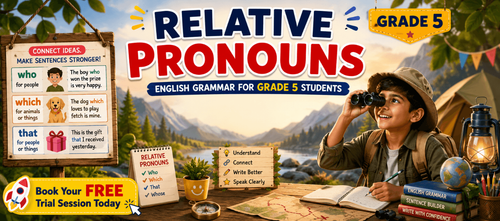

Relative Pronouns English Grammar Worksheet for Grade 5 Students
Learning relative pronouns can make sentences more meaningful, detailed, and interesting. In Grade 5 English grammar, students learn how words like who, which, and that connect ideas and provide more information about people, animals, places, or things. This Relative Pronouns English grammar worksheet for Grade 5 helps students understand sentence structure through fun and engaging grammar activities.
The worksheet includes underlining activities, fill in the blanks, sentence correction, dialogue writing, and paragraph writing tasks. These activities encourage students to identify relative pronouns correctly and use them naturally in sentences. With regular practice, students can improve their grammar, writing clarity, and communication skills in a simple and enjoyable way.
Download these English grammar worksheets and practice regularly to strengthen your language skills and build a strong foundation. You can also book a free trial to get expert guidance and improve your reading, writing, and comprehension abilities. The worksheets are designed in a simple and structured way to help K–8 students learn grammar concepts easily and use them confidently in everyday communication.
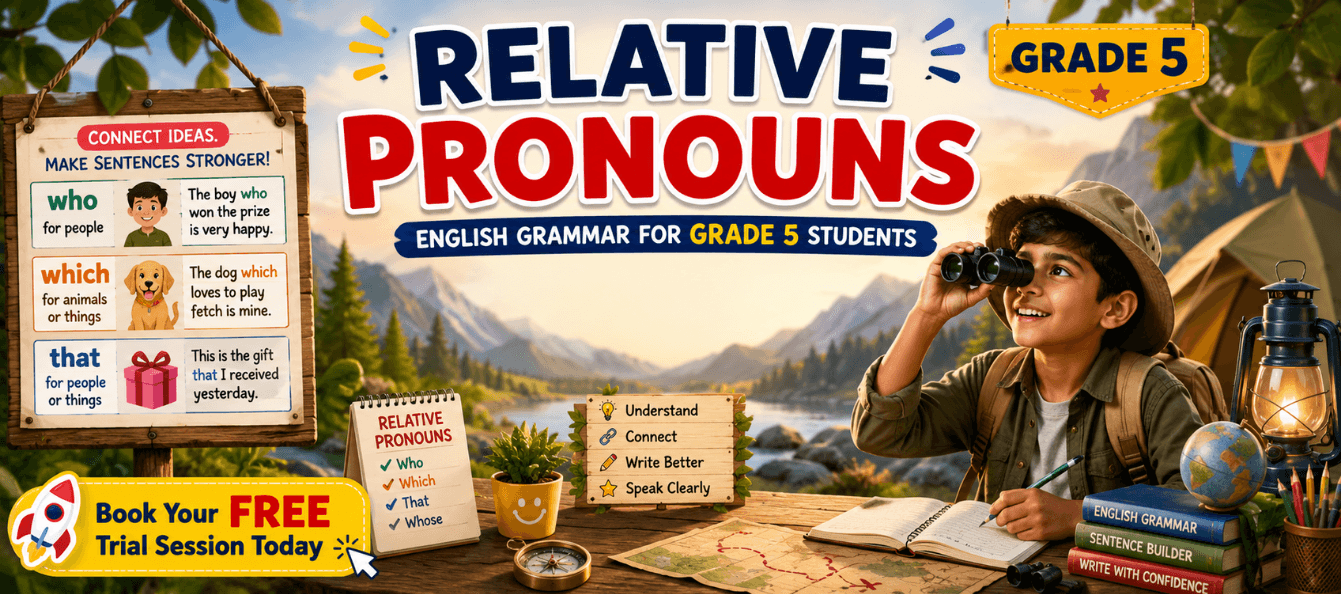
What Is Relative Pronouns?
Relative pronouns are words that connect one part of a sentence to another and give more information about a noun mentioned earlier. In this Grade 5 English grammar worksheet, students learn the common relative pronouns who, which, and that.
The worksheet explains:
• “Who” is used for people.
• “Which” is used for animals or things.
• “That” is used for both people and things.
Students are expected to:
• Identify relative pronouns in sentences
• Use suitable relative pronouns in blanks
• Correct incorrect relative pronouns
• Write conversations and paragraphs using relative pronouns
Examples from the worksheet include:
• The girl who won the prize is my sister.
• We have a dog which loves playing fetch.
What’s in This Worksheet?
1. Underline the Relative Pronouns
Students read each sentence carefully and underline the relative pronoun used in the sentence.
2. Fill in the Blanks
Students complete sentences by choosing suitable relative pronouns.
3. Rewrite the Sentences
Students identify incorrect relative pronouns, correct them, and rewrite the complete sentence properly.
4. Dialogue Writing
Students create a short conversation using relative pronouns naturally.
5. Paragraph Writing
Students write short paragraphs using sentence starters and relative pronouns.
6. Grammar Skill Practice
The worksheet helps students improve sentence connection, grammar understanding, and writing fluency.
7. Exam Preparation Support
The exercises help students prepare for grammar-based school tests and classroom activities.
Definitions, Examples, Techniques, and Tips
Definition
Relative pronouns connect parts of a sentence and give more information about a noun that came before.
Common Relative Pronouns
• Who
• Which
• That
Usage Rules from the Worksheet
• “Who” is used for people.
• “Which” is used for animals or things.
• “That” is used for both people and things.
Examples from the Worksheet
• The girl who won the prize is my cousin.
• I found the puppy that was lost.
• That is the car which won the race.
Techniques for Learning
• Read the sentence carefully before choosing the pronoun.
• Check whether the noun is a person, place, animal, or thing.
• Use “who” for people.
• Use “which” for animals or objects.
• Use “that” for both people and things.
Quick Learning Tips
• Practice identifying relative pronouns daily.
• Underline the pronoun while reading.
• Rewrite incorrect sentences to improve grammar accuracy.
• Use relative pronouns while speaking and writing simple sentences.
Why Is It Important to Learn This?
Learning relative pronouns is important because they help students connect ideas clearly and correctly. They make sentences more meaningful and easier to understand.
This grammar topic helps students:
• Improve sentence formation
• Write detailed sentences
• Speak more clearly
• Understand grammar rules better
• Develop confidence in English communication
Relative pronouns are also useful in school writing tasks, grammar exercises, and classroom discussions. Students who understand relative pronouns can write smoother and more complete sentences.
Where Will This Knowledge Help You?
Students can use relative pronouns in many daily learning situations.
1. School Exams
Relative pronouns are commonly included in grammar tests and English worksheets.
2. Creative Writing
Students can write better stories, conversations, and paragraphs.
3. Classroom Activities
Relative pronouns help students answer questions and speak confidently.
4. Reading Practice
Students can understand sentence connections more easily while reading passages.
5. Everyday Communication
Using correct grammar improves speaking and writing skills.
How to Use This Worksheet?
1. Read Each Sentence Carefully
Understand the sentence before choosing or identifying the relative pronoun.
2. Attempt the Worksheet Independently
Try solving each activity on your own first.
3. Follow the Question Order Carefully
The solutions follow the exact worksheet order. Compare every answer carefully with the original question.
4. Review Your Answers
Check whether the correct relative pronoun is used for people, animals, or things.
5. Correct Mistakes Properly
Rewrite incorrect sentences neatly and underline the corrected pronouns.
6. Practice Writing Activities
Complete the conversation and paragraph writing sections using meaningful sentences.
7. Practice Regularly
Daily grammar practice helps improve accuracy and confidence.
Important Tips and Tricks
1. Use “Who” for People
Example:
The teacher who teaches us Maths is very kind.
2. Use “Which” for Things or Animals
Example:
That is the car which won the race.
3. Use “That” for Both People and Things
Example:
The dress that she wore is pink.
4. Read the Full Sentence Before Choosing
Understanding the noun helps in selecting the correct relative pronoun.
5. Underline Carefully
When asked to underline the relative pronoun, underline only the pronoun word.
6. Rewrite Sentences Neatly
Correct grammar mistakes properly while rewriting the complete sentence.
7. Use Meaningful Sentences in Writing Tasks
While writing conversations or paragraphs, include relative pronouns naturally.
8. Avoid Mixing Pronouns Incorrectly
Do not use “who” for things or objects.
Complete Answer Key
Exercise 1
Underline the Relative Pronouns in each sentence below.
1. The girl who won the prize is my cousin.
Underline: who
2. I know the boy who broke the window.
Underline: who
3. This is the book that I lost yesterday.
Underline: that
4. He met the doctor who treated him.
Underline: who
5. The story that she told was interesting.
Underline: that
6. I found the puppy that was lost.
Underline: that
7. She knows a singer who sings classical songs.
Underline: who
8. That is the car which won the race.
Underline: which
9. I visited the zoo which has pandas.
Underline: which
10. The dress that she wore is pink.
Underline: that
Exercise 2
Fill in the blanks with suitable Relative Pronouns.
1. The teacher who teaches us Maths is very kind.
2. This is the dog that barked all night.
3. I know a girl who can solve tricky puzzles.
4. This is the toy that I wanted to buy.
5. We visited a place which has many peacocks.
6. My aunt is someone who helps everyone.
7. The car that stopped suddenly is very old.
8. The house which I live in is near the school.
9. This is the movie that won the award.
10. Do you know a boy who speaks five languages?
Exercise 3
Correct the Relative Pronoun in each sentence and rewrite it properly. Underline the pronoun that you added.
1. The boy who won the race is my friend.
2. I know a girl who can swim fast.
3. The dog that is barking lives next door.
4. That is the book that I wanted.
5. The cake that she baked is delicious.
6. This is the house that has a red door.
7. She told a story that I already knew.
8. The car that broke down is fixed.
9. I found a pencil that was under the table.
10. The boy whose glasses are blue is my cousin.
Exercise 4
Choose any one of the topics below and write a 3–4 line conversation using Relative Pronouns like who, which, that.
Talking about a book that you love
Person 1: Do you remember the book that I bought yesterday?
Person 2: Yes, it is the story that you really enjoyed reading.
Person 1: The author who wrote the book is very famous.
Person 2: I like books that have exciting adventures.
Person 1: That is the reason which makes this book special.
Exercise 5
Choose any two sentence starters and write a short paragraph for each using Relative Pronouns (who, which, that).
1. I have a friend who…
I have a friend who loves painting beautiful pictures. She is a student who always helps everyone in class. She carries a bag which has many colourful pencils. She is someone that all teachers appreciate.
2. She saw a dog that…
She saw a dog that was playing near the park. The dog chased a ball which rolled across the road. A boy who lived nearby called the dog back home. It was a happy moment that made everyone smile.
Practicing relative pronouns regularly can help Grade 5 students improve their grammar, writing, and speaking skills with confidence. This English grammar worksheet gives students many opportunities to understand how who, which, that, and whose are used in sentences. By completing these exercises carefully and practicing daily, students can become more confident English learners and stronger communicators.