
Sentence Practice Using Idioms and Phrases – Grade 8 Sheet
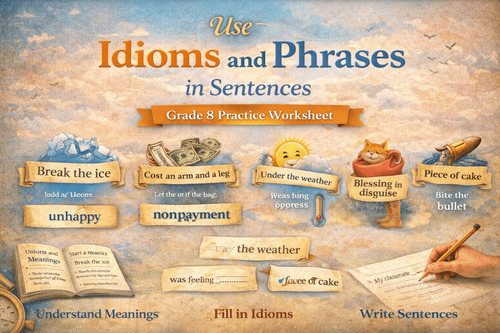

Use Idioms and Phrases in Sentences Grade 8 Practice Worksheet
Idioms make language colorful, interesting, and expressive. Instead of using plain sentences, idioms allow speakers and writers to express ideas in creative and memorable ways. In this Grade 8 English grammar worksheet on Use Idioms and Phrases in Sentences, students explore how idioms are used in everyday communication. Through fun and engaging exercises, learners practice understanding idioms, identifying their figurative meanings, and using them correctly in sentences. This worksheet helps students become more confident in recognizing idioms and applying them naturally while speaking and writing.
What Is Idioms And Phrases?
Idioms and phrases are groups of words that have a meaning different from the literal meaning of the individual words. When people use idioms, they are not always describing something exactly as the words suggest. Instead, idioms convey a figurative meaning that people commonly understand through usage and context.
For example, if someone says they are “under the weather,” they are not literally standing beneath the weather. The idiom actually means that the person is feeling unwell. Similarly, “break the ice” does not mean breaking real ice. It refers to starting a conversation in a situation where people may feel shy or uncomfortable.
The Grade 8 English grammar worksheet on idioms and phrases helps students learn how these expressions work in sentences. By practicing idioms in stories, meanings, and sentence completion exercises, students improve their understanding of figurative language and develop stronger communication skills.
What’s In This Worksheet?
This English grammar worksheet includes several engaging activities that help students learn idioms step by step.
1. A short story activity where students use idioms from a word bank to complete sentences meaningfully.
2. A figurative meaning exercise where students read sentences with idioms and explain what the idioms mean in context.
3. A literal or figurative identification task where students determine whether the idiom is used in its literal meaning or figurative meaning.
4. Sentence completion tasks that require students to finish sentences using suitable idioms.
5. A creative writing activity where students write their own sentences using different idioms.
These exercises allow students to practice idioms in multiple ways. They strengthen vocabulary, improve reading comprehension, and help learners understand how idioms function in everyday communication. This worksheet is also useful for exam preparation because it builds familiarity with figurative language and sentence interpretation.
Definitions, Examples, Techniques, And Tips
Definition of Idioms
An idiom is a group of words that together have a meaning that is different from the literal meanings of the individual words.
Example
If someone says “spill the beans,” it does not mean dropping beans. It means revealing a secret.
Understanding Figurative Meaning
Many idioms rely on figurative meaning. Figurative meaning refers to the idea or message behind the words rather than their direct meaning.
For example:
“See the light at the end of the tunnel” suggests that a difficult situation is finally coming to an end.
Literal vs Figurative Language
Literal language means the words are used exactly as they appear.
Figurative language means the words express an idea beyond their direct meaning.
Example:
“Hit the sack” figuratively means going to sleep.
Techniques To Understand Idioms
Students can follow these techniques while learning idioms:
• Look at the context of the sentence
• Think about what the speaker is trying to express
• Identify whether the meaning is literal or figurative
• Practice using idioms in different sentences
Quick Learning Tips
• Read idioms carefully within the sentence
• Try to imagine the situation described
• Use idioms while speaking or writing to remember them better
Why Is It Important To Learn This?
Learning idioms and phrases is important because they are commonly used in everyday conversations, stories, and written communication. Understanding idioms allows students to interpret meanings correctly and avoid confusion when reading or listening.
Idioms also improve writing and speaking skills. When students use idioms appropriately, their language becomes more expressive and engaging. Instead of repeating simple phrases, they can communicate ideas more creatively.
For Grade 8 students, learning idioms strengthens vocabulary and builds confidence in language usage. It also helps them understand figurative expressions used in literature and classroom discussions.
Where Will This Knowledge Help You?
Understanding idioms is helpful in many real-life and academic situations.
During exams, students may encounter questions that ask them to identify idioms or explain their meanings.
In writing tasks, idioms can make essays and stories more expressive and interesting.
In classroom discussions and presentations, students can communicate ideas more naturally when they understand common idiomatic expressions.
Idioms are also widely used in books, movies, and conversations. Knowing them helps students understand the true meaning behind many expressions used in daily life.
How To Use This Worksheet?
Students can follow these steps to use this English grammar worksheet effectively.
1. Read the instructions carefully before starting each section.
2. Attempt each question independently by thinking about the meaning of the idiom in the sentence.
3. Use the word bank when completing the story in the first activity.
4. Decide whether the meaning of each idiom is literal or figurative in the identification exercise.
5. Complete the sentence exercises using suitable idioms that make the sentence meaningful.
6. Review the complete answer key after finishing the worksheet.
7. Compare your answers carefully with the solutions given below. The answers follow the exact worksheet order.
Regular practice with worksheets like this helps students understand idioms clearly and improves their ability to use figurative language correctly.
Important Tips And Tricks
1. Always read the entire sentence before deciding the meaning of an idiom.
2. Pay attention to context because idioms usually depend on the situation described.
3. Do not interpret idioms word by word. Their meanings are usually figurative.
4. Practice identifying whether an idiom is literal or figurative.
5. When completing sentences, choose idioms that fit naturally into the context.
6. Examiners expect students to understand idiomatic expressions clearly and apply them correctly in sentences.
7. Practice writing your own sentences using idioms to strengthen understanding.
Complete Answer Key
Exercise - 1
1. Riya had just moved to a new city and joined a new school. On her first day, she was extremely shy and didn’t know how to talk to anyone. Luckily, her new batchmate told a funny story during lunch to break the ice.
2. The next day, Riya started to feel a little weak and tired. She didn’t have the energy to play during P.E. and told her teacher she was feeling under the weather.
3. A few days later, while discussing plans for the annual day event, one of the students accidentally let the cat out of the bag.
4. That spoiled the surprise, but the teacher appreciated their excitement. Later, Riya was asked to host the school event. Though she was nervous, she decided to bite the bullet.
5. In the end, her confident speech impressed everyone. She later realized that being asked to host the event was actually a blessing in disguise.
Exercise - 2
1. Figurative Meaning: Finally seeing hope or a solution after a long difficult situation.
2. Figurative Meaning: A person who appears harmless but is actually dangerous or dishonest.
3. Figurative Meaning: To surprise or confuse someone suddenly.
4. Figurative Meaning: Being very calm and brave under pressure.
5. Figurative Meaning: To start a conversation and make people feel comfortable.
6. Figurative Meaning: To reveal a secret.
7. Figurative Meaning: To give up or stop trying.
8. Figurative Meaning: Feeling slightly ill or not well.
Exercise - 3
1. b) Figurative
2. b) Figurative
3. b) Figurative
4. b) Figurative
5. a) Literal
6. b) Figurative
7. a) Literal
Exercise - 4
1. The final math paper was so easy that it was a piece of cake.
2. I was really nervous at the new school, but my classmate broke the ice by starting a friendly conversation.
3. Rohan wasn’t feeling well this morning; he said he was under the weather.
4. She wanted to avoid the dentist, but finally she bit the bullet and went for the appointment.
5. I knew it was an expensive phone, but I didn’t expect it to cost an arm and a leg.
6. Mom asked if I would clean the entire house without help, and I said the ball is in your court.
7. When I got the top rank in class, I felt like I was walking on air.
Exercise - 5
1. Break the ice
The new teacher told a funny story to break the ice with the students.
2. A blessing in disguise
Missing the bus turned out to be a blessing in disguise because I met an old friend on the next one.
3. Burning the midnight oil
She was burning the midnight oil to prepare for the final exams.
4. Hit the nail on the head
When he explained the problem clearly, he hit the nail on the head.
5. Bite the bullet
I was scared of public speaking, but I decided to bite the bullet and give my presentation.
6. Under the weather
I stayed home from school because I was feeling under the weather.
7. Cost an arm and a leg
The designer dress cost an arm and a leg.
8. Once in a blue moon
We go out for dinner once in a blue moon.
9. Throw cold water on something
His negative comments threw cold water on our exciting plan.
10. The ball is in your court
I have finished my part of the project; now the ball is in your court.
Practicing idioms regularly helps students become more confident speakers and writers. The Grade 8 English grammar worksheet on Use Idioms and Phrases in Sentences gives students a chance to explore figurative language through stories, meanings, and sentence writing. By understanding and practicing idioms, learners improve their communication skills and develop stronger language abilities. Continued practice with idioms will make reading, writing, and speaking English more expressive and enjoyable.