
Sentence Rewriting for Grade 7: Grammar Practice for Clear Writing [Free PDF]
![Sentence Rewriting for Grade 7: Grammar Practice for Clear Writing [Free PDF]](https://cdn5.planetspark.in/media/small_Class_7_English_Grammar_Worksheet_on_Sentence_Rewriting_30239d5bd4.png)

English Grammar Worksheet Grade 7: Advanced Sentence Rewriting (Meaning Retained)
Rewriting sentences while maintaining their original meaning is an important skill for developing strong writing abilities. In this Grade 7 worksheet on "Advanced Sentence Rewriting (Meaning Retained)," students will practice transforming sentences into different forms, ensuring that the meaning remains unchanged. This practice is essential for writing more varied and sophisticated sentences, enhancing both clarity and style.
Download these English grammar worksheets and practice regularly to strengthen your language skills and build a strong foundation. You can also book a free trial to get expert guidance and improve your reading, writing, and comprehension abilities. The worksheets are designed in a simple and structured way to help K–8 students learn grammar concepts easily and use them confidently in everyday communication. Book a free trial!
## What is the topic?
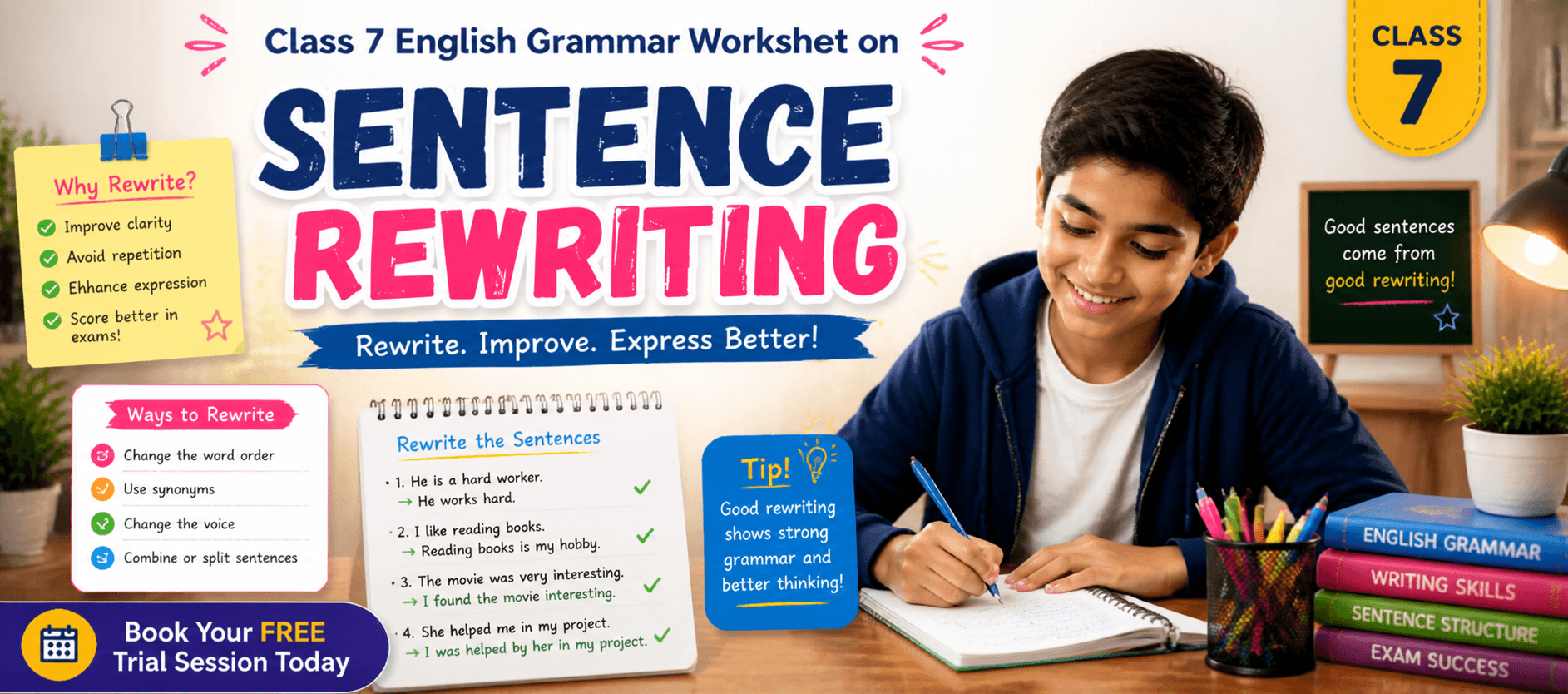
The focus of this worksheet is on sentence rewriting. Students will be given sentences that need to be rewritten in a different form, such as changing the structure, replacing words, or transforming clauses. The challenge is to retain the original meaning of the sentence while altering its form. This helps students understand sentence structure and improve their ability to express ideas in multiple ways.
Students will learn:
- How to rewrite sentences without changing their meaning.
- How to manipulate sentence structure to express the same idea differently.
- How to use various sentence types for more diverse and effective communication.
## What’s in this worksheet?
This worksheet provides exercises to help students practice advanced sentence rewriting techniques. The exercises include:
1. **Underline the words** – Identifying the key elements in a sentence to understand what needs to be preserved during rewriting.
2. **Multiple choice questions** – Selecting the correct version of a sentence after it has been rewritten.
3. **Sentence rewriting** – Rewriting sentences while retaining the meaning, often by changing structure or word choice.
4. **Fill in the blanks** – Completing sentences by filling in appropriate words that maintain the sentence's meaning.
5. **Paragraph writing** – Writing a short paragraph using rewritten sentences, applying the concept of maintaining meaning while changing structure.
By practicing these exercises, students will become more adept at manipulating sentence structure without altering the meaning.
## Definitions, examples, techniques, and tips
- **Sentence Rewriting Definition**: Sentence rewriting involves changing the structure or wording of a sentence while ensuring that the original meaning remains intact. It may involve using synonyms, adjusting the sentence order, or changing from active to passive voice (or vice versa).
- **Example of Sentence Rewriting**:
- **Original**: "She was too tired to continue working."
- **Rewritten**: "She was so tired that she could not continue working."
- **Techniques for sentence rewriting**:
1. Identify the key components of the sentence (subject, verb, object) and keep them intact while modifying the rest of the sentence.
2. Use synonyms or rephrase parts of the sentence without changing the overall meaning.
3. When possible, experiment with different sentence structures (e.g., changing an active sentence to passive or combining two sentences into one).
- **Quick learning tips**:
- Always double-check that the sentence's original meaning is preserved after rewriting.
- Use varied sentence types and connectors to add variety to your writing.
- When unsure, compare your rewritten sentence with the original to ensure it conveys the same idea.
## Why is it important to learn this?
Rewriting sentences while maintaining their meaning is a critical skill for improving writing fluency. It helps students:
- Strengthen their understanding of sentence structure and grammar.
- Develop more sophisticated writing skills by expressing ideas in multiple ways.
- Improve clarity and readability in their writing.
This skill is essential for Grade 7 students, as it prepares them for more advanced writing tasks, such as essays, reports, and creative writing.
## Where will this knowledge help you?
This knowledge is applicable in a variety of writing contexts:
- **Exams**: Many exams involve tasks that require students to rephrase or rewrite sentences.
- **Writing tasks**: The ability to rewrite sentences improves students' capacity to write well-structured essays and reports.
- **Class participation**: Clear communication is key during class discussions or presentations, and sentence rewriting skills can help students articulate their ideas better.
## How to use this worksheet?
1. **Attempt independently first**: Read each sentence and try to rewrite it in your own way while keeping the meaning the same.
2. **Review answers carefully**: After rewriting, check if the meaning is still preserved.
3. **Correct mistakes**: If the meaning changes or becomes unclear, adjust your rewritten sentence accordingly.
4. **Practice regularly**: Continue practicing these exercises to improve your sentence rewriting skills.
The solutions follow the exact worksheet order. Compare your answers carefully to ensure accuracy.
## Important tips and tricks
- **Common mistakes**:
- Changing the meaning of the sentence during the rewriting process.
- Failing to maintain grammatical accuracy while altering sentence structure.
- **What examiners expect**:
- Clear, precise sentences that maintain their original meaning.
- Varied sentence structures that showcase grammatical flexibility.
- **How to score full marks**:
- Ensure that your rewritten sentence has the same meaning as the original.
- Pay attention to grammar, punctuation, and structure when making changes.
- **How to approach activity-based or writing-based tasks**:
- Focus on the clarity of your sentences. Rewriting doesn’t mean making the sentence overly complicated.
- Be mindful of the changes you make, and ensure that each modification maintains the integrity of the original idea.
## Complete Answer Key
**Exercise No. 1:**
- He is too tired so he slept. (Underline: He, Circle: is)
- She was so tired that she fell asleep. (Underline: She, Circle: was)
- He was so happy that he smiled all day. (Underline: He, Circle: was)
- She is too weak to run. (Underline: She, Circle: is)
- He was too late to catch the bus. (Underline: He, Circle: was)
**Exercise No. 2:**
1. b) He is so tired that he slept.
2. a) She was so tired that she fell asleep.
3. a) He was so happy that he smiled all day.
4. b) She is so weak that she cannot run.
5. b) He was so late that he could not catch the bus.
**Exercise No. 3:**
1. He was too tired to continue working. (Ensure meaning is retained when rewriting.)
2. He was so happy that he smiled all day. (Ensure meaning is retained when rewriting.)
3. She was so tired that she fell asleep. (Ensure meaning is retained when rewriting.)
4. She was too weak to run. (Ensure meaning is retained when rewriting.)
5. He was too late to catch the bus. (Ensure meaning is retained when rewriting.)
**Exercise No. 4:**
1. too
2. too
3. too
4. too
5. so
6. too
7. so
8. too
9. too
10. too
**Exercise No. 5**: Answers may vary.
## Outro
By practicing sentence rewriting, students will not only improve their understanding of sentence structure but also enhance their ability to express ideas in diverse and clear ways. This skill is essential for both academic and real-life communication, as it empowers students to write more effectively and creatively.
Book a free trial!