
Sentence Transformation Practice for Grade 7 English Grammar PDF
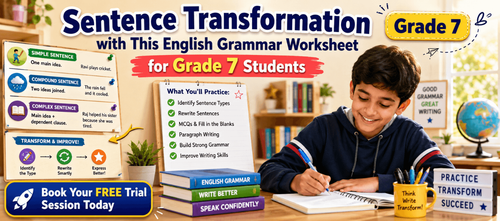

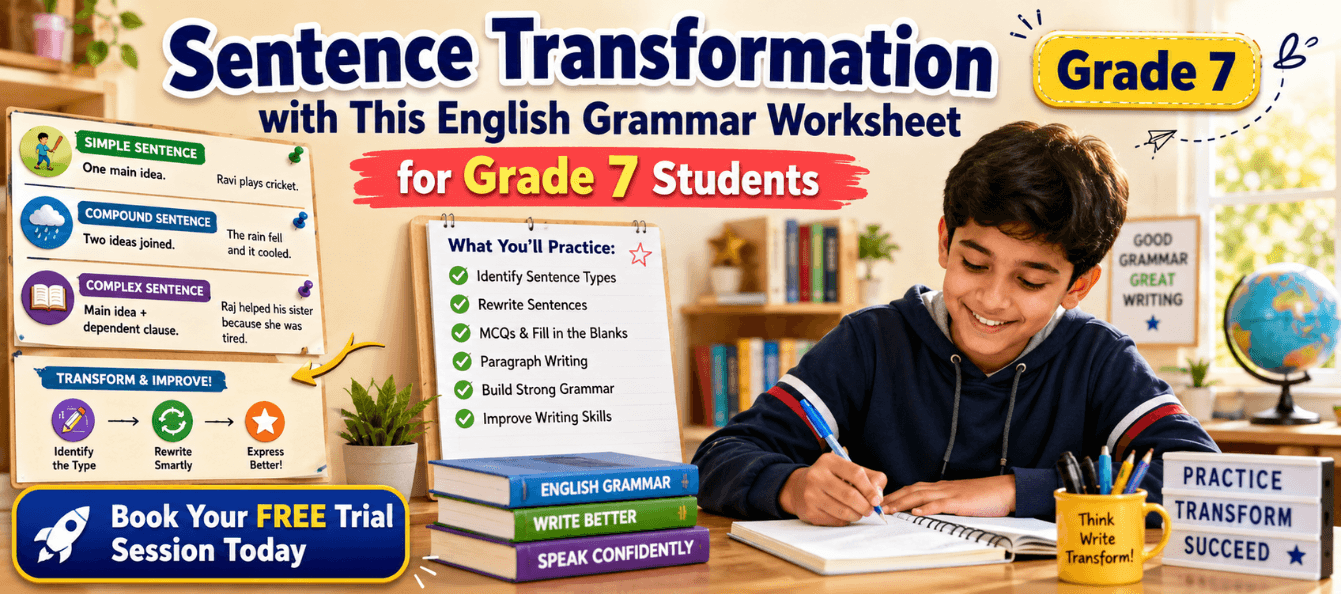
Sentence Transformation with This English Grammar Worksheet for Grade 7 Students
Sentence transformation is an important part of English grammar because it helps students learn how to express the same idea in different sentence forms. This Grade 7 English grammar worksheet on Sentence Types: Transformation helps students understand simple, compound, and complex sentences through engaging activities and sentence rewriting practice. Students also improve their reading, writing, and grammar skills while solving multiple-choice questions, rewriting sentences, filling in the blanks, and paragraph writing tasks.
This English grammar worksheet for Grade 7 gives students an excellent opportunity to practice sentence transformation in a structured and easy-to-understand way. The activities are designed to strengthen grammar concepts and help students become more confident while writing and speaking English.
Download these English grammar worksheets and practice regularly to strengthen your language skills and build a strong foundation. You can also book a free trial to get expert guidance and improve your reading, writing, and comprehension abilities. The worksheets are designed in a simple and structured way to help K–8 students learn grammar concepts easily and use them confidently in everyday communication.
What Is the Topic?
Sentence Types: Transformation teaches students how to change one type of sentence into another without changing the meaning. In this worksheet, students practice transforming simple sentences into compound or complex sentences and vice versa.
Students learn:
• Simple sentences
• Compound sentences
• Complex sentences
• Sentence rewriting
• Sentence structure identification
• Grammar-based sentence transformation
The worksheet also helps students understand how conjunctions and sentence structures work together in English grammar.
What’s in This Worksheet?
1. Labeling sentences as simple, compound, or complex.
2. Multiple-choice questions based on sentence transformation rules.
3. Sentence rewriting activities.
4. Fill in the blanks using suitable words.
5. Paragraph writing using different sentence types.
6. Grammar practice focused on sentence construction and transformation.
7. Exercises that improve writing and comprehension skills.
8. Activities that support grammar learning and exam preparation.
Definitions, Examples, Techniques, and Tips
Simple Sentences
A simple sentence contains one main idea.
Example:
Ravi plays cricket in the park.
Compound Sentences
A compound sentence joins two ideas using conjunctions.
Example:
The rain fell and it cooled the hot street.
Complex Sentences
A complex sentence contains one main clause and one dependent clause.
Example:
Raj helped his younger sister because she needed assistance.
Sentence Transformation Techniques
• Use conjunctions carefully.
• Maintain the original meaning.
• Identify the sentence type before rewriting.
• Read the complete sentence before choosing the answer.
Quick Learning Tips
• Practice sentence rewriting daily.
• Pay attention to words like because, and, after, till, although, and when.
• Read each sentence carefully before transforming it.
• Check whether the sentence is simple, compound, or complex.
Why Is It Important to Learn This?
Learning sentence transformation helps students improve grammar accuracy and sentence formation. It also helps students write better paragraphs, answer grammar questions correctly, and improve communication skills.
This topic is important because:
• It improves writing skills.
• It strengthens grammar understanding.
• It helps students write different sentence forms.
• It improves sentence variety in writing.
• It supports school grammar exams and class activities.
Where Will This Knowledge Help You?
Students can use sentence transformation skills in:
• School grammar tests
• English exams
• Paragraph writing
• Creative writing tasks
• Classroom discussions
• Reading comprehension activities
• Everyday English communication
Understanding sentence types also helps students write clearer and more effective sentences.
How to Use This Worksheet?
1. Read each question carefully before answering.
2. Identify whether the sentence is simple, compound, or complex.
3. Attempt every question independently first.
4. Compare your answers carefully with the solutions.
5. Follow the exact worksheet order while checking answers.
6. Review grammar rules used in each transformation.
7. Correct mistakes and rewrite incorrect answers.
8. Practice similar sentence transformations regularly.
Important Tips and Tricks
1. Read conjunctions carefully because they often help identify sentence types.
2. Do not change the original meaning while rewriting sentences.
3. Use punctuation correctly in compound and complex sentences.
4. Identify the subject and verb before transforming a sentence.
5. In multiple-choice questions, choose the option that follows the grammar rule correctly.
6. While writing paragraphs, use a mix of simple, compound, and complex sentences.
7. Practice sentence rewriting regularly to improve speed and accuracy.
8. Check sentence flow and grammar after rewriting.
Complete Answer Key
Exercise No. 1
1. Ravi plays cricket in the park. – Simple Sentence
2. Meera studies in library. – Simple Sentence
3. The rain fell and it cooled the hot street. – Compound Sentence
4. Raj helped his younger sister because she needed assistance. – Complex Sentence
5. The teacher explained the lesson. – Simple Sentence
6. The picture that Neha painted was beautiful. – Complex Sentence
7. Arjun opened the window and he did it quickly. – Compound Sentence
8. The sun shines over the river. – Simple Sentence
9. Asha cleaned her study table after finishing her homework. – Complex Sentence
10. The bus stopped near the school. – Simple Sentence
Exercise No. 2
1. Transform into a compound sentence: She worked hard ________ she failed.
✔ c) She worked hard but she failed.
2. Transform into a complex sentence: I missed the bus ________ I was late.
✔ a) I missed the bus because I was late.
3. Transform into a simple sentence: He completed his work and went home.
✔ b) After completing his work, he went home.
4. Transform into a compound sentence: She opened the window ________ let the air in.
✔ a) She opened the window and let the air in.
5. Transform into a complex sentence: I was tired ________ I slept early.
✔ c) I was tired since I slept early.
6. Transform into a simple sentence: He finished the project before he left.
✔ c) Finishing the project, he left.
7. Transform into a compound sentence: The rain stopped ________ we went out.
✔ b) The rain stopped and we went out.
8. Transform into a complex sentence: I waited ________ the teacher arrived.
✔ a) I waited until the teacher arrived.
9. Transform into a simple sentence: He ran fast and caught the bus.
✔ a) Running fast, he caught the bus.
10. Transform into a compound sentence: She opened the box ________ found a note.
✔ b) She opened the box and found a note.
Exercise No. 3
1. She studied well because she wanted to pass.
Change to Simple:
She studied well to pass.
2. He was tired and he slept early.
Change to Complex:
Because he was tired, he slept early.
3. After finishing lunch, he went to play.
Change to Compound:
He finished lunch and he went to play.
4. The bell rang, and the students stood.
Change to Simple:
The students stood at the ringing of the bell.
5. Ravi helped me because I was hurt.
Change to Compound:
I was hurt, so Ravi helped me.
6. I opened the door and saw a kitten.
Change to Complex:
When I opened the door, I saw a kitten.
7. Meera waited till the rain stopped.
Change to Simple:
Meera waited till the stopping of the rain.
8. Although he is young, he is brave.
Change to Compound:
He is young, but he is brave.
9. He completed the work and left.
Change to Complex:
After he completed the work, he left.
10. The teacher entered and everyone stood.
Change to Simple:
On the teacher entering, everyone stood.
Exercise No. 4
Read the passage and fill the blanks with suitable words.
Riya looked out of the classroom window as the sky darkened and clouds gathered thickly above the wide playground. A cool breeze blew through the corridors, carrying the sweet smell of rain and damp earth. The tall trees bent gently in the rising wind while distant thunder rolled across the grey sky. Within minutes, heavy rain poured down in shiny sheets, and students ran inside to stay dry. The teacher smiled and said, “It’s the first shower of the season.” Everyone stood by the window, watching the sparkling drops sparkle on the grass. Puddles formed near the swings, and the soft sound of rain blended with the cheerful echoes of laughter and the rhythmic tapping of raindrops drumming on the school roof. Later, the breeze carried the refreshing smell of monsoon air, and children whispered excitedly as they hoped the showers would last a little longer.
Exercise No. 5
Write a short paragraph using a mix of simple, compound, and complex sentences on the topic: My Birthday
My birthday is my favorite day of the year. I wake up early and decorate my room with colorful balloons. My parents prepare delicious food, and my friends come to my house in the evening. Although the weather was rainy last year, everyone arrived on time. We played games, cut the birthday cake, and enjoyed music together. After the party ended, I thanked everyone for making my birthday special.
This Grade 7 English grammar worksheet on Sentence Types: Transformation is a helpful way to practice sentence rewriting and improve grammar skills. Regular practice with simple, compound, and complex sentences helps students become confident writers and better communicators. Keep practicing sentence transformation activities to improve your grammar accuracy and writing fluency.