
Sentence Types Practice for Grade 6 Middle School Learners

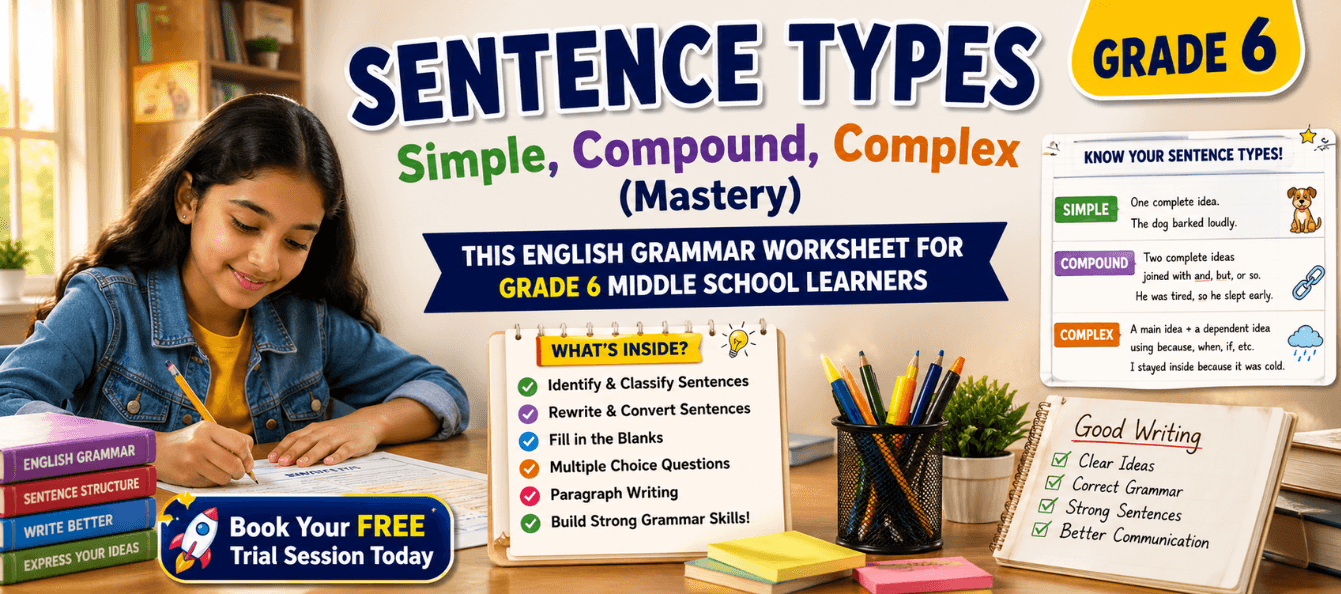
Sentence Types with This English Grammar Worksheet for Grade 6 Middle School Learners
Learning sentence types can make writing more meaningful, interesting, and grammatically correct. In Grade 6, students begin learning how simple, compound, and complex sentences work together to improve communication skills. This English grammar worksheet on Sentence Types – Simple, Compound, Complex (mastery) helps learners understand sentence structures through engaging exercises, rewriting activities, fill-in-the-blanks, and paragraph writing tasks.
Students often use only short sentences while writing. However, understanding different sentence types helps them connect ideas clearly and express thoughts in a more creative way. This worksheet is designed especially for Grade 6 middle school learners to build confidence in grammar practice and sentence formation.
Download these English grammar worksheets and practice regularly to strengthen your language skills and build a strong foundation. You can also book a free trial to get expert guidance and improve your reading, writing, and comprehension abilities. The worksheets are designed in a simple and structured way to help K–8 students learn grammar concepts easily and use them confidently in everyday communication.
What Is the Topic?
This Grade 6 English grammar worksheet focuses on sentence types. Students learn how to identify and use simple, compound, and complex sentences correctly.
A simple sentence contains one complete idea.
A compound sentence joins two ideas using joining words like “and,” “but,” or “so.”
A complex sentence contains a main clause and a dependent clause connected using words such as “because,” “when,” or “if.”
This worksheet helps students:
• Identify sentence patterns
• Rewrite sentences correctly
• Improve sentence structure
• Practice grammar skills
• Use linking words properly
What’s in This Worksheet?
1. Sentence Identification Activities
Students identify simple, compound, and complex sentences.
2. Underlining, Highlighting, and Circling Tasks
Learners underline simple sentences, highlight compound sentences, and circle complex sentences.
3. Multiple Choice Questions
Students choose the correct sentence types from given options.
4. Sentence Rewriting Practice
Students rewrite sentences into simple, compound, or complex forms.
5. Fill in the Blanks
Students complete a grammar passage with suitable words.
6. Paragraph Writing
Students write a paragraph using different sentence types.
7. Grammar Skill Building
The worksheet improves sentence formation and writing clarity.
8. Exam Preparation Practice
The exercises support school grammar preparation and revision.
Definitions, Examples, Techniques, and Tips
Simple Sentence:
A sentence with one complete thought.
Example:
The dog barked loudly.
Compound Sentence:
A sentence that joins two complete ideas using words like “and,” “but,” or “so.”
Example:
He was tired, so he slept early.
Complex Sentence:
A sentence that contains a main idea and a dependent idea connected with words such as “because,” “when,” or “if.”
Example:
I stayed inside because it was cold.
Techniques Used in This Worksheet:
• Identifying sentence structures
• Using conjunctions correctly
• Rewriting sentence forms
• Understanding sentence patterns
• Building meaningful sentences
Quick Tips:
• Look for words like “and,” “but,” and “so” in compound sentences.
• Words such as “because,” “when,” and “if” usually show complex sentences.
• Simple sentences contain one complete idea.
• Read each sentence carefully before deciding the type.
Why Is It Important to Learn This?
Learning sentence types helps students improve grammar, writing, and speaking skills. Different sentence structures make writing more interesting and meaningful.
This topic is important because:
• It improves communication skills
• It helps students write better paragraphs
• It strengthens grammar understanding
• It develops sentence variety
• It improves school performance
Students who understand sentence types can express ideas more clearly and confidently.
Where Will This Knowledge Help You?
1. English Exams
Sentence type questions are common in grammar tests.
2. Paragraph Writing
Students can write more organized and detailed paragraphs.
3. Story Writing
Different sentence forms make stories more engaging.
4. Classroom Activities
Students participate more confidently during grammar exercises.
5. Daily Communication
Clear sentence formation improves spoken and written English.
How to Use This Worksheet?
1. Read Each Question Carefully
Understand whether the task asks you to identify, rewrite, underline, highlight, or circle sentences.
2. Attempt the Questions Independently
Try solving every question before checking the answers.
3. Compare Answers Carefully
The solutions follow the exact worksheet order. Match each answer carefully with the question number.
4. Check Sentence Clues
Look for joining words and dependent clauses carefully.
5. Correct Your Mistakes
Review punctuation, conjunctions, and sentence structure.
6. Practice Regularly
Repeated grammar practice improves sentence-building skills.
Important Tips and Tricks
1. Identify Joining Words
Words like “and,” “but,” and “so” often form compound sentences.
2. Find Dependent Clauses
Words such as “because,” “when,” and “if” usually indicate complex sentences.
3. Keep Simple Sentences Clear
Simple sentences contain one complete thought.
4. Read Every Option Properly
Some answer choices may appear similar, so read carefully.
5. Practice Sentence Conversion
Changing sentence types improves grammar understanding.
6. Use Correct Punctuation
Commas and full stops improve sentence clarity.
7. Write Neatly in Paragraph Tasks
Well-structured writing is easier to understand.
Complete Answer Key
Exercise No. 1
1. __The bird sang sweetly.__
2. I wanted to play, but it started raining.
3. __Riya reads every night.__
4. She finished her work, and she went home.
5. __The dog barked loudly.__
6. He was tired, so he slept early.
7. __We love ice cream.__
8. (I stayed inside because it was cold.)
9. (She smiled when she saw her mother.)
10. (We will go out if it stops raining.)
Exercise No. 2
1. Identify the simple sentence.
b) Riya reads every morning.
2. Find the compound sentence.
c) Raj plays and sings today.
3. Spot the complex sentence.
a) Meera studies because test nears.
4. Join with a coordinator.
c) Ravi runs and jumps quickly.
5. Pick the simple pattern.
a) Asha sings in assembly.
6. Choose the complex example.
b) We go home when bell rings.
7. Pick correct compound form.
c) Raj played and Meera cheered.
8. Find the simple sentence.
b) I read books at night.
9. Select the compound sentence.
a) The sky is clear and stars shine.
10. Choose the complex sentence.
c) She smiled because she was happy.
Exercise No. 3
1. Riya plays and she sings.
Change to Compound.
Answer: Riya plays, and she sings.
2. Meera studies because she has exam.
Change to Complex.
Answer: Meera studies because she has an exam.
3. Ravi eats rice at noon.
Change to Simple.
Answer: Ravi eats rice at noon.
4. Raj studies and he reads.
Change to Compound.
Answer: Raj studies, and he reads.
5. Asha smiles because she is glad.
Change to Complex.
Answer: Asha smiles because she is glad.
6. We go to school daily.
Change to Simple.
Answer: We go to school daily.
7. Meera plays and dances.
Change to Compound.
Answer: Meera plays, and she dances.
8. Riya writes because she likes poems.
Change to Complex.
Answer: Riya writes because she likes poems.
9. Raj reads books at night.
Change to Simple.
Answer: Raj reads books at night.
10. Ravi runs and jumps fast.
Change to Compound.
Answer: Ravi runs, and he jumps fast.
Exercise No. 4
1. simple
2. compound
3. complex
4. because
5. because
6. because
7. because
8. because
9. because
10. while
Exercise No. 5
My Favourite Season
My favourite season is winter because the weather becomes cool and pleasant. I enjoy wearing warm clothes, and I love drinking hot chocolate. The mornings are foggy, but the afternoons are bright and comfortable. I play outside with my friends when the weather is sunny. My family and I enjoy eating hot snacks during winter evenings. Winter is my favourite season because it makes me feel happy and fresh.
Practicing sentence types regularly helps Grade 6 students become better writers and confident speakers. This English grammar worksheet on Sentence Types – Simple, Compound, Complex (mastery) provides excellent practice for identifying, rewriting, and using different sentence structures correctly. Regular practice will improve grammar accuracy, writing skills, and classroom performance.