
"Simile, Metaphor & Personification: Figurative Language Worksheet for Grade 7 "
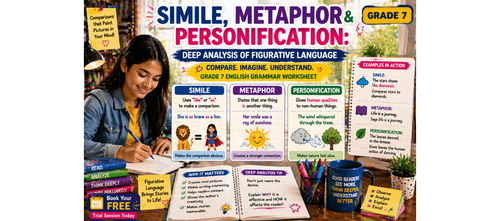

Title: Simile, Metaphor, and Personification: Grade 7 English Grammar Worksheet for Deep Analysis
Have you ever read a sentence like “The wind whispered” or “Her smile was a ray of sunshine” and felt that the writing was extra special? That is the magic of figurative language. In Grade 7, learning about simile, metaphor, and personification helps you understand how authors create vivid pictures in your mind. A simile uses “like” or “as” to make a comparison. A metaphor states that one thing is another thing. Personification gives human qualities to non-human things. This Grade 7 English grammar worksheet on simile, metaphor, and personification (deep analysis) will teach you not just to name these devices, but to explain why they are effective. You will learn how comparisons bring writing to life, how personification makes nature feel alive, and how deep analysis helps you understand stories on a whole new level.
Download these English grammar worksheets and practice regularly to strengthen your language skills and build a strong foundation. You can also book a free trial to get expert guidance and improve your reading, writing, and comprehension abilities. The worksheets are designed in a simple and structured way to help K–8 students learn grammar concepts easily and use them confidently in everyday communication.
Book a free trial!
What Is the Topic?
The topic of this worksheet is **Simile, Metaphor and Personification (Deep Analysis)**. These three devices are types of figurative language. All three devices create a comparison between two different things. A simile uses the words “like” or “as” to make a comparison. For example, “as brave as a lion” is a simile. In a simile, the comparison is obvious because “like” or “as” announces it. Similes use the words “like” or “as” to compare. A metaphor states that one thing is another thing. For example, “time is a thief” is a metaphor. A metaphor states that one thing is another thing. In a metaphor, the comparison is not stated with “like” or “as”. A metaphor creates a stronger connection than a simile. Personification gives human qualities to non-human things. For example, “the wind whispered” is personification. Personification makes nature feel alive and active in a story. Personification helps readers feel more connected to the natural world. Deep analysis means explaining why a figure of speech is effective. Deep analysis goes beyond naming the device. A good analysis explains how the comparison affects the reader. This deeper thinking makes you a stronger reader.
Book a free trial!
What’s in This Worksheet?
This worksheet contains five different exercises that help students master simile, metaphor, and personification with deep analysis. Here is what is included:
1. Exercise No. 1 – Multiple Choice Questions – Students choose the correct word to complete each sentence about simile, metaphor, and personification. This exercise tests basic definitions and key differences between the three devices.
2. Exercise No. 2 – Fill in the Blanks – Students complete sentences by filling in missing words related to simile, metaphor, and personification. The exact words are not provided in a word bank; students must use their understanding of the concepts.
3. Exercise No. 3 – True and False – Students read ten statements about simile, metaphor, and personification and decide whether each one is true or false. This helps correct common misunderstandings about how these devices work.
4. Exercise No. 4 – Underline the Words – Students read ten sentences that each contain a simile, metaphor, or personification. For each sentence, students must identify and underline the specific words that show the figurative language. This exercise focuses on recognizing each device in context.
5. Exercise No. 5 – Paragraph Writing – Students read a paragraph about simile, metaphor, and personification that has blanks. They must fill in each blank using a word from the word bank provided at the end of the paragraph. This combines reading comprehension with vocabulary application.
This worksheet supports exam preparation by covering definitions, examples, and deep analysis skills. It goes beyond just naming the device and teaches students to ask why the comparison works and how it affects the reader.
Book a free trial!
Definitions, Examples, Techniques, and Tips
Based only on the content of this worksheet, here are the exact definitions and examples students will learn:
Definitions:
- Simile: A simile uses the words “like” or “as” to make a comparison. For example, “as brave as a lion” uses simile to compare bravery to a lion. “He ran as fast as the wind” uses the word “as” to compare. “Her voice was like honey” is an example of a simile. In a simile, the comparison is obvious because “like” or “as” announces it. Similes use the words “like” or “as” to compare. A simile helps readers picture what the writer is describing.
- Metaphor: A metaphor states that one thing is another thing. For example, “Her smile was a ray of sunshine” is an example of a metaphor. “The classroom was a zoo” is a metaphor about a noisy room. A metaphor states that one thing is another thing. In a metaphor, the comparison is not stated with “like” or “as”. A metaphor creates a stronger connection than a simile.
- Personification: Personification gives human qualities to non-human things. “The wind whispered through the trees” is an example of personification. Personification makes writing more vivid and imaginative. Personification gives human qualities to objects or animals. Personification can make nature feel alive and active in a story. Personification helps readers feel more connected to the natural world.
- Deep analysis: Deep analysis means explaining why a figure of speech is effective. Deep analysis goes beyond naming the device. Ask why the comparison works. What two things are being compared? What qualities does the comparison highlight? How does it affect the reader? Good analysis explains how the comparison affects the reader. This deeper thinking makes you a stronger reader.
Examples taken directly from the worksheet (Exercise No. 4):
1. The old house groaned under the weight of the heavy snow. (Personification)
2. He fought like a tiger protecting its cubs from every danger. (Simile)
3. She floated across the stage like a swan on a calm lake. (Simile)
4. Fear knocked on his door and whispered terrible lies into his ear. (Personification)
5. The city never sleeps, even in the darkest hours of the night. (Personification)
6. Her tears were a river flowing down her cheeks without stopping. (Metaphor)
7. The alarm clock screamed at me to wake up and face the day. (Personification)
8. His words were daggers that pierced her heart with every syllable. (Metaphor)
9. Hope is a bird that perches in the soul and sings without words. (Metaphor)
10. The wind howled like a wolf searching for its lost pack. (Simile)
Key facts from True and False section:
- A simile and a metaphor both make comparisons between different things. (True)
- The moon was a ghostly galleon is a simile. (False – it is a metaphor)
- Personification can make nature feel alive and active in a story. (True)
- A metaphor uses “like” or “as” to compare two things. (False)
- The leaves danced in the wind is an example of personification. (True)
- Deep analysis of a metaphor means just identifying it and moving on. (False)
- A good analysis explains how the comparison affects the reader. (True)
- Time is a thief is a simile because it compares time to a thief. (False – it is a metaphor)
- Personification helps readers feel more connected to the natural world. (True)
- Understanding figurative language makes reading more enjoyable and meaningful. (True)
Quick learning tip: To identify a simile, look for “like” or “as”. To identify a metaphor, look for “is” or “was” stating one thing is another. To identify personification, look for human actions (whispered, screamed, danced, knocked) given to non-human things.
Book a free trial!
Why Is It Important to Learn This?
Learning about simile, metaphor, and personification with deep analysis is important for several reasons. First, these devices make writing come alive. Figurative language makes writing more vivid and imaginative. Instead of saying “it was windy,” an author writes “the wind howled like a wolf.” Instead of saying “she was sad,” an author writes “her tears were a river.” Second, understanding these devices helps you become a better reader. A good analysis explains how the comparison affects the reader. You learn to see beyond the literal meaning and understand the emotions and images the author wants to create. Third, personification helps readers feel more connected to the natural world. When the wind whispered or the sun smiled, nature feels alive and active. Fourth, deep analysis goes beyond just naming the device. You learn to ask why the comparison works, what qualities are being highlighted, and how it affects the reader. This deeper thinking makes you a stronger reader and writer. Finally, these skills are tested in literature exams where you must identify and analyze figurative language. Understanding figurative language makes reading more enjoyable and meaningful.
Book a free trial!
Where Will This Knowledge Help You?
Knowledge of simile, metaphor, and personification will help you in many academic and real-life situations:
1. Literature exams and reading comprehension tests – Many questions ask you to identify whether a sentence contains a simile, metaphor, or personification. This worksheet directly prepares you for those questions. Even harder questions ask you to explain why the device is effective – that is deep analysis.
2. Writing creative stories and poems – You can use similes, metaphors, and personification to make your own writing more vivid and imaginative. Instead of writing “the room was noisy,” write “the classroom was a zoo.” Your readers will picture it immediately.
3.*Class discussions – When your teacher asks, “What figure of speech is this?” or “Why did the author use this comparison?” you will be able to answer with confidence. You will also be able to explain how the device affects the reader.
4. Reading novels and poetry – Authors use figurative language on almost every page. Once you learn to spot similes, metaphors, and personification, you will enjoy reading much more. You will notice how comparisons create moods and feelings.
5. Writing analysis essays – Deep analysis means explaining why a figure of speech is effective. When you write an essay, you can name the device and then explain what two things are being compared, what qualities are highlighted, and how it affects the reader.
6. Understanding songs and advertisements – Song lyrics and ads are full of similes, metaphors, and personification. “Love is a battlefield” is a metaphor. “I’m like a bird” is a simile. You will understand these lines on a deeper level.
Book a free trial!
How to Use This Worksheet?
Follow these steps to get the most out of this Grade 7 English grammar worksheet on simile, metaphor, and personification (deep analysis):
1. Attempt independently first – Without looking at any answers, complete all five exercises in order. Start with Exercise No. 1 (Multiple Choice Questions), then move to Exercise No. 2 (Fill in the Blanks), then Exercise No. 3 (True and False), then Exercise No. 4 (Underline the Words), and finally Exercise No. 5 (Paragraph Writing with word bank).
2. Review answers carefully – After you finish all exercises, go to the Complete Answer Key section below. Compare your answers one by one. Pay special attention to Exercise No. 4 – make sure you correctly identified whether each sentence is a simile, metaphor, or personification and underlined the correct words.
3. Correct mistakes – For any answer that is different from the answer key, write the correct answer next to your attempt. Try to understand why you made the mistake. Did you confuse a metaphor with a simile? Did you miss the personification?
4. Practice regularly – Figurative language takes practice to master. Repeat the worksheet after a few days. For the paragraph writing task (Exercise No. 5), try to fill in the blanks without looking at the word bank first. Remember that deep analysis goes beyond just naming the device.
The solutions follow the exact worksheet order. Students should compare their answers carefully.
Book a free trial!
Important Tips and Tricks
Here are important tips and tricks based directly on this worksheet to help you master simile, metaphor, and personification and score full marks:
1. The “like” or “as” test for similes – If a sentence uses the word “like” or “as” to compare two things, it is a simile. “He fought like a tiger” – the word “like” tells you it is a simile. “She floated like a swan” – simile. “As brave as a lion” – simile. Similes use the words “like” or “as” to compare.
2. The “is” test for metaphors – If a sentence says one thing is another thing (using “is,” “was,” “are,” “were”), it is a metaphor. “Her smile was a ray of sunshine” – “was” tells you it is a metaphor. “The classroom was a zoo” – metaphor. “Time is a thief” – metaphor. In a metaphor, the comparison is not stated with “like” or “as.”
3. Look for human actions on non-human things for personification – If a non-human thing (wind, sun, city, alarm clock, fear) does a human action (whispering, smiling, sleeping, screaming, knocking), it is personification. “The wind whispered” – wind cannot whisper. “The city never sleeps” – a city cannot sleep. “The alarm clock screamed” – a clock cannot scream.
4. Deep analysis is more than just naming – A common mistake is thinking deep analysis of a metaphor means just identifying it and moving on. This is false. Deep analysis means explaining why the figure of speech is effective. Ask: What two things are being compared? What qualities does the comparison highlight? How does it affect the reader? Good analysis explains how the comparison affects the reader.
5. Metaphors create a stronger connection than similes – Because a metaphor states that one thing IS another, it feels more direct and powerful. “Time is a thief” feels stronger than “time is like a thief.” Remember this for analysis questions.
6. What examiners expect – Examiners expect you to correctly identify similes, metaphors, and personification. They also expect you to perform deep analysis. This means you cannot just write “this is a metaphor.” You must write why it works and how it affects the reader. This deeper thinking makes you a stronger reader.
7. How to score full marks – When answering multiple-choice questions, look for keywords like “comparison,” “like,” “as,” “is,” “human qualities,” “vivid,” “imaginative,” “picture,” and “why.” For true and false, remember that “the moon was a ghostly galleon” is a metaphor (not a simile) and that “time is a thief” is a metaphor (not a simile).
8. For underlining tasks (Exercise No. 4) – Underline the exact words that create the comparison or give human qualities. For similes, underline the two things being compared and the word “like” or “as.” For metaphors, underline the thing being described and what it is being compared to. For personification, underline the non-human thing and the human action.
9. For paragraph writing tasks (Exercise No. 5) – Read the entire paragraph first. Then read the word bank. Then fill in each blank one at a time. The word bank includes: simile, metaphor, personification, why, highlight, reader, alive, characters, writer, faster. Note that “faster” is in the word bank but is not used in the paragraph as written on Page 7. The correct fill follows the logical flow of the paragraph.
Book a free trial!
Complete Answer Key
Below is the complete answer key for the Grade 7 English grammar worksheet on **Simile, Metaphor and Personification (Deep Analysis)**. The answers follow the exact order of the worksheet. Section names and question numbers are reproduced exactly as they appear in the worksheet.
Exercise No. 1
Choose the correct word to complete each sentence.
1. A simile uses the words “like” or “as” to make a ______.
Answer: a) comparison
2. “Her smile was a ray of sunshine” is an example of a ______.
Answer: b) metaphor
3. “The wind whispered through the trees” is an example of ______.
Answer: a) personification
4. A metaphor states that one thing ______ another thing.
Answer: c) is
5. Personification gives human qualities to non-human ______.
Answer: c) things
6. “Brave as a lion” uses ______ to compare bravery to a lion.
Answer: b) simile
7. “The classroom was a zoo” is a ______ about a noisy room.
Answer: a) metaphor
8. Personification makes writing more vivid and ______.
Answer: b) imaginative
9. A simile helps readers ______ what the writer is describing.
Answer: c) picture
10. Deep analysis means explaining ______ a figure of speech is effective.
Answer: a) why
Exercise No. 2
Fill in the blanks. (Note: The worksheet provides sentences with blanks. Based on the content of the worksheet, the expected answers are as follows.)
1. All three devices create a comparison between two different things.
2. A metaphor states that one thing is another thing.
3. “The sun smiled down on the children” is an example of personification.
4. In a simile, the comparison is obvious because “like” or “as” announces it.
5. “He ran as fast as the wind” uses the word “as” to compare.
6. “Her voice was like honey” is an example of a simile.
7. Personification gives human qualities to objects or animals.
8. “The snow was a white blanket” is an example of a metaphor.
9. In a metaphor, the comparison is not stated with “like” or “as”.
10. Similes use the words “like” or “as” to compare.
Exercise No. 3
True and False. Write True or False for each statement.
1. A simile and a metaphor both make comparisons between different things.
Answer: True
2. “The moon was a ghostly galleon” is a simile.
Answer: False
3. Personification can make nature feel alive and active in a story.
Answer: True
4. A metaphor uses “like” or “as” to compare two things.
Answer: False
5. “The leaves danced in the wind” is an example of personification.
Answer: True
6. Deep analysis of a metaphor means just identifying it and moving on.
Answer: False
7. A good analysis explains how the comparison affects the reader.
Answer: True
8. “Time is a thief” is a simile because it compares time to a thief.
Answer: False
9. Personification helps readers feel more connected to the natural world.
Answer: True
10. Understanding figurative language makes reading more enjoyable and meaningful.
Answer: True
Exercise No. 4
Underline the words that show the simile, metaphor, or personification.
1. The old house groaned under the weight of the heavy snow.
Underline: groaned (personification – house groaning)
2. He fought like a tiger protecting its cubs from every danger.
Underline: like a tiger (simile)
3. She floated across the stage like a swan on a calm lake.
Underline: like a swan (simile)
4. Fear knocked on his door and whispered terrible lies into his ear.
Underline: knocked and whispered (personification – fear knocking and whispering)
5. The city never sleeps, even in the darkest hours of the night.
Underline: never sleeps (personification – city sleeping)
6. Her tears were a river flowing down her cheeks without stopping.
Underline: were a river (metaphor)
7. The alarm clock screamed at me to wake up and face the day.
Underline: screamed (personification – alarm clock screaming)
8. His words were daggers that pierced her heart with every syllable.
Underline: were daggers (metaphor)
9. Hope is a bird that perches in the soul and sings without words.
Underline: is a bird (metaphor)
10. The wind howled like a wolf searching for its lost pack.
Underline: howled like a wolf (simile)
Exercise No. 5
Read the paragraph. Fill in each blank with a word from your understanding. Word bank: (simile, metaphor, personification, why, highlight, reader, alive, characters, writer, faster)
Figurative language makes writing come alive. A simile compares two things using “like” or “as”. For example, “as brave as a lion.” A metaphor compares two things by saying one thing is another. For example, “time is a thief.” Personification gives human qualities to non-human things. For example, “the wind whispered.” Deep analysis goes beyond naming the device. Ask why the comparison works. What two things are being compared? What qualities does the comparison highlight? How does it affect the reader? A metaphor creates a stronger connection than a simile. Personification makes nature feel alive. Good analysis explains how the device helps the reader understand the story’s theme, mood, or characters. This deeper thinking makes you a stronger reader. (Note: Based on the word bank, “writer” could also fit, but “reader” is consistent with the paragraph’s focus on reading analysis. The word “faster” is not used in the paragraph as structured.)
Book a free trial!
You have now completed the entire worksheet on simile, metaphor, and personification with deep analysis. These three devices are like secret tools that authors use to paint pictures in your mind and make you feel emotions. A simile compares with “like” or “as.” A metaphor says one thing is another. Personification gives human actions to non-human things. But the most important skill is deep analysis – asking why the device works and how it affects you as the reader. Keep practicing, keep asking “why,” and soon you will be a master of figurative language. You are building skills that will make you a confident, thoughtful, and skilled reader in Grade 7 and beyond.
Book a free trial!