
Simple and Complete Subjects and Predicates Worksheet Grade 5
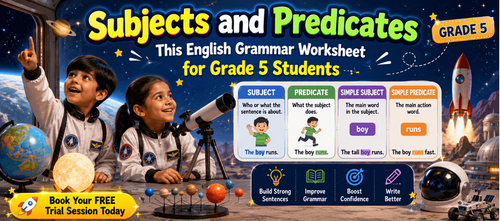

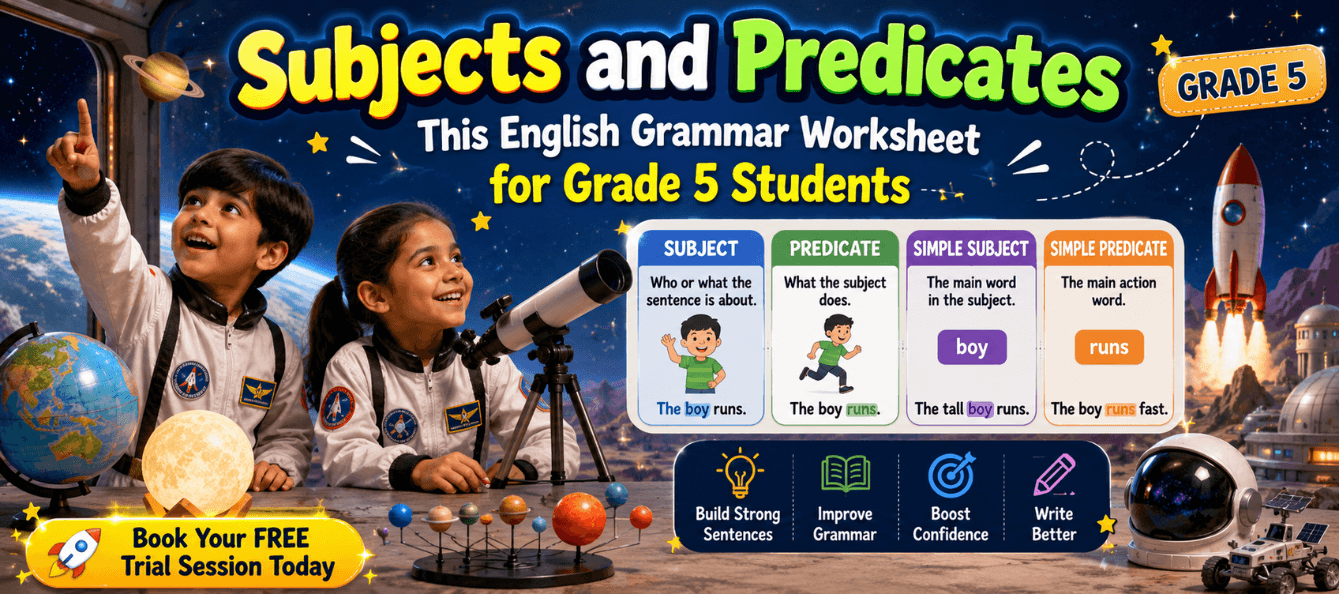
Subjects and Predicates with This English Grammar Worksheet for Grade 5 Students
Understanding subjects and predicates is one of the most important grammar skills for young learners. This English grammar worksheet for Grade 5 on Subjects and Predicates helps students learn how sentences are formed and how different parts of a sentence work together. With engaging exercises like fill in the blanks, multiple-choice questions, sentence rewriting, and paragraph writing, students can improve their grammar skills in a structured and enjoyable way.
This Grade 5 worksheet gives learners many opportunities to practice identifying simple subjects, complete subjects, simple predicates, and complete predicates. By solving different types of questions, students become more confident in reading, writing, and understanding English sentences correctly.
Download these English grammar worksheets and practice regularly to strengthen your language skills and build a strong foundation. You can also book a free trial to get expert guidance and improve your reading, writing, and comprehension abilities. The worksheets are designed in a simple and structured way to help K–8 students learn grammar concepts easily and use them confidently in everyday communication.
What Is the Topic?
Subjects and predicates are important parts of every sentence. The subject tells who or what the sentence is about, while the predicate tells what the subject does or what happens in the sentence.
In this English grammar worksheet for Grade 5, students learn:
• Complete subjects
• Simple subjects
• Complete predicates
• Simple predicates
The worksheet also helps students understand sentence structure through practice activities. Students are expected to identify different parts of sentences, rewrite sentences correctly, complete missing words, and write their own paragraph using complete subjects and predicates.
What’s in This Worksheet?
1. Fill in the blank questions that help students complete sentences correctly.
2. Multiple-choice questions where students select the correct option based on subjects and predicates.
3. Sentence rewriting activities that focus on finding simple subjects and simple predicates.
4. Passage-based fill in the blanks for grammar practice in context.
5. Paragraph writing activity on “A Day at School.”
6. Grammar exercises that improve sentence understanding and sentence construction.
7. Activities designed to strengthen reading, writing, and grammar accuracy.
8. Practice questions that support school exams and classroom learning.
Definitions, Examples, Techniques, and Tips
Definitions
• Subject: The part of the sentence that tells who or what the sentence is about.
• Predicate: The part of the sentence that tells what the subject does.
• Simple Subject: The main word or noun in the subject.
• Complete Subject: All the words that describe or complete the subject.
• Simple Predicate: The main verb or action word in the predicate.
• Complete Predicate: All the words that tell what the subject does.
Examples From the Worksheet
• The tall boy ran fast.
Complete subject: The tall boy
• The girls played cricket.
Simple predicate: played
• The car stopped at the gate.
Complete predicate: stopped at the gate
• The bright kite flew.
Simple subject: kite
Techniques
• Read the sentence carefully before choosing the answer.
• Find the main noun first to identify the subject.
• Look for the action word to identify the predicate.
• Check all answer options before selecting the correct one.
• Rewrite sentences carefully while keeping the sentence meaning correct.
Quick Learning Tips
• Subjects usually come before the verb.
• Predicates usually include the action in the sentence.
• Simple subjects and simple predicates are usually shorter.
• Complete subjects and complete predicates include extra describing words.
Why Is It Important to Learn This?
Learning subjects and predicates helps students form complete and meaningful sentences. It improves grammar accuracy and helps students avoid incomplete sentences while writing.
This topic is important because:
• It improves sentence construction.
• It helps students write clearly.
• It strengthens grammar understanding.
• It improves reading comprehension.
• It helps students communicate better in speaking and writing.
Students who understand subjects and predicates can write stronger sentences in essays, answers, stories, and classroom assignments.
Where Will This Knowledge Help You?
Subjects and predicates are useful in many areas of learning and communication.
• In school exams, students must identify sentence parts correctly.
• In writing tasks, students can create complete and meaningful sentences.
• During class participation, students can speak more confidently.
• In paragraph writing, students can organize ideas clearly.
• In grammar exercises, students can answer questions accurately.
• In daily communication, students can express thoughts properly.
How to Use This Worksheet?
1. Read each sentence carefully before answering.
2. Attempt every question independently first.
3. Identify the subject and predicate step by step.
4. Compare your answers carefully with the answer key.
5. Follow the exact worksheet order while checking answers.
6. Correct mistakes neatly after reviewing answers.
7. Practice similar sentence structures regularly.
8. Re-read difficult questions and understand why the correct answer works.
9. Use the paragraph writing activity to improve sentence-building skills.
10. Revise subjects and predicates regularly before exams.
Important Tips and Tricks
1. Do not confuse the complete subject with the simple subject.
2. Remember that the simple predicate is usually the main action word.
3. Read all answer choices carefully in multiple-choice questions.
4. Avoid skipping describing words while identifying complete subjects.
5. Check sentence meaning before selecting an answer.
6. In fill in the blanks, use words that make the sentence meaningful and grammatically correct.
7. Practice identifying nouns and verbs because they help in finding subjects and predicates.
8. In paragraph writing, make sure every sentence has a proper subject and predicate.
9. Examiners expect grammatically complete sentences.
10. Writing neatly and following instructions carefully helps students score better marks.
Complete Answer Key
Exercise No. 1
1. Rahul ran across the playground.
2. The yellow school bus arrived early.
3. Mango tastes very sweet.
4. My best friend helped me.
5. The dog barked at the mail carrier.
6. The old tree in the park fell down.
7. The eagle flew high in the sky.
8. The heavy rain flooded the streets.
9. Riya read a book in the library.
10. The delicious pizza smelled amazing.
Exercise No. 2
1. a) The tall boy
2. c) Puppy
3. b) painted a flower
4. a) played
5. b) The old tree near school
6. a) stopped at the gate
7. b) kite
8. a) smiled
9. c) The children in class
10. b) found a shiny marble
Exercise No. 3
1. The big puppy barked loudly.
Simple subject: puppy
2. The tall girl read a book.
Simple predicate: read
3. The windy storm shook trees.
Simple subject: storm
4. The fast bus reached school.
Simple predicate: reached
5. The brown dog chased birds.
Simple subject: dog
6. The bright sun warmed land.
Simple predicate: warmed
7. The noisy bell rang quickly.
Simple subject: bell
8. The small boy kicked ball.
Simple predicate: kicked
9. The lazy cat slept well.
Simple subject: cat
10. The kind teacher helped us.
Simple predicate: helped
Exercise No. 4
Riya entered the school garden before class, enjoying the quiet moment before the morning rush began. A gentle breeze blew near the flowers, carrying the mild scent of wet leaves from the watering done earlier. She watched a playful squirrel jump quickly between branches, stopping now and then to nibble on a bud. Ravi walked beside her and pointed to a red ball lying on the grass, probably forgotten by students from the previous day’s games period. Near the tall gulmohar tree, tiny yellow petals drifted slowly to the ground as the breeze moved through the branches. A group of early-arrival students chatted softly while tracing curved patterns in the sand with sticks. Close to the garden gate, the gardener arranged metal tools neatly against the wall. Just then, the teacher raised a silver whistle and called everyone to line up, and the quiet garden filled with hurried footsteps.
Exercise No. 5
A Day at School
The school bell rang loudly in the morning. The students entered the classroom quietly. Our teacher greeted everyone with a smile. The science lesson was very interesting today. My best friend shared his lunch with me during recess. The playground became noisy during games period. Our class completed the project work together. The principal appreciated the students during assembly. The final bell rang in the afternoon. I returned home happily after school.
This English grammar worksheet for Grade 5 on Subjects and Predicates gives students excellent practice in understanding sentence structure and grammar rules. By completing activities like fill in the blanks, sentence rewriting, multiple-choice questions, and paragraph writing, students can become more confident in grammar and writing skills. Regular practice will help learners improve accuracy, build stronger sentences, and perform better in exams and classroom activities.