
Simple Joining Words Practice Worksheet for Class 2 Students
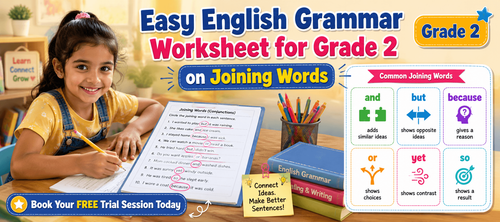

Easy English Grammar Worksheet for Grade 2 on Joining Words
Learning joining words helps children connect ideas and form meaningful sentences correctly. This English grammar worksheet for Grade 2 on Joining Words gives students simple sentence-based practice to identify conjunctions in everyday English. Through easy reading activities and grammar exercises, students improve sentence-building, comprehension, and communication skills in a fun and structured way.
In Grade 2, students begin learning how words such as and, but, because, or, yet, and so connect different parts of sentences. This worksheet helps children understand how joining words are used to combine ideas smoothly. By reading carefully and identifying conjunctions in each sentence, students strengthen their grammar foundation and become more confident in reading and writing activities.
Download these English grammar worksheets and practice regularly to strengthen your language skills and build a strong foundation. You can also book a free trial to get expert guidance and improve your reading, writing, and comprehension abilities. The worksheets are designed in a simple and structured way to help K–8 students learn grammar concepts easily and use them confidently in everyday communication.
What Is the Topic?
Joining words are words that connect two words, phrases, or parts of sentences. These words are also called conjunctions. In this English grammar worksheet for Grade 2, students learn how conjunctions join ideas together in sentences.
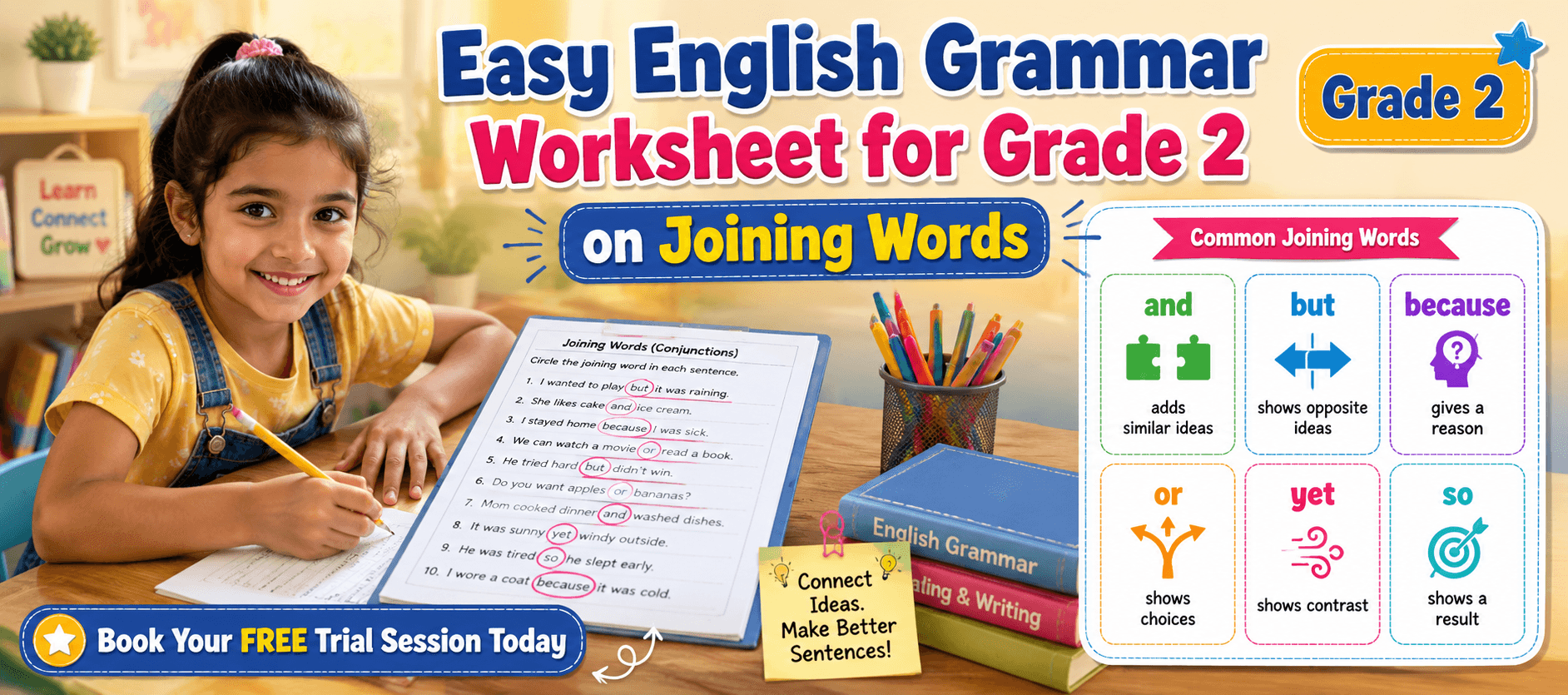
The worksheet focuses on common joining words such as:
1. And
2. But
3. Because
4. Or
5. Yet
6. So
Students are asked to circle the joining word in each sentence. This activity helps learners understand how conjunctions make sentences complete and meaningful.
By practicing joining words, students improve sentence flow, grammar understanding, and reading skills.
What’s in This Worksheet?
1. The worksheet contains ten simple grammar sentences.
2. Students must identify and circle the conjunction in each sentence.
3. The activity focuses on commonly used joining words.
4. Students practice reading sentences carefully before choosing answers.
5. The worksheet improves sentence understanding and grammar recognition.
6. Learners become familiar with how ideas are connected in English.
7. The worksheet uses easy vocabulary suitable for Grade 2 students.
8. The activity supports grammar revision and classroom learning.
9. Students improve reading comprehension through sentence analysis.
10. The worksheet provides structured grammar practice for young learners.
Definitions, Examples, Techniques, and Tips
Joining words are words that connect ideas in sentences. They help sentences sound complete and meaningful.
Examples from the worksheet:
and
This joining word connects similar ideas.
Example:
She likes cake and ice cream.
but
This joining word connects opposite ideas.
Example:
I wanted to play but it was raining.
because
This joining word gives a reason.
Example:
I stayed home because I was sick.
or
This joining word shows choices.
Example:
We can watch a movie or read a book.
yet
This joining word connects contrasting ideas.
Example:
It was sunny yet windy outside.
so
This joining word shows a result.
Example:
He was tired so he slept early.
Sentence examples from the worksheet:
Mom cooked dinner and washed dishes.
In this sentence, and joins two actions.
He tried hard but didn’t win.
In this sentence, but joins opposite ideas.
Quick learning techniques:
1. Read the entire sentence carefully before identifying the joining word.
2. Look for words that connect two ideas.
3. Practice reading conjunctions aloud to understand sentence flow.
4. Learn the purpose of each joining word through regular practice.
5. Circle only the conjunction and not the complete sentence.
Why Is It Important to Learn This?
Learning joining words is important because conjunctions help students connect ideas clearly while speaking and writing. Without conjunctions, sentences may sound incomplete or disconnected.
This topic improves grammar, sentence-building, reading, and communication skills. Students learn how to combine thoughts smoothly and create meaningful sentences. Understanding joining words also helps children improve comprehension because they can understand relationships between ideas in sentences.
Joining words are commonly used in school grammar activities, writing tasks, and exams. Learning them properly in Grade 2 builds a strong foundation for future language learning and writing improvement.
Where Will This Knowledge Help You?
1. Students use joining words while speaking and writing every day.
2. Conjunctions help children combine ideas correctly.
3. This topic improves sentence-building and writing skills.
4. Students use joining words during grammar worksheets and exams.
5. Conjunctions improve reading comprehension and sentence understanding.
6. Students become more confident during classroom communication.
7. Joining words help learners express ideas more clearly.
8. Grammar practice with conjunctions strengthens writing and speaking abilities.
How to Use This Worksheet?
1. Read each sentence carefully before selecting the joining word.
2. Look for the word that connects two ideas or actions.
3. Circle only the conjunction neatly.
4. Follow the exact worksheet order while solving the questions.
5. Compare your answers carefully with the complete answer key.
6. Correct mistakes neatly after reviewing your work.
7. Practice conjunction identification regularly for better understanding.
8. Read sentences aloud to understand how joining words connect ideas.
9. Revise common conjunctions often to improve grammar skills.
10. Practice using joining words in daily conversations and writing.
Important Tips and Tricks
1. Joining words connect two ideas in a sentence.
2. Read the full sentence carefully before choosing the conjunction.
3. Common conjunctions include and, but, because, or, yet, and so.
4. Circle neatly and avoid marking extra words.
5. Practice identifying conjunctions from books and conversations.
6. In exams, look carefully for words that join actions, reasons, or choices.
7. Do not confuse conjunctions with nouns or action words.
8. Read slowly to understand how the sentence is connected.
9. Revise common joining words regularly for better memory.
10. Regular grammar practice improves sentence-writing confidence.
Complete Answer Key
Circle the joining word (conjunction) in each sentence.
1. I wanted to play but it was raining.
Answer: but
2. She likes cake and ice cream.
Answer: and
3. I stayed home because I was sick.
Answer: because
4. We can watch a movie or read a book.
Answer: or
5. He tried hard but didn’t win.
Answer: but
6. Do you want apples or bananas?
Answer: or
7. Mom cooked dinner and washed dishes.
Answer: and
8. It was sunny yet windy outside.
Answer: yet
9. He was tired so he slept early.
Answer: so
10. I wore a coat because it was cold.
Answer: because
Practicing joining words regularly helps students improve sentence-building, grammar, and communication skills. This English grammar worksheet for Grade 2 on Joining Words gives children simple and structured practice that helps them understand conjunctions clearly. With careful reading and regular grammar revision, students can become more confident in writing, classroom participation, and English grammar activities.