
Singular Subject Verb Agreement Worksheet for Class 3
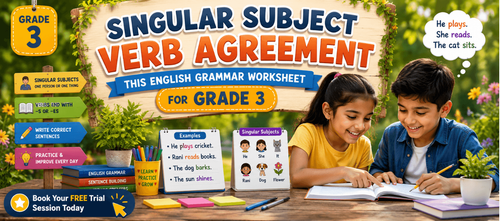

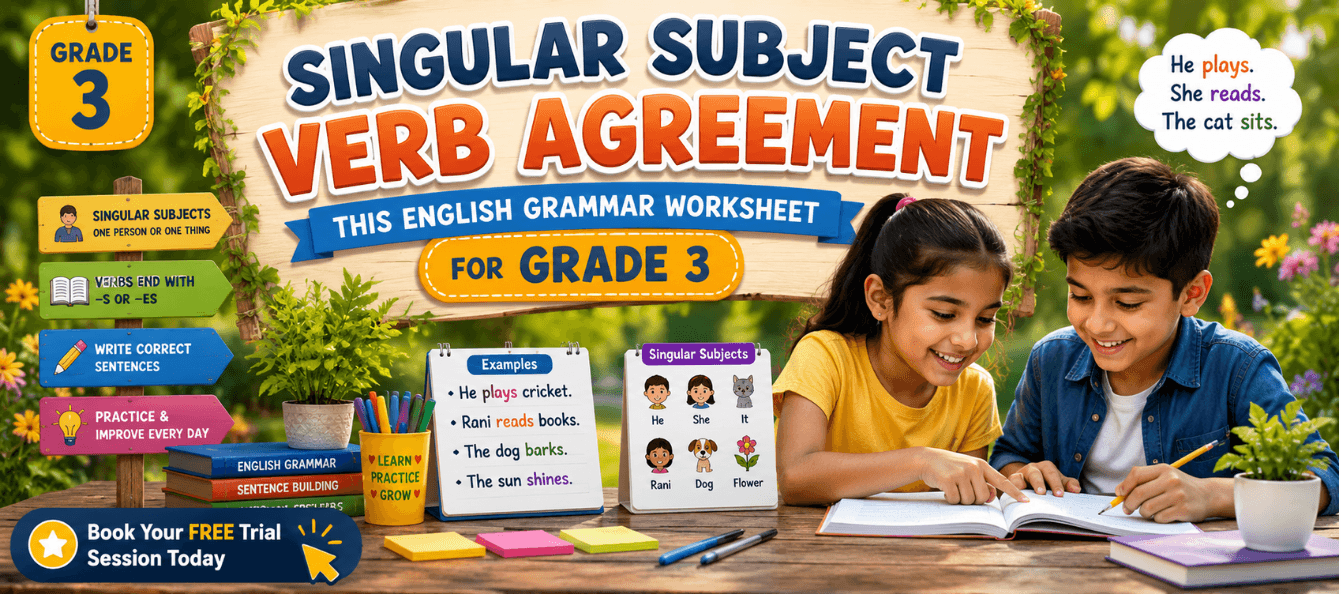
Singular Subject Verb Agreement with This English Grammar Worksheet for Grade 3
Learning subject-verb agreement becomes easy and fun when students practice simple sentence exercises regularly. This English grammar worksheet for Grade 3 focuses on singular subjects and helps children understand how verbs change when talking about one person, one animal, or one thing. Through fill in the blanks, multiple-choice questions, sentence correction, and sentence writing activities, students get plenty of practice using the correct verb forms in sentences.
This worksheet is designed in a simple and engaging way so that Grade 3 students can confidently learn how singular subjects work with verbs in the present tense. Students will practice sentences with subjects like he, she, it, names, animals, and objects. They will also learn how verbs usually end with -s or -es when used with singular subjects. Regular practice with these exercises can help students improve their grammar, writing, and speaking skills in daily communication and school assignments.
Download these English grammar worksheets and practice regularly to strengthen your language skills and build a strong foundation. You can also book a free trial to get expert guidance and improve your reading, writing, and comprehension abilities. The worksheets are designed in a simple and structured way to help K–8 students learn grammar concepts easily and use them confidently in everyday communication.
What Is the Topic?
Subject-verb agreement means that the subject and the verb in a sentence must match correctly. In this Grade 3 English grammar worksheet, students learn about singular subjects.
Every sentence has a subject and a verb:
• The subject tells who or what the sentence is about.
• The verb shows the action.
When the subject is one person or one thing, we use a singular verb in the present tense. Singular verbs usually end with -s or -es.
Examples from the worksheet:
• He plays cricket every day.
• Rani reads storybooks.
Students are expected to:
• Identify singular subjects
• Choose correct singular verbs
• Rewrite sentences correctly
• Form meaningful sentences using singular subjects
What’s in This Worksheet?
1. Fill in the blanks questions
Students complete sentences by choosing the correct verb for a singular subject.
2. Multiple-choice questions
Students select the correct verb from the given options.
3. Rewrite the sentences
Students rewrite incorrect sentences using the correct singular verb forms.
4. Underline the verb activity
Students identify and underline the correct verb in each sentence.
5. Sentence formation activity
Students create their own sentences using singular subjects and correct verbs.
6. Grammar skill practice
The worksheet helps students practice subject-verb agreement in present tense sentences.
7. Exam preparation support
These exercises improve grammar accuracy and help students perform better in classwork, homework, and tests.
Definitions, Examples, Techniques, and Tips
Definition:
Subject-verb agreement means the verb must match the subject correctly.
Definition from the worksheet:
Every sentence has a subject (who or what the sentence is about) and a verb (the action). The verb must match the subject in number (singular or plural).
Rule:
When the subject is one person or one thing (singular), we use a verb with -s or -es in the present tense.
Examples:
• He plays cricket every day.
• Rani reads storybooks.
• The cat sits on the mat.
• The baby cries when she is hungry.
Techniques:
• Look carefully at the subject before choosing the verb.
• If the subject is he, she, it, or a name, the verb usually ends with -s.
• Read the sentence aloud to check whether it sounds correct.
Quick Learning Tips:
• Singular subjects take singular verbs.
• Verbs like plays, reads, cries, shines, and sits are used with singular subjects.
• Practice daily sentence writing to improve grammar skills.
• Pay attention to verbs ending with -s or -es.
Why Is It Important to Learn This?
Learning subject-verb agreement is very important for students because it helps them form correct sentences. When students use the correct verb forms, their writing and speaking become clearer and more accurate.
This topic helps Grade 3 students:
• Speak confidently
• Write grammatically correct sentences
• Improve communication skills
• Understand sentence structure better
Correct subject-verb agreement also helps students avoid common grammar mistakes in exams and classroom activities. It builds a strong grammar foundation that supports future learning.
Where Will This Knowledge Help You?
Students use subject-verb agreement in many daily activities and school tasks.
1. School exams
Correct grammar helps students score better in English tests and worksheets.
2. Sentence writing
Students can write complete and correct sentences in assignments.
3. Speaking activities
Using the correct verb form improves spoken English.
4. Reading practice
Students understand sentences more clearly while reading stories and lessons.
5. Classroom participation
Good grammar helps students answer questions confidently during class discussions.
How to Use This Worksheet?
1. Read the rule carefully
Understand how singular subjects use verbs ending with -s or -es.
2. Attempt each question independently
Try solving the exercises without help first.
3. Follow the worksheet order carefully
The solutions follow the exact worksheet order from Exercise 1 to Exercise 4.
4. Compare answers carefully
Check whether the verb matches the singular subject correctly.
5. Correct mistakes
Rewrite incorrect answers and practice again.
6. Practice regularly
Daily grammar practice helps students remember rules easily.
7. Read sentences aloud
This helps students identify whether the sentence sounds correct.
Important Tips and Tricks
1. Check the subject first
Always identify whether the subject is singular before choosing the verb.
2. Remember the -s or -es rule
Singular subjects usually take verbs ending in -s or -es.
3. Avoid common mistakes
Do not use verbs like go, sit, talk, or wash with singular subjects in present tense sentences.
4. Read carefully before answering
Many questions test whether students can identify the correct singular verb form.
5. Practice sentence correction
Rewriting incorrect sentences helps students remember grammar rules better.
6. Use proper sentence structure
Make sure every sentence has a subject and a matching verb.
7. Write neat and complete answers
Clear and correct writing helps students score full marks.
Complete Answer Key
Exercise 1
Fill in the blanks with the correct verb for the singular subject.
1. The boy flies a kite.
2. She sings the song well.
3. My father drinks tea every morning.
4. He goes to school on time.
5. The sun shines in the sky.
6. A cow eats grass.
7. The baby cries when she is hungry.
8. This bag feels heavy.
9. My friend writes me letters.
10. The cat sits on the mat.
Exercise 2
Choose the correct verb for the singular subject.
1. The girl draws a picture.
2. He goes to the market.
3. My sister polishes her shoes.
4. The bird sits in the cage.
5. She throws the ball far.
6. The baby sleeps softly.
7. It lies in the basket.
8. The man wears a blue shirt.
Exercise 3
Rewrite the sentence with the correct verb form for the singular subject. Underline the verb.
1. The chef __cooks__ tasty food.
2. My brother __washes__ the car.
3. A parrot __talks__ loudly.
4. He __fixes__ the toy truck.
5. The lion __roars__ at night.
6. She __wears__ a green dress.
7. The doctor __checks__ the patient.
8. My aunt __plants__ flowers.
9. The horse __runs__ fast.
10. It __jumps__ over the wall.
Exercise 4
Choose any 5 singular subjects below and write one sentence for each using the correct verb.
1. The elephant walks slowly in the zoo.
2. My sister reads storybooks every night.
3. A butterfly flies over the flowers.
4. The teacher explains the lesson clearly.
5. The baby sleeps in the cradle.
Practicing subject-verb agreement regularly can help Grade 3 students become more confident in English grammar. This Singular Subject Verb Agreement English grammar worksheet for Grade 3 gives students simple and effective practice with sentence building, verb usage, and grammar correction. By solving these exercises carefully and reviewing the answers, students can improve their writing, speaking, and overall language skills step by step.