
Splitting Sentences for Clarity: Grade 7 Grammar Worksheet [Printable PDF]
![Splitting Sentences for Clarity: Grade 7 Grammar Worksheet [Printable PDF]](https://cdn5.planetspark.in/media/small_Class_7_Grammar_Worksheet_on_Splitting_Sentences_for_Clarity_b748bff9f8.png)

English Grammar Worksheet Grade 7: Splitting Long Sentences for Clarity
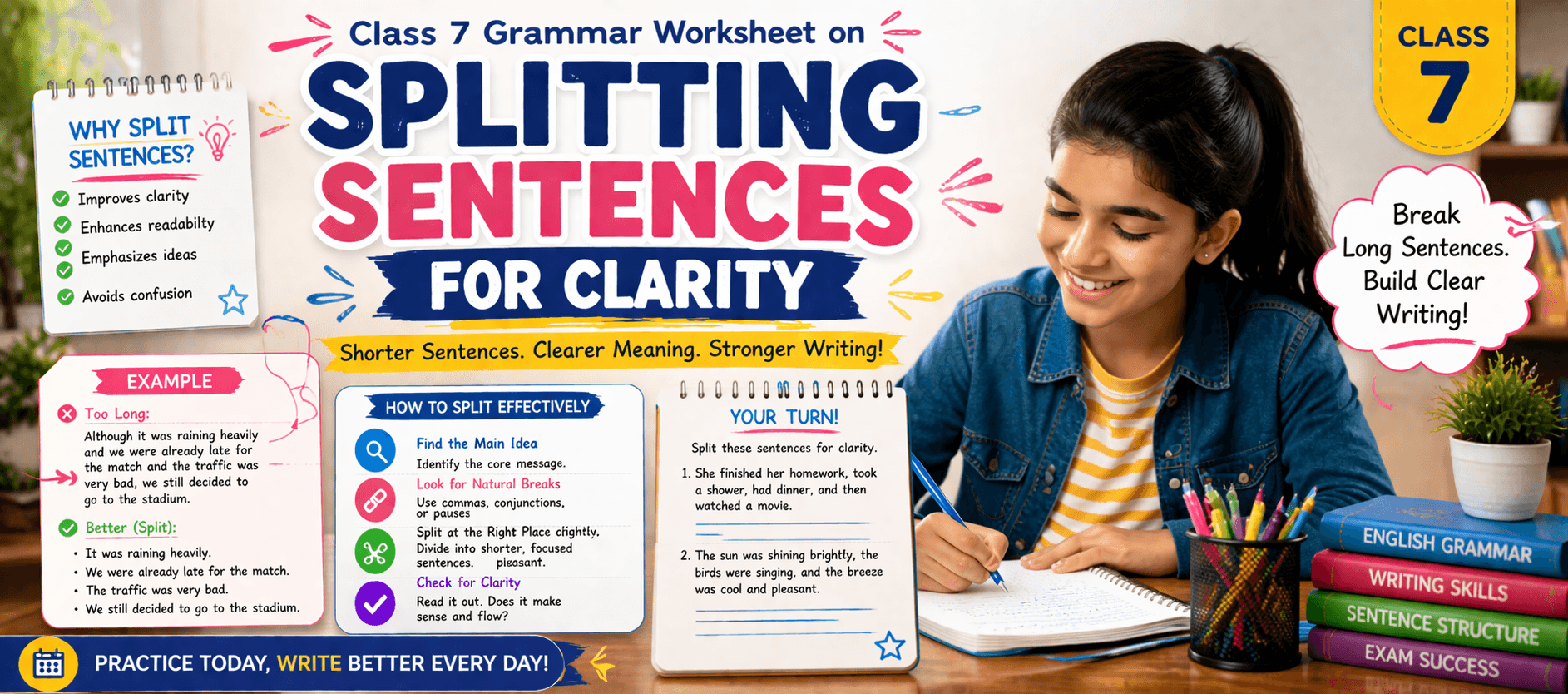
Clarity is key in writing, and one of the best ways to improve clarity is by splitting long, complex sentences. In this Grade 7 worksheet on "Splitting Long Sentences for Clarity," students will practice breaking down long sentences into shorter, more digestible parts. This technique helps students present their ideas more clearly and prevents readers from getting lost in overly complex sentences.
Download these English grammar worksheets and practice regularly to strengthen your language skills and build a strong foundation. You can also book a free trial to get expert guidance and improve your reading, writing, and comprehension abilities. The worksheets are designed in a simple and structured way to help K–8 students learn grammar concepts easily and use them confidently in everyday communication. Book a free trial!
## What is the topic?
This worksheet focuses on splitting long sentences to improve clarity. A long sentence can often be confusing or overwhelming to readers, but by breaking it down into smaller, more focused parts, students can communicate their ideas more effectively. This technique helps in making writing more readable and easy to follow.
Students will learn:
- How to identify long, complex sentences.
- How to split long sentences into two or more shorter ones without losing meaning.
- The importance of maintaining clarity and flow when breaking down sentences.
## What’s in this worksheet?
The worksheet includes various exercises to help students practice splitting long sentences for better clarity:
1. **Underline the words** – Identifying the main ideas in a sentence to understand how to split it.
2. **Multiple choice questions** – Choosing the sentence that has been split clearly and logically.
3. **Sentence rewriting** – Rewriting long sentences into shorter ones while retaining the original meaning.
4. **Fill in the blanks** – Completing sentences by adding appropriate conjunctions or punctuation to split them effectively.
5. **Paragraph writing** – Writing a short paragraph using the technique of splitting long sentences for clarity.
By practicing these exercises, students will enhance their ability to write more clearly and effectively, improving both their academic writing and everyday communication.
## Definitions, examples, techniques, and tips
- **Splitting Sentences for Clarity Definition**: Splitting long sentences involves breaking down a single, complex sentence into two or more simpler sentences while ensuring that the original meaning is preserved. This technique helps improve readability and makes the writing easier to understand.
- **Example of Splitting a Long Sentence**:
- **Original**: "He went home, ate, slept, and studied, and then he went out again."
- **Split**: "He went home and ate. After sleeping, he studied. Then, he went out again."
- **Techniques for splitting sentences**:
1. Look for natural breaks in the sentence, such as after conjunctions or commas.
2. Separate different ideas or actions into their own sentences.
3. Make sure each new sentence is clear and concise.
- **Quick learning tips**:
- Read your sentence out loud to see if it feels too long or awkward.
- Try splitting it into two or more sentences, ensuring each part is still easy to understand.
- Focus on maintaining clarity by ensuring that each split sentence conveys one main idea.
## Why is it important to learn this?
Splitting long sentences is an important skill because:
- It improves the clarity of writing, making it easier for readers to follow.
- It helps students present their ideas more concisely and logically.
- It prevents sentences from becoming confusing or overwhelming, making them more engaging to read.
Learning this skill will help Grade 7 students write more effectively, whether they're working on essays, reports, or other assignments.
## Where will this knowledge help you?
This knowledge will be useful in many writing contexts:
- **Exams**: Many writing tasks require students to write clearly and concisely.
- **Writing tasks**: This skill is essential for writing essays, research papers, and reports.
- **Class participation**: Clear writing is also important for creating effective presentations or giving speeches.
## How to use this worksheet?
1. **Attempt independently first**: Read through each sentence and identify parts that might need to be split for clarity.
2. **Review answers carefully**: After splitting the sentences, check if each part makes sense on its own.
3. **Correct mistakes**: If a sentence becomes unclear or loses its meaning when split, adjust your approach.
4. **Practice regularly**: Continue practicing with other sentences to improve your ability to split them effectively.
The solutions follow the exact worksheet order. Compare your answers carefully to ensure accuracy.
## Important tips and tricks
- **Common mistakes**:
- Splitting sentences in a way that causes confusion or changes the meaning.
- Over-splitting a sentence, making it choppy or disjointed.
- **What examiners expect**:
- Clear, concise sentences that convey one main idea at a time.
- Proper use of punctuation and conjunctions when splitting sentences.
- **How to score full marks**:
- Focus on clarity when splitting sentences, ensuring that the original meaning is maintained.
- Avoid creating overly complex or too short sentences; balance is key.
- **How to approach activity-based or writing-based tasks**:
- In rewriting exercises, try to break long sentences into natural, logical parts.
- In writing tasks, use this technique to keep your sentences clear and to the point.
## Complete Answer Key
**Exercise No. 1:**
- He went home and he ate and he slept and he studied. (Underline: He, Circle: went)
- She came home, then she ate and watched TV. (Underline: She, Circle: came)
- They played football, then went to the park. (Underline: They, Circle: played)
- He cooked dinner, and then he cleaned the kitchen. (Underline: He, Circle: cooked)
- They worked all day and went for a walk after. (Underline: They, Circle: worked)
**Exercise No. 2:**
1. b) He went home, ate, slept, and studied.
2. b) She came home, ate, and watched TV.
3. c) They played football and then went to the park.
4. c) He cooked dinner and then cleaned the kitchen.
5. b) They worked all day, then went for a walk.
**Exercise No. 3:**
1. He went home. He ate. He slept and studied. (Ensure the sentence is split for clarity.)
2. She came home. She ate. Then, she watched TV. (Ensure the sentence is split for clarity.)
3. They played football. Then, they went to the park. (Ensure the sentence is split for clarity.)
4. He cooked dinner. Then, he cleaned the kitchen. (Ensure the sentence is split for clarity.)
5. They worked all day. Then, they went for a walk. (Ensure the sentence is split for clarity.)
**Exercise No. 4:**
1. then
2. after
3. even though
4. although
5. although
6. so
7. when
8. after
9. after
10. then
**Exercise No. 5**: Answers may vary.
This activity is a creative task and does not have a predefined answer. Example: "The importance of time management cannot be overstated. Proper time management helps individuals focus on their tasks, reduces stress, and allows for greater productivity. By managing time well, students can complete their assignments on time and still have time for activities they enjoy. This skill is necessary for success in both academic and professional life."
## Outro
By mastering the skill of splitting long sentences for clarity, students will improve the overall readability of their writing. This technique not only helps with academic assignments but also with everyday communication, making writing more effective and engaging.
Book a free trial!