
Subject Verb Agreement Made Easy for Class 3 Kids
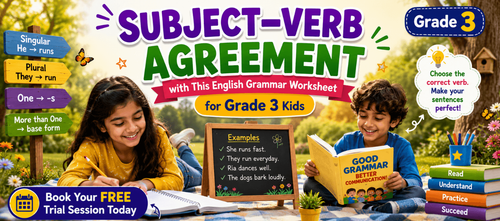

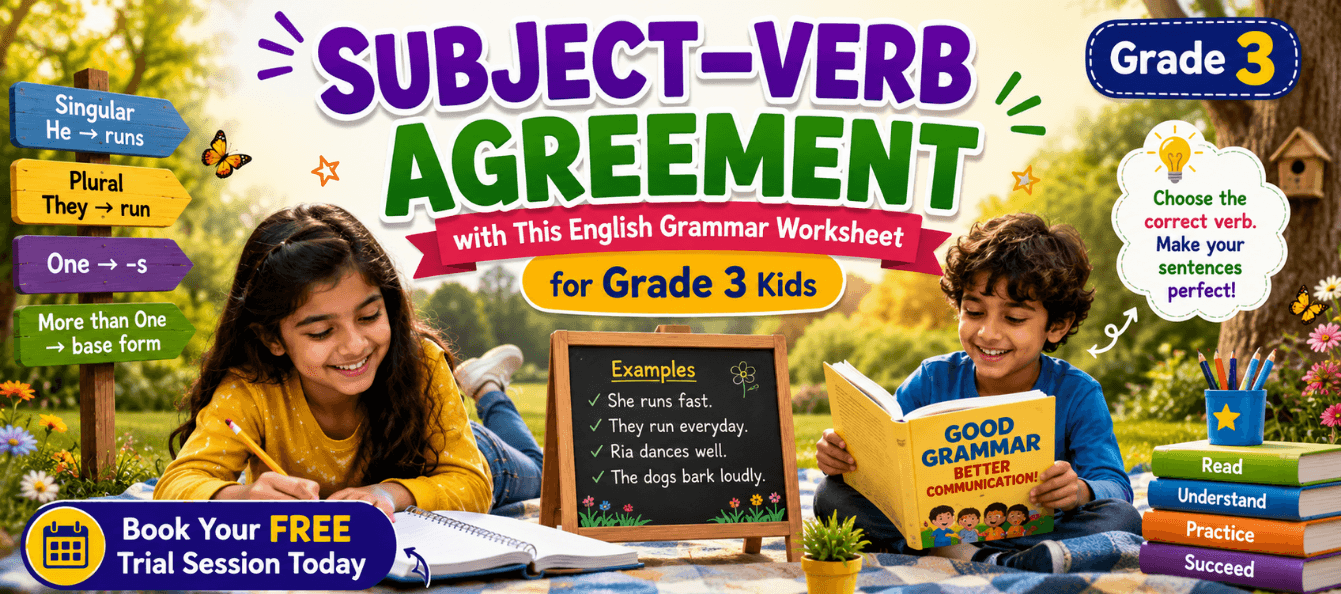
Subject-Verb Agreement with This English Grammar Worksheet for Grade 3 Kids
Learning subject-verb agreement can make sentence writing easier and more fun for young learners. This English grammar worksheet for Grade 3 helps children understand how subjects and verbs work together correctly in sentences. With simple exercises like fill in the blanks, sentence correction, matching, and rearranging words, students can practice grammar step by step in an enjoyable way.
This Grade 3 subject-verb agreement worksheet is designed to improve sentence-building skills and help students use correct verbs with singular and plural subjects. By solving these activities carefully, children can become more confident in speaking and writing correct English sentences.
Download these English grammar worksheets and practice regularly to strengthen your language skills and build a strong foundation. You can also book a free trial to get expert guidance and improve your reading, writing, and comprehension abilities. The worksheets are designed in a simple and structured way to help K–8 students learn grammar concepts easily and use them confidently in everyday communication.
What Is Subject-Verb Agreement?
Subject-verb agreement means the verb must match the subject in a sentence.
If the subject is one person or thing, we add -s to the verb.
If the subject is more than one, we use the base form of the verb.
Examples from the worksheet:
He / She / It – runs, eats
She runs fast.
I / You / We / They – run, eat
They run everyday.
Ria – dances
Ria dances well.
The dogs – bark
The dogs bark loudly.
Students learning this topic in Grade 3 are expected to understand how verbs change according to the subject used in a sentence. They also learn how to identify correct and incorrect verb forms while writing sentences.
What’s in This Worksheet?
1. Fill in the blanks with the correct verb forms.
2. Rewrite incorrect sentences using correct subject-verb agreement.
3. Match subjects with suitable verbs to create correct sentences.
4. Rearrange jumbled words to form meaningful sentences.
5. Practice sentence structure using singular and plural subjects.
6. Improve grammar accuracy through repeated sentence-building exercises.
7. Learn how verbs change depending on the subject used in the sentence.
8. Build confidence in writing grammatically correct English sentences.
9. Strengthen reading and comprehension through simple grammar activities.
10. Prepare for school grammar exercises and English exams with guided practice.
Definitions, Examples, Techniques, and Tips
Definition
Subject-verb agreement means the verb must match the subject in a sentence.
Rule 1
If the subject is one person or thing, we add -s to the verb.
Examples:
She runs fast.
Ria dances well.
Rule 2
If the subject is more than one, we use the base form of the verb.
Examples:
They run everyday.
The dogs bark loudly.
Techniques for Learning
1. Read the subject carefully before choosing the verb.
2. Check whether the subject is one or more than one.
3. Use verbs ending with -s for one person or thing.
4. Use the base form of the verb for more than one subject.
5. Practice sentence correction exercises regularly.
Quick Learning Tips
1. He, She, and It usually take verbs ending in -s.
2. I, You, We, and They usually take the base form of the verb.
3. Read the whole sentence aloud to check if it sounds correct.
4. Practice matching subjects and verbs daily.
5. Rearranging words into proper sentences improves grammar understanding.
Why Is It Important to Learn This?
Learning subject-verb agreement is important because it helps students make correct sentences while speaking and writing English. Correct grammar improves communication skills and makes sentences easy to understand.
This grammar topic also helps children:
1. Write sentences correctly.
2. Speak confidently in class.
3. Improve reading and writing skills.
4. Understand sentence structure better.
5. Perform well in grammar tests and school assignments.
When students use correct subject-verb agreement, their writing becomes clearer and more meaningful.
Where Will This Knowledge Help You?
Subject-verb agreement is useful in many daily learning activities.
1. It helps students write correct answers in English exams.
2. It improves sentence writing in homework and classwork.
3. It helps during reading and comprehension activities.
4. It supports better speaking during classroom discussions.
5. It improves grammar accuracy in paragraph writing and storytelling.
6. It helps students communicate ideas clearly.
7. It builds a strong grammar foundation for higher classes.
How to Use This Worksheet?
1. Read each question carefully before answering.
2. Identify the subject in the sentence first.
3. Choose the correct verb that matches the subject.
4. Attempt all exercises independently.
5. Compare your answers carefully with the complete answer key.
6. Follow the exact worksheet order while checking answers.
7. Correct mistakes and rewrite incorrect answers properly.
8. Practice similar sentence patterns regularly.
9. Read completed sentences aloud to improve understanding.
10. Revise the worksheet again to strengthen grammar skills.
Important Tips and Tricks
1. Singular subjects usually take verbs ending with -s.
2. Plural subjects usually take the base form of the verb.
3. Always read the entire sentence before selecting the verb.
4. Watch for common mistakes like:
He run
They eats
We walks
5. Rearranging sentence exercises should be done carefully in the correct word order.
6. Matching exercises should create complete and meaningful sentences.
7. Sentence correction exercises help students notice grammar mistakes easily.
8. Examiners expect proper subject and verb matching in every sentence.
9. Practice regularly to improve speed and accuracy.
10. Double-check spellings and punctuation while writing answers.
Complete Answer Key
Exercise 1
1. He runs every day.
2. They are in the garden.
3. She likes to dance.
4. We go to school.
5. The dog barks loudly.
6. My friends have new toys.
7. The girl sings well.
8. I am happy today.
9. The baby cries a lot.
10. You look nice.
Exercise 2
1. The baby cries loudly.
2. They eat lunch at noon.
3. My brother plays football.
4. We walk to the shop.
5. The children sing a song.
6. I go to class on time.
7. The bird flies high in the sky.
8. The dog chases the cat.
Exercise 3
1. She – sings a song
2. They – are coming
3. He – eats breakfast
4. We – go to school
5. The dog – barks at night
6. I – am ready
7. My friends – play football
8. The teacher – checks homework
9. You – look nice
10. It – is raining
Exercise 4
1. He walks to school.
2. They read the books.
3. It is rainy today.
4. He goes to the office.
5. The students are playing.
6. My friend is a dancer.
7. The dog is barking.
8. I like ice cream.
Practicing this English grammar worksheet for Grade 3 can help students become more confident in using correct subject-verb agreement while speaking and writing. By solving fill in the blanks, sentence correction, matching, and rearranging exercises regularly, children can improve grammar accuracy and sentence-building skills step by step. Continuous practice makes learning easier and helps students perform better in school activities and exams.